

ON DECK FOR WEDNESDAY, NOVEMBER 25th
KEY POINTS:
- Stocks are falling again as US holiday mode takes over
- US data dump clears the decks before American Thanksgiving
- What Macklem said as BoC hike prospects increased
- Who’s zooming who on tariffs and unfair trade?
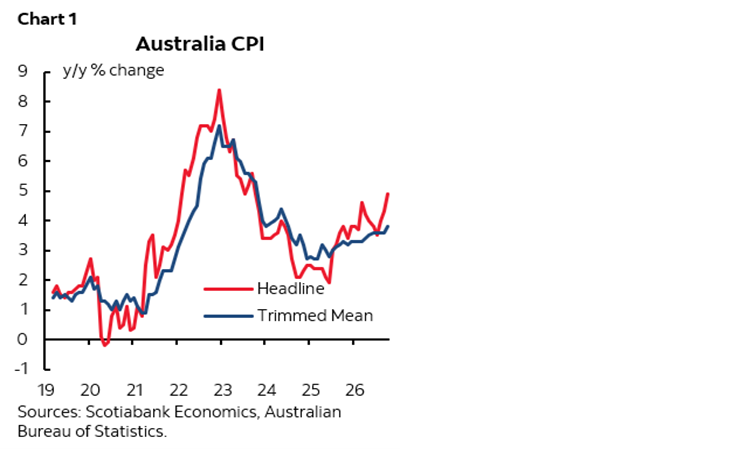
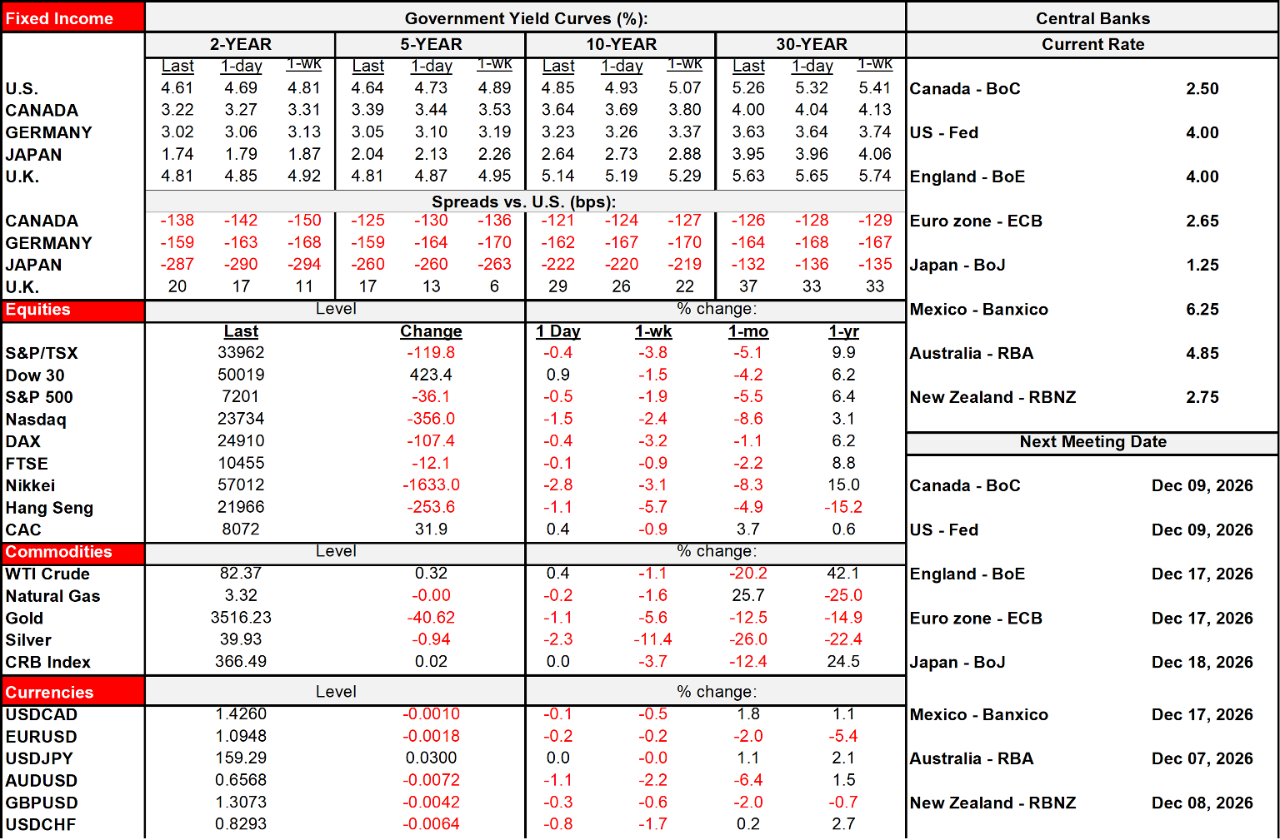
Stocks are falling again this morning. US futures are down by 2–3% on the S&P and Nasdaq. TSX futures are off by over 1%. European cash markets are ed with some flat (London), some up (Paris) and some down by under 1%. Sovereign bonds continue to rally with the US Treasury yield curve down by 8–9bps through 10s. Canada’s curve is also rallying by about 5bps everywhere. Gilts and EGBs are performing similarly to Canada. Aussie bonds underperformed elsewhere overnight after warmer than expected inflation (chart 1). Oil prices are marginally up by a few dimes. Currencies are broadly lower to the USD except for CAD, the yen and CHF.
And take it all with a lot of salt. US holiday mode is gripping markets and position covering could be a key driver into much lighter liquidity over the back half of the week. I’d like to get beyond this period in order to assess risk appetite without overreacting to the effects of US market participants rushing out the door.
US DATA DUMP
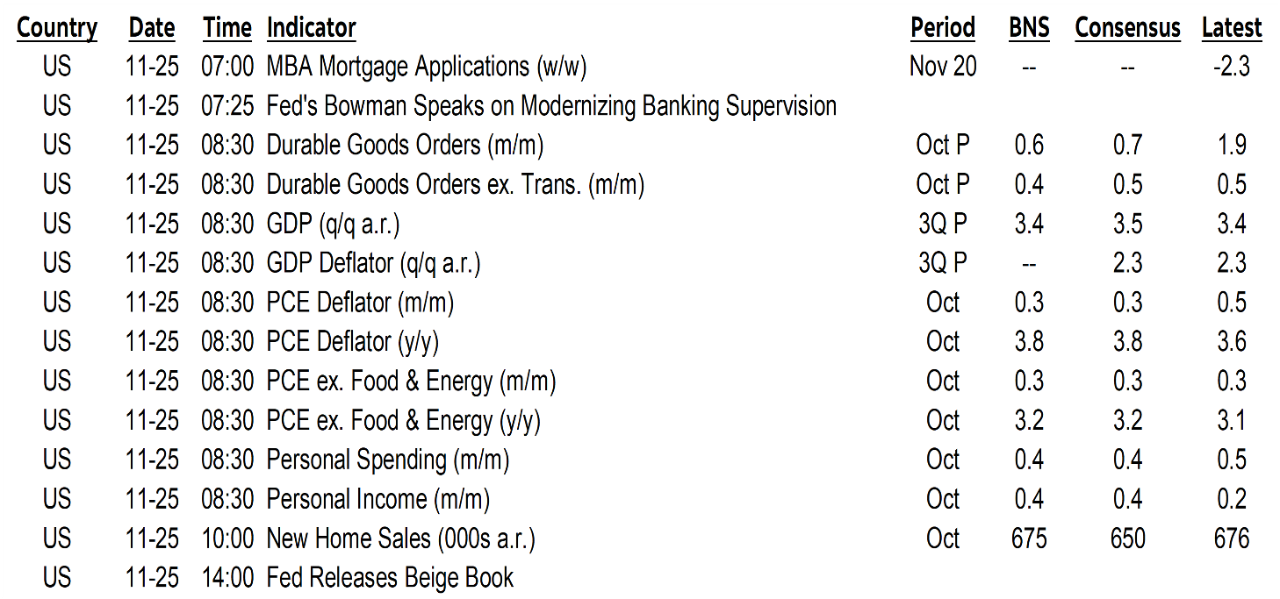
There is no official early US close today ahead of US Thanksgiving, but then there is reality. There will be a major data dump before Americans head out.
- Personal income (8:30amET): October’s incomes could grow at the fastest pace since May. Wages and salaries are posting decent growth, and incomes will be lifted by two special factors. One is a one-time Medicare premium rebate of $90 to about 21 million Americans. Another is because November 1st was on a Sunday this year, so some payments will be brought forward to October, such as Veterans’ and other military benefits.
- Personal spending (8:30amET): The retail sales control group’s 0.6% m/m SA rise in October is expected to lift total personal spending by a similar to slightly slower pace given close historical correlations.
- PCE inflation (8:30amET): The problem facing spending, however, is that much of the gain is probably due to higher prices. The Fed’s preferred measures of inflation—the PCE and core PCE price deflators—are both expected to rise by about 0.3% m/m SA. November’s readings are informed by CPI, relevant producer price components and methodological differences including different weights on various types of spending. If the core PCE estimate is in the right ballpark, then it would reinforce FOMC communications that lean toward hiking again on December 9th. A lower than expected number could impact rate pricing after an expected December hike.
- Q3 GDP revisions (8:30amET): I don’t think we have enough information to stray from the initial reading of 3.4% q/q SAAR. There may be slight upside potential from positive retail sales revisions. The next revision will be the one to incorporate fuller evidence on services.
- Durable goods orders (8:30amET): October’s reading is expected to continue to be driven by core capital goods orders and especially from the tech-sector. Boeing’s plane orders were strong at an unchanged pace over the prior month.
- New home sales (10amET): Will October’s reading get a lift from weather like I believe the upside surprise to housing starts enjoyed? Most estimates don’t think so. It could be that sales remain tepid at such high mortgage rates but good weather enabled brought-forward homebuilding activity. Thank El Niño.
WHAT GOVERNOR MACKLEM SAID
BoC Governor Macklem’s speech (here) and press conference raised market pricing for the December 9th rate decision to 20bps, or just over 80% of a quarter-point hike. His tone was hawkish on balance. A few other shops issued forecast revisions and joined our prior call for the BoC to hike on the 9th. s
- The most important thing was what Macklem did not say. He offered no real attempt at leaning against expectations for a follow-up hike on December 9th. This was his last opportunity to do so before the blackout period kicks in next Wednesday.
- His speech emphasized that the BoC dilly dallied too long during the pandemic and let inflation get out of control. We knew that, but the relevant factor is the intimation they won’t do so again this time. That’s a front-loading argument.
- Nearer term inflation by year-end may be slightly lower than forecast in October because oil prices have come off their peaks and refining margins have declined. No surprise there. Their forecast for inflation to land at 3.4% y/y in 2026Q4 is more likely to be a few tenths lower now, perhaps closer to 3% y/y. Some reactions I saw were kind of silly, as if to interpret the comment as saying that inflation has gone away. It wasn’t. First, 3% is still too high relative to the 2% target that he emphasized over and over. Second, it’s the outlook that matters as monetary policy can’t do anything about wherever inflation lands this quarter.
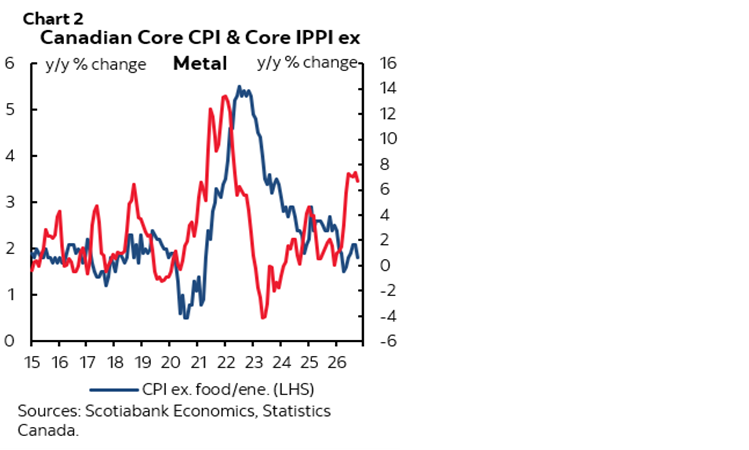
- Macklem noted that broader cost pressures have also be rising, so it’s incorrect to believe that oil is the only driver of cost-push inflation pass through. Chart 2 shows this by plotting industrial prices ex-energy, ex-food and ex-precious metals as a leading indicator of core consumer inflation. Core industrial price inflation has been taken off for a few years now and way ahead of the Iran war that started only earlier this year.
- Could anything between now and December 9th bump a hike off course? Perhaps, but there is a high bar.
- One thing might be if a major market shock unfolds. So far we haven’t ticked that box with, for example, the S&P500 down by under 10% from the early October peak and including what’s in S&P futures this morning. There might also have to be evidence of severe strain in financial markets. Further, it’s the impact upon overall financial conditions that would matter and that means also taking into consideration rallying bonds.
- Another could be big movements in oil and other commodity prices between now and then, but present energy and other commodity prices are still high enough to a) drive investment, and b) encourage pass through. My concern is that the Iran war is going to escalate again and perhaps once the lame duck session of Congress is over in order to enable achievement of some legislative priorities without losing more Republican votes. That should mean that the BoC is focused upon oil price risk rather than just present spot prices.
- Macklem noted they’ll be watching GDP that we get this Monday with estimates around 1½% q/q SAAR versus the BoC’s 2% forecast in the October MPR, although there remains a considerable amount of missing information. We’ll also get another round of jobs data for November on December 4th, just give days before the decision. See my weekly for why I don’t think the BoC will be—and shouldn’t be—fussed by jobs data. I won’t re-hash all of those arguments here, but quickly, one is that the breakeven rate of job growth is likely around zero to negative given tighter immigration policy. Another is that the past three months of weakness have mostly been due to unwinding the hot summertime youth jobs market over May through July.
- Why a high bar? Because the BoC is more focused upon the lagging effects of its actions well off into 2027 when a combination of the commodity dividend, fiscal stimulus, AI investments and the mega-deduction’s investment incentive could propel growth and inflation with it. Also recall that the BoC’s estimate of potential growth—the economy’s noninflationary supply-side speed limit—is very low at just 1½% this year and next and 1¾% in 2028. Therefore, any actual GDP growth above this modest threshold would continue to eliminate the modest amount of spare capacity and push the economy into excess demand.
TARIFFS—WHO’S ZOOMING WHO?
Surprise, surprise, the US “investigation” into unfair trade practices under Section 301 of the 1974 Trade Act concluded….wait for it….sit down….I know you’re gonna be shocked….there is a rampant lack of fairness that requires remedial tariffs in order to rectify the imbalances! Whoa, didn’t see that one coming. Give a prior, get the sought-after result. The formal US announcements on tariffs is expected soon amid talk from anonymous officials that they will target Europe and Asia but without altering the prior tariff rates which requires details and clarification. Canada and Mexico are not being mentioned and there appears to be continued progress toward bilateral agreements to reduce the tariffs against those countries.
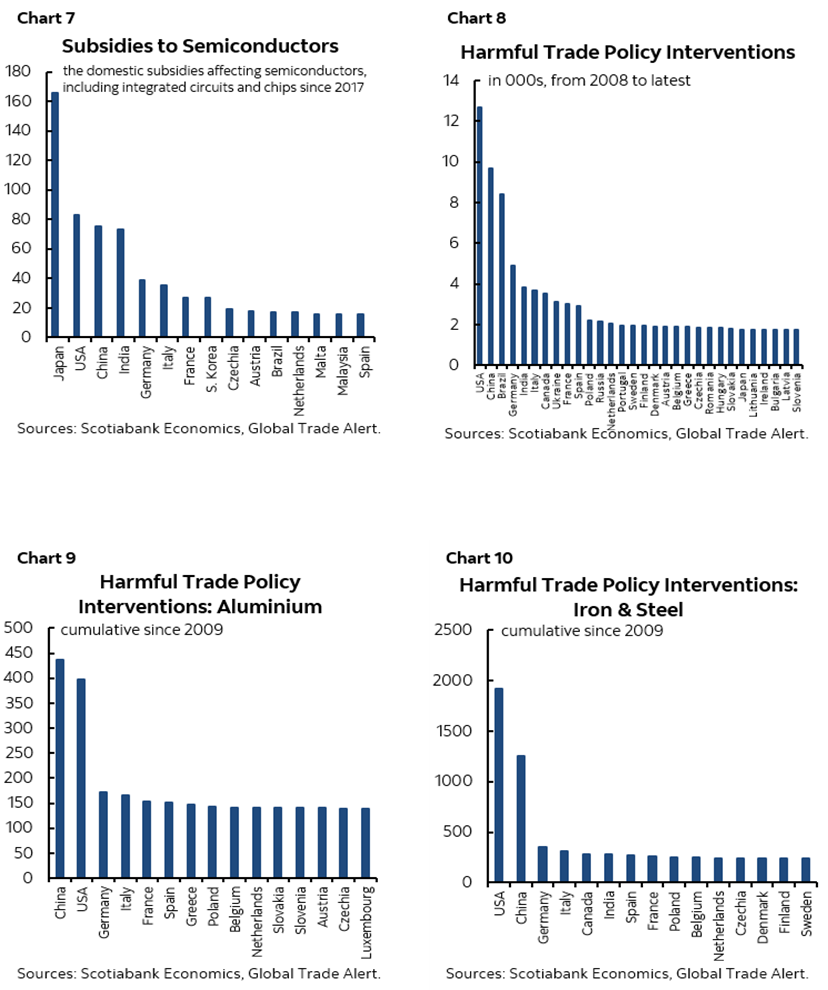
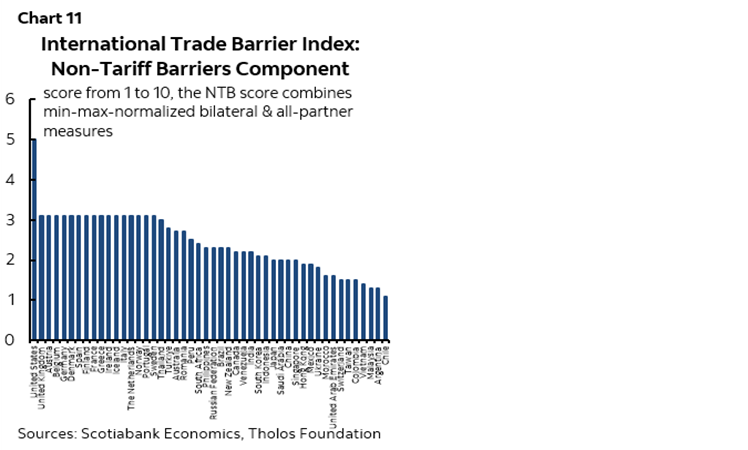
The real question is who is unfair. Enter charts 3–11.
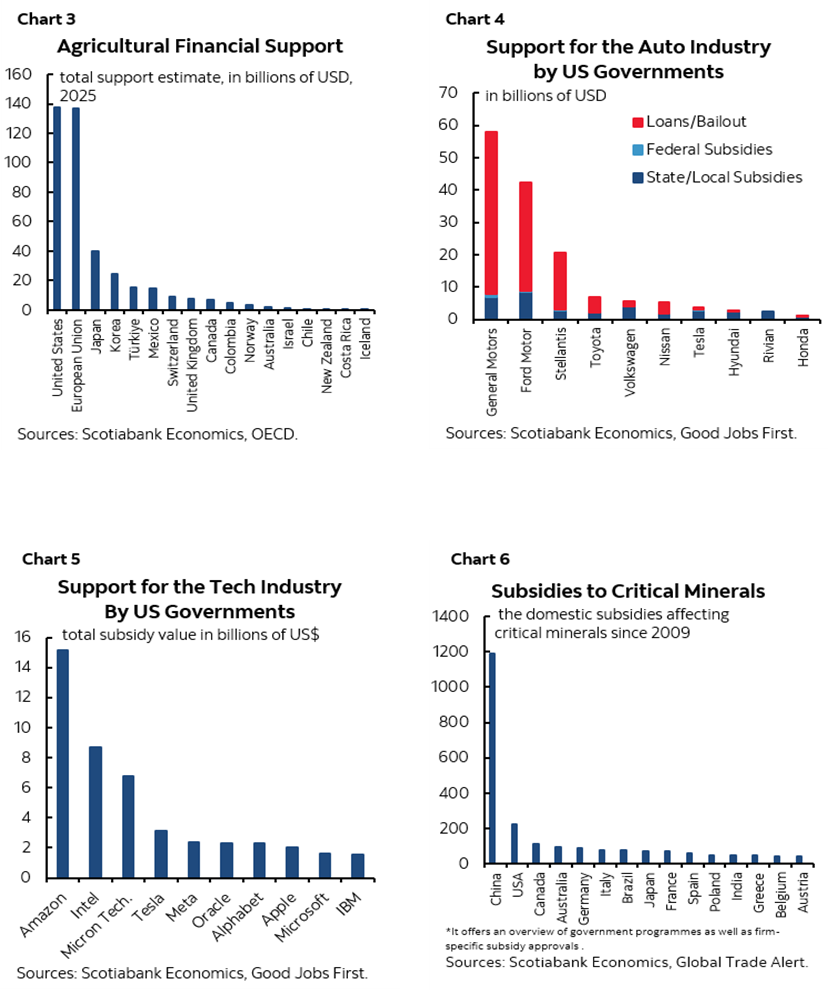
- Who subsidizes agriculture more than the US? Nobody!
- Who hands dollops of subsidies to the auto and tech industries? Well, many folks, but definitely including the US which cannot claim to be innocent by any means.
- Who subsidizes critical minerals development the most? Well, China…and then way back in very distant second place is the US.
- Who subsidizes semiconductors the most? Well, Japan—followed by the US in second place.
- Who tops the charts in terms of unfair trade policy interventions? The US.
- What about rankings on unfair trade practices in the key commodity of aluminum? China, then the US is closely behind.
- Iron and steel policy distortions? Nobody beats the US.
- Nontariff barriers? The US leads hands down by a country mile or two over everyone else.
- And by now, everyone gets that the US leads on tariffs applied against other countries.
The reason for tariffs has nothing to do with levelling the playing field that the US itself heavily distorts. Tax revenues keep getting given away and driving the deficit and debt skyward. Public debt outstanding was about US$16 trillion by late 2016 and is now well over $40T. A deficit to GDP ratio around 6% is unsustainable over time. The US government needs revenues, so you seek revenues through tariffs. Tariffs are a tax paid by American consumers and American businesses, but you just don’t call them a tax and hope they don’t catch on. The number one issue in this past election was affordability and tariff pass through has played a role in sparking higher prices. Voters appear to have caught on. Doubling down would be tone deaf into 2028.
DISCLAIMER
This report has been prepared by Scotiabank Economics as a resource for the clients of Scotiabank. Opinions, estimates and projections contained herein are our own as of the date hereof and are subject to change without notice. The information and opinions contained herein have been compiled or arrived at from sources believed reliable but no representation or warranty, express or implied, is made as to their accuracy or completeness. Neither Scotiabank nor any of its officers, directors, partners, employees or affiliates accepts any liability whatsoever for any direct or consequential loss arising from any use of this report or its contents.
These reports are provided to you for informational purposes only. This report is not, and is not constructed as, an offer to sell or solicitation of any offer to buy any financial instrument, nor shall this report be construed as an opinion as to whether you should enter into any swap or trading strategy involving a swap or any other transaction. The information contained in this report is not intended to be, and does not constitute, a recommendation of a swap or trading strategy involving a swap within the meaning of U.S. Commodity Futures Trading Commission Regulation 23.434 and Appendix A thereto. This material is not intended to be individually tailored to your needs or characteristics and should not be viewed as a “call to action” or suggestion that you enter into a swap or trading strategy involving a swap or any other transaction. Scotiabank may engage in transactions in a manner inconsistent with the views discussed this report and may have positions, or be in the process of acquiring or disposing of positions, referred to in this report.
Scotiabank, its affiliates and any of their respective officers, directors and employees may from time to time take positions in currencies, act as managers, co-managers or underwriters of a public offering or act as principals or agents, deal in, own or act as market makers or advisors, brokers or commercial and/or investment bankers in relation to securities or related derivatives. As a result of these actions, Scotiabank may receive remuneration. All Scotiabank products and services are subject to the terms of applicable agreements and local regulations. Officers, directors and employees of Scotiabank and its affiliates may serve as directors of corporations.
Any securities discussed in this report may not be suitable for all investors. Scotiabank recommends that investors independently evaluate any issuer and security discussed in this report, and consult with any advisors they deem necessary prior to making any investment.
This report and all information, opinions and conclusions contained in it are protected by copyright. This information may not be reproduced without the prior express written consent of Scotiabank.
™ Trademark of The Bank of Nova Scotia. Used under license, where applicable.
Scotiabank, together with “Global Banking and Markets”, is a marketing name for the global corporate and investment banking and capital markets businesses of The Bank of Nova Scotia and certain of its affiliates in the countries where they operate, including; Scotiabank Europe plc; Scotiabank (Ireland) Designated Activity Company; Scotiabank Inverlat S.A., Institución de Banca Múltiple, Grupo Financiero Scotiabank Inverlat, Scotia Inverlat Casa de Bolsa, S.A. de C.V., Grupo Financiero Scotiabank Inverlat, Scotia Inverlat Derivados S.A. de C.V. – all members of the Scotiabank group and authorized users of the Scotiabank mark. The Bank of Nova Scotia is incorporated in Canada with limited liability and is authorised and regulated by the Office of the Superintendent of Financial Institutions Canada. The Bank of Nova Scotia is authorized by the UK Prudential Regulation Authority and is subject to regulation by the UK Financial Conduct Authority and limited regulation by the UK Prudential Regulation Authority. Details about the extent of The Bank of Nova Scotia's regulation by the UK Prudential Regulation Authority are available from us on request. Scotiabank Europe plc is authorized by the UK Prudential Regulation Authority and regulated by the UK Financial Conduct Authority and the UK Prudential Regulation Authority.
Scotiabank Inverlat, S.A., Scotia Inverlat Casa de Bolsa, S.A. de C.V, Grupo Financiero Scotiabank Inverlat, and Scotia Inverlat Derivados, S.A. de C.V., are each authorized and regulated by the Mexican financial authorities.
Not all products and services are offered in all jurisdictions. Services described are available in jurisdictions where permitted by law.