

ON DECK FOR FRIDAY, NOVEMBER 20th

KEY POINTS:
- The ANT is getting squished and the whole AI trade is softening
- Canadian retail sales moment stalls into Q4, but it’s early
- UK consumers are alive and kicking ahead of the holiday season
- Trump presser unlikely to reveal much
- Canadian trade pragmatism—what it could mean, and the opposing forces
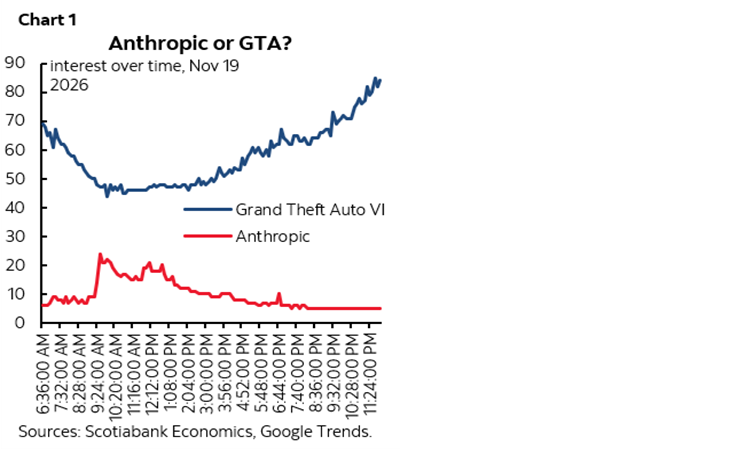
The ANT got squished took the whole AI trade down with it. That’s one possible interpretation of what transpired in the wake of the biggest IPO ever. Anthropic initially rallied well above the $83 issuance price yesterday morning before settling back toward a more modest gain by day’s end. It’s down sharply in today’s pre-market. At no point did broader equities share in any enthusiasm which is perhaps a stark signal on the durability of the tech trade; recall that when SpaceX debuted in June, it rallied for a few days and coincided with general risk-on sentiment including across tech. Not this time. As Jay notes, there is more interest in Grand Theft Auto than Anthropic (chart 1).
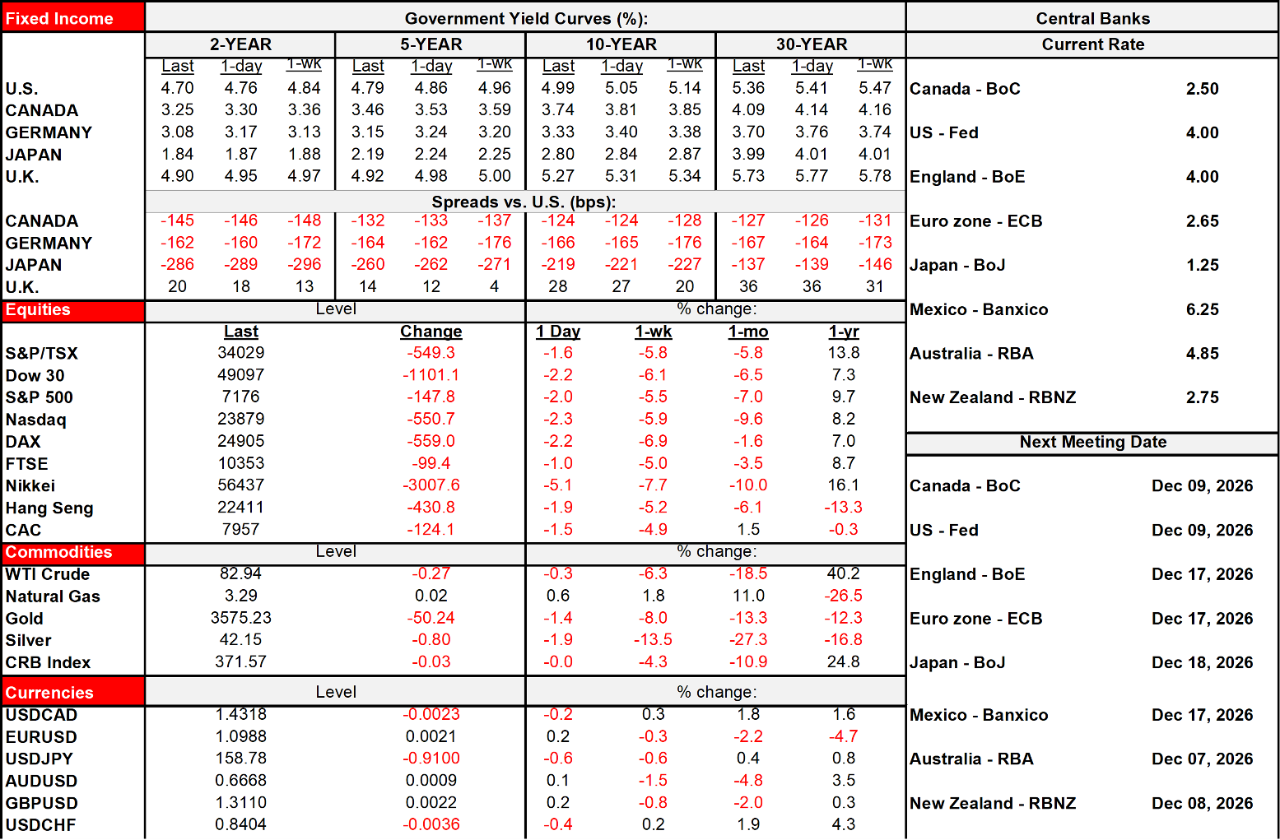
After the S&P and Nasdaq both fell by 2%+ yesterday, futures are tracking a further decline in the vicinity of 1–2% declines this morning. TSX futures are also down by just under 1%. European cash markets are similarly lower.
Sovereign bonds are picking up the safe haven flows. Yields are down across the board in the US, Canada, and all of Europe. Oil is a touch lower but Trump is deferring talk on what to do with Iran until next month; my guess is he doesn’t want to rile up the GOP during the lame duck session when he needs them for other things. Gold is down another $60/oz. The dollar isn’t really benefiting as most major currencies are up against it.
CANADIAN RETAIL SALES MOMENTUM MAY BE STALLING, BUT IT’S EARLY
Canadian retail sales were up by 3.9% q/q SAAR in Q4 but are tentatively tracking just shy of a -2% q/q SAAR contraction in Q4 (chart 2). A lot of Q4 data still lies ahead including the key holiday season.
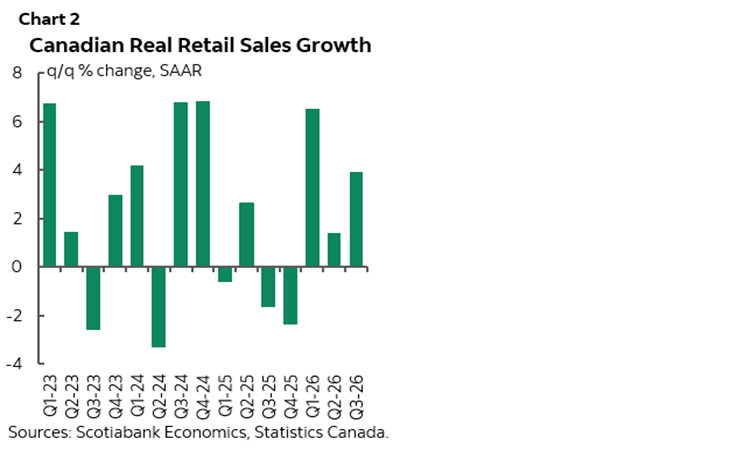
On a monthly basis, volumes were up by only 0.1% m/m SA in September. Nominal sales were up 0.8% (0.7% initial guidance) and revised up in August to 1.4% m/m (from 1.2%). October’s preliminary flash nominal guidance was -1.5% m/m SA; while we don’t get any details, our tracking of prices suggests this was driven by lower volumes. CPI-gas, for instance, was up 1.9% m/m SA in October.
UK CONSUMERS ARE ALIVE AND KICKING
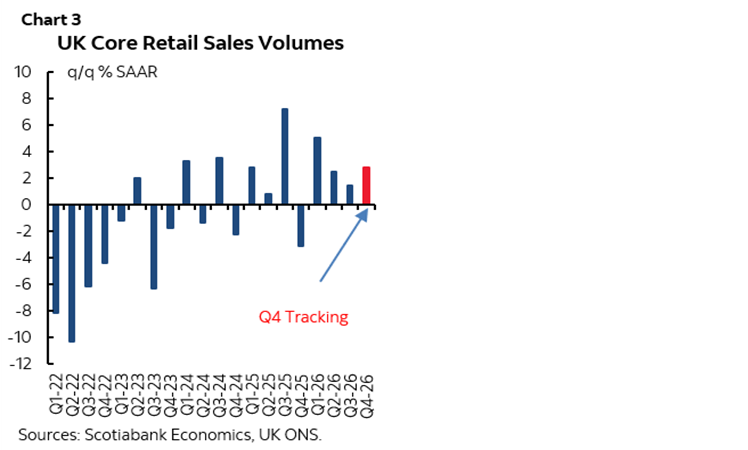
UK retail sales volumes ex-gasoline beat expectations. October was up 0.9% m/m SA (0.1% consensus) with only a partial assist from a downward revision that presented a lower than previously understood starting point (-0.9% m/m instead of -0.7%). There has been positive momentum since 2024, but at a fairly tepid pace (chart 3).
TRUMP’S PRESSER UNLIKELY TO REVEAL MUCH
Trump holds a presser at 12pmET today to sum up his Asia trip. Various reports indicate no breakthroughs in talks with Putin and Xi Jinping. Generalities about seeking to undermine the UN through reforms and doing likewise against the International Criminal Court reflect disturbingly common ground between the three. By all accounts, there was only rhetoric absent substantive agreement on key issues like Ukraine, Iran, US-China trade, etc.
CANADIAN TRADE PRAGMATISM
Dominic LeBlanc—the Canadian government’s lead on the trade file—floated a trial balloon in yesterday’s interview that sought acceptance for some reduced level of US tariffs against Canada. The broad tone had a feeling of moving to stage 5 in Maslow’s stages of grief—acceptance. He seeks an interim deal that would achieve some relief on Section 232 and Section 338 tariffs—ideally wiping out the latter and reducing the former—before then perhaps moving onto a broader CUSMA renegotiation. He did not expand upon what Canada would offer in terms of its retaliatory tariffs, investments, purchases of US goods such as defence companies or anything like that. The clear signal was to take what you can get now and keep trying. No firm timeline was set as guidance indicated negotiations may stretch into the new year. It’s difficult to fully judge what is being sought since there would be a lot of important bilateral details beneath just the tariff rates. The purpose of the interview was clearly to pave the way for an acceptance tone in what lies ahead while making it clear that a deal is not imminently at hand.
Critics may say dig in, as Canadians won’t accept any American tariffs and you don’t want to codify acceptance of tariffs against the longstanding spirit of the trade deal since that could make it impossible to unwind in future. They may say you’ve got the US administration on the ropes after a long laundry list of failures resulted in being totally wiped out in the midterm elections and potentially on a path to lose the Presidency. They may also say hold firm, the cavalry is coming, and that notwithstanding the concentrated pain to a narrow portion of the Canadian economy, Canada should sit back and rely on the US courts, Congress and voters to reverse US protectionism. Tariffs are part of what is hurting America in terms of affordability and maintaining them could further work against the GOP into 2028. They may say that the current unelected US cabinet is in its dying days so fade the rhetoric.
Others would say get some relief and keep pushing that rock up the hill in order to reduce the pain where feasible and keep negotiating. All or nothing has no place in trade negotiations. That you can die of old age before the US legal system gets around to doing anything in a system whereby the law you get is determined by money and politics. Ignore the insults and lack of professionalism from Trump and outsiders like Navarro’s angry tirades and who carries no influence. This camp may also argue against relying on the Democrats who had a chance to throw some tangible love at Canada but instead shot down Keystone XL and maintained Trump 1.0 tariffs when Biden was in office. His VP and failed presidential candidate—Kamala Harris—had voted against USMCA and opposed the TPP and was perhaps at best a more polite protectionist than the current administration. They could note that the ‘progressive,’ left-wing members of the faction that seems to be steering the Democrats are no friends of trade and commerce in general. This camp may also argue that time is of the essence in sectors most affected by tariffs and that playing the waiting game may be too costly. This camp could also say that Canada can still exact some revenge in its choices on what to buy, from whom, and who to include in its investment plans, such that Canada has plenty of negotiating leverage. It may also argue that Canada may pivot toward greater Chinese involvement in the Canadian economy as a continued evolution away from the US in terms of the falling US share of Canadian exports and falling US share of FDI into Canada as the rest of the world marches in.
Yet another consideration would be that anything you agree to with the Trump administration may not be worth the paper it’s printed on anyway so don’t kid yourself that any agreement would stand or that you could achieve anything further. That questionable considerations drive outcomes in Washington. And anything agreed upon that serves American auto and steel firms won’t matter anyway given the reluctance by some to live up to their commitments.
A still further consideration is that some US tariff pressure on Canada may be necessary in a perverse way. Wiping them away could stall or reverse domestic progress in Canada toward changing its ways on many fronts including major projects, tearing down barriers to growth and revitalizing its armed forces. This country needs a boot in the tenders in order to exact change, or else nothing gets done. Witness the last time around when a collective sigh of relief after the USMCA deal resulted in lost momentum to change things. Canada is a messy combination of competing governments and special interest groups that repeatedly thwart change.
Key is also how provincial governments respond, namely Ontario where much of the affected steel and auto industries are located.
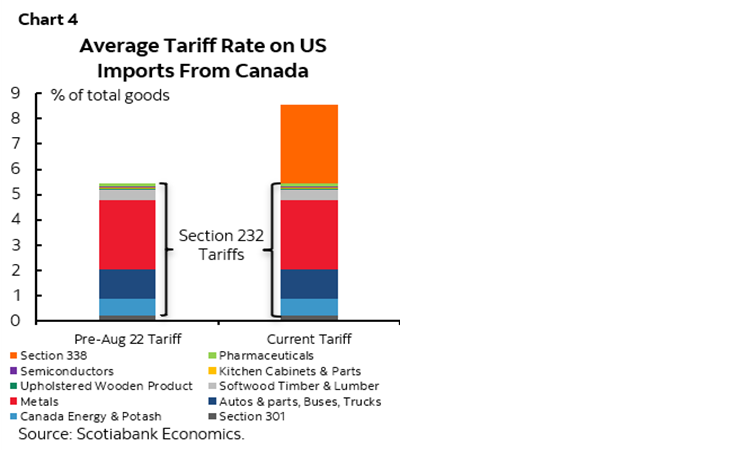
As for the potential impact of some tariff relief, have a look at chart 4. If wiping out the 338 tariffs can be achieved, then the effective tariff rate (ETR) would drop by a little over three percentage points. US tariffs on Canadian energy and potash obviously make no sense and penalize Americans perhaps the most of any tariffs so maybe they’re most likely to see a reversal but that’s unknown at this point. Key then becomes the 232 tariffs on metals and autos. The domestic blowback in the US against aluminum tariffs when Quebec is a dominant provider might do Canada’s work for it. With reductions on auto and steel tariffs, the overall ETR could be meaningfully dropped to within the low single digit percentage points. Some would say make the affected firms whole by writing a cheque.
It’s a political calculus with concentrated significance to a handful of sectors but with modest macroeconomic consequences. Canada has performed just fine in the tariffs era. The C$ has adjusted, the rates spread to the US may narrow going forward but Canadian borrowing costs are likely to remain lower than in the US, and US growth can continue to create an income-driven pull effect on Canadian exports.
DISCLAIMER
This report has been prepared by Scotiabank Economics as a resource for the clients of Scotiabank. Opinions, estimates and projections contained herein are our own as of the date hereof and are subject to change without notice. The information and opinions contained herein have been compiled or arrived at from sources believed reliable but no representation or warranty, express or implied, is made as to their accuracy or completeness. Neither Scotiabank nor any of its officers, directors, partners, employees or affiliates accepts any liability whatsoever for any direct or consequential loss arising from any use of this report or its contents.
These reports are provided to you for informational purposes only. This report is not, and is not constructed as, an offer to sell or solicitation of any offer to buy any financial instrument, nor shall this report be construed as an opinion as to whether you should enter into any swap or trading strategy involving a swap or any other transaction. The information contained in this report is not intended to be, and does not constitute, a recommendation of a swap or trading strategy involving a swap within the meaning of U.S. Commodity Futures Trading Commission Regulation 23.434 and Appendix A thereto. This material is not intended to be individually tailored to your needs or characteristics and should not be viewed as a “call to action” or suggestion that you enter into a swap or trading strategy involving a swap or any other transaction. Scotiabank may engage in transactions in a manner inconsistent with the views discussed this report and may have positions, or be in the process of acquiring or disposing of positions, referred to in this report.
Scotiabank, its affiliates and any of their respective officers, directors and employees may from time to time take positions in currencies, act as managers, co-managers or underwriters of a public offering or act as principals or agents, deal in, own or act as market makers or advisors, brokers or commercial and/or investment bankers in relation to securities or related derivatives. As a result of these actions, Scotiabank may receive remuneration. All Scotiabank products and services are subject to the terms of applicable agreements and local regulations. Officers, directors and employees of Scotiabank and its affiliates may serve as directors of corporations.
Any securities discussed in this report may not be suitable for all investors. Scotiabank recommends that investors independently evaluate any issuer and security discussed in this report, and consult with any advisors they deem necessary prior to making any investment.
This report and all information, opinions and conclusions contained in it are protected by copyright. This information may not be reproduced without the prior express written consent of Scotiabank.
™ Trademark of The Bank of Nova Scotia. Used under license, where applicable.
Scotiabank, together with “Global Banking and Markets”, is a marketing name for the global corporate and investment banking and capital markets businesses of The Bank of Nova Scotia and certain of its affiliates in the countries where they operate, including; Scotiabank Europe plc; Scotiabank (Ireland) Designated Activity Company; Scotiabank Inverlat S.A., Institución de Banca Múltiple, Grupo Financiero Scotiabank Inverlat, Scotia Inverlat Casa de Bolsa, S.A. de C.V., Grupo Financiero Scotiabank Inverlat, Scotia Inverlat Derivados S.A. de C.V. – all members of the Scotiabank group and authorized users of the Scotiabank mark. The Bank of Nova Scotia is incorporated in Canada with limited liability and is authorised and regulated by the Office of the Superintendent of Financial Institutions Canada. The Bank of Nova Scotia is authorized by the UK Prudential Regulation Authority and is subject to regulation by the UK Financial Conduct Authority and limited regulation by the UK Prudential Regulation Authority. Details about the extent of The Bank of Nova Scotia's regulation by the UK Prudential Regulation Authority are available from us on request. Scotiabank Europe plc is authorized by the UK Prudential Regulation Authority and regulated by the UK Financial Conduct Authority and the UK Prudential Regulation Authority.
Scotiabank Inverlat, S.A., Scotia Inverlat Casa de Bolsa, S.A. de C.V, Grupo Financiero Scotiabank Inverlat, and Scotia Inverlat Derivados, S.A. de C.V., are each authorized and regulated by the Mexican financial authorities.
Not all products and services are offered in all jurisdictions. Services described are available in jurisdictions where permitted by law.