

ON DECK FOR THURSDAY, NOVEMBER 19th
KEY POINTS:
- Tech lifting stocks ahead of ANT’s IPO
- Straight lining our updated BoC forecast
- How quickly may the ANT get squished?
- What Keynes may have done with ANT
- Australia lost jobs again, driving yields and the A$ lower
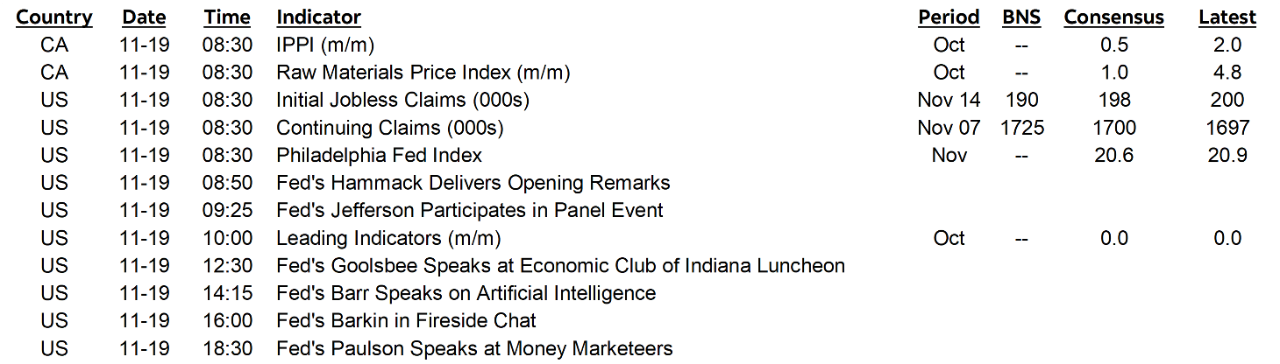
- Canadian producer prices to further inform coming CPI pressures
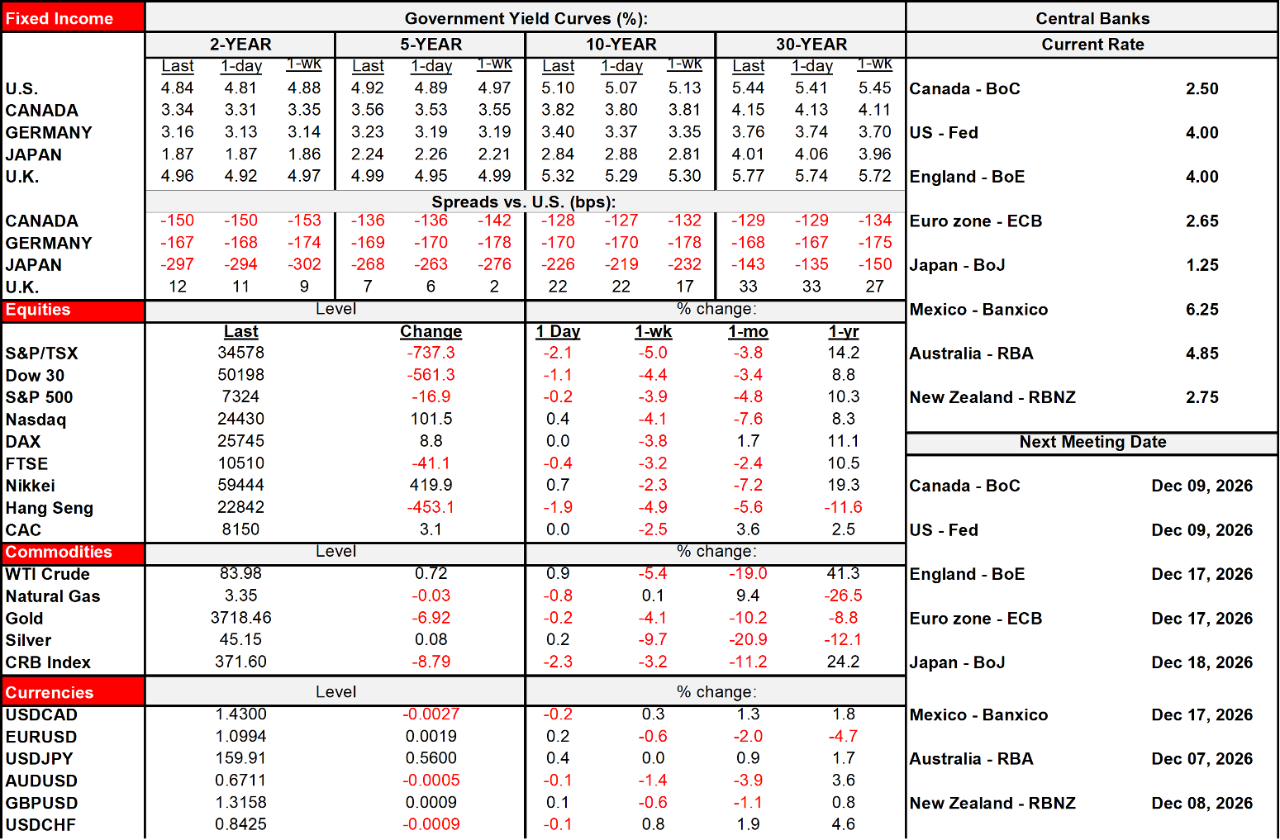
Today will be about tech stocks. Namely Anthropic’s IPO (see below). It is popping Nasdaq futures higher by about 2% as the whole sector is generally benefitting, for now. S&P futures are also up by over 1%. TSX futures are up by less and most European cash markets are mixed.
Sovereign bond yields are broadly higher across the US, Canada, UK and Eurozone with all maturities and benchmarks up by a handful of basis points. Currency land is seeing dollar weakness except against the yen, MXN and A$ (jobs, see below).
Oil is up a few dimes. I’m a little surprised that oil isn’t up by more given headlines late yesterday that Trump is weighing new strikes on Iran according to the New York Times. That got lost behind the frankly stunning Trump-Putin “friend” talk. Russia is no friend to the west.
The BoC’s December move is now pricing 18bps of a quarter point hike after jumping about 4bps higher yesterday. See below where I share perspectives offered in chat rooms and with clients yesterday.
ANTHROPIC’S IPO—GET IN, GET OUT, QUICKLY
Today will be about Ants. Not those ones. ANT—the new ticker in town, namely Anthropic’s IPO. The biggest-ever IPO was set at US$83 per share and a cumulative $107B issuance would value the company at around $1.5 trillion. Trading will debut on the Nasdaq between 11am–12pmET. So-called ‘grey market’ indications point to a strong debut. Investors should be careful in the coming days as the common pattern with IPOs is that they lose their lustre fairly quickly based on years of evidence in the literature. We also have a recent example to point to—SpaceX debuted at $135/share, then hit a peak of $201.80 within five days and subsequently fell to a low of $108 within about a month and a half while presently trading at about $143.
John Maynard Keynes was a successful investor in part because he didn't fight crowds but got out quickly. Let them build castles-in-the-air as he called them, ride along, set your disciplined return target and get out without getting greedy. For a logical guy, his core investment thesis was based upon riding other people's emotions—to a point. Disciplined investors in IPOs can do likewise; getting greedy and not knowing when to bail can get your head handed back to you.
AUSTRALIA LOST JOBS AGAIN
Australia lost 43,500 jobs in October, almost all of which were part-time (-40,600) with full-time jobs little changed (-2.9k). The unemployment rate rose two-tenths to 4.9% despite a two-tenths drop in the participation rate to 66.6%. About 80,000 jobs have been lost in the last two months and employment has fallen in three of the past four months (charts 2, 3).
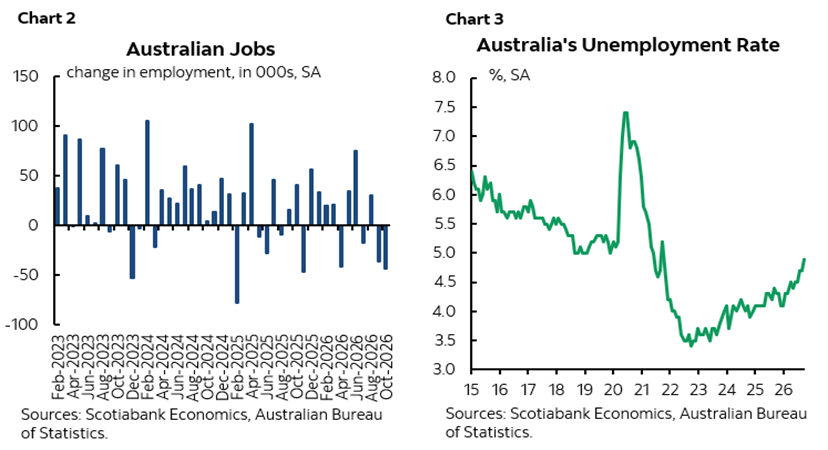
There was already nothing priced for the RBA’s next decision on December 8th and the February decision saw about a 6bps reduction in pricing toward basically no change expected. Australia’s rates curve pivoted toward pricing a full cut by next August–September and a rising probability of a cut beforehand. The two-year yield plunged 15bps and the A$ is the worst performing cross to the USD today.
CANADIAN PRODUCER PRICES—GAUGING WHAT’S IN THE CPI PIPELINE
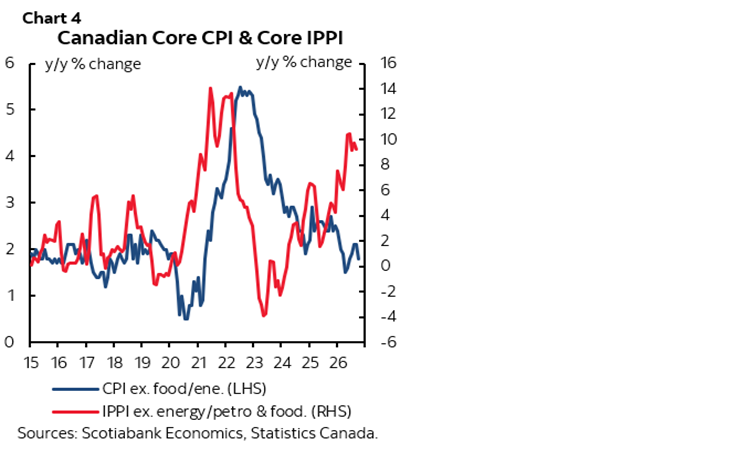
We’ll get an update on a measure of inflationary pressures in the pipeline when Canada refreshes producer prices for October (8:30amET). Key will be the core industrial price gauge (ex-food and energy) that serves as a leading indicator of coming consumer price inflation (chart 4).
UPDATED BOC FORECAST
We’ve tweaked our Bank of Canada and Canadian yield curve forecasts by removing a December pause that previously reflected allowing for some flexibility to assess how the BoC’s narrative would line up with ours (chart 1). With clearly hawkish guidance out of the October meeting, we feel comfortable to explicitly show a December hike which is consistent with guidance for a while now. We now think the BoC goes in a straight line to 3.25% by the March decision which includes three consecutive further 25bps rate hikes in December, January and March. Same end point, just pulled forward a touch.
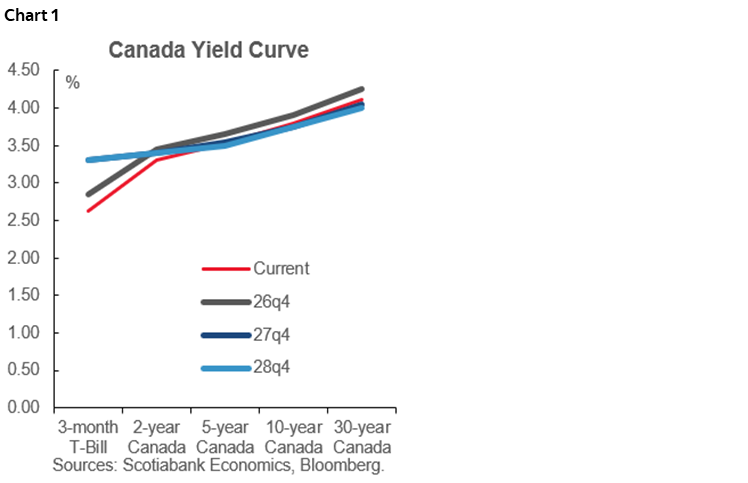
Aside from nearer term tweaks there is little else by way of major changes. Risks, however, are probably more slanted toward higher yields through the belly than what we are showing as a base case. Canada 5s, for instance, are expected to remain close to 3½%, but given we think the risk over time is toward more rather than fewer BoC hikes, 5s could be rich. Our BoC forecast only goes to the top end of the estimated neutral rate range without going into clearly restrictive territory. 5s—and hence fixed term mortgage rates—could be vulnerable to a meaningfully higher outcome.
More recent signals we are reading from the BoC reinforce a hiking bias as argued in views shared with clients and chat rooms yesterday.
For one thing, on Monday morning, the BoC released this piece titled “Act now or wait? How monetary policy should respond to supply shocks.” It was written by Stephen Murchison who is one of the advisors to the Governor. In it, Murchison presented scenarios for the output gap, inflation and policy rate under two supply shock scenarios: wait and see or act now.
As their names suggest, ‘wait and see’ is the dithering approach that waits for clear evidence that the shock is persistent before acting. This is basically what they did the last time around.
The ‘act now’ scenario says don’t wait to see if the shock will persist, get on with it, then adjust the response as needed as new information arrives.
His scenarios concluded that the cost to waiting and seeing exceeded the cost to acting now and getting on with it.
In plain language, they don’t want to do what they did the last time around when they waited until it was more than abundantly clear that the shock was persisting. They are more likely to front load this time.
They will always say that staff research is their own opinion and not necessarily Governing Council’s. That’s not the same as saying that a piece by an advisor to the Governor should be ignored.
Interestingly, however, Murchison didn’t use the fancy new Prima model in his analysis. I’m not so fussed about that. When you set a prior for your modelers to scurry off and find a new model that does a better job at backcasting the inflation surge the BoC missed the last time around, it should surprise no one that they found one! It’s called conforming to the prior. Key will be how Prima performs out of sample when every inflation shock is different from the prior one and this will take years to assess. Then we have the Lucas critique of large scale models to begin with.
Further, yesterday’s speech by DepGov Gravelle and the limited Q&A offered three main points.
First, Gravelle went back to the April MPR on pages 8–9 of his speech and reminded the audience of the scenario surrounding a more prolonged war in Iran and the impact on energy prices that, if realized, would merit ‘consecutive’ rate increases. He said "Inflation has tracked the high oil price scenario from April 2026 more closely than the base case."
I think that with the oil price correction since about mid-October when their October MPR was priced in terms of oil, they’re likely back toward the April high oil price scenario for inflation. Then it's up to assumptions on where to from here. My bias remains that the war is not over. There is no way out for either side and the risk of escalation remains which should maintain a risk premium in oil prices for an extended period.
Pair the two points above—referencing the April MPR and Murchison’s fresh note—and it seems the BoC is reinforcing a generally hawkish bias this week. The BoC is very forward-looking now. This isn’t Warsh. Their projections show a sustained overshoot of inflation to their target throughout much of their forecast horizon. That says to me that they think they are behind, given the lagging effects of monpol adjustments.
Secondly, in the limited Q&A, Gravelle explicitly noted “We’re seeing the spillover spread” by way of the impact of higher commodity prices moving into core inflation. Yes indeed, given trend m/m movements in core inflation measures.
Third, Gravelle elaborated upon why the BoC won’t provide explicit forward guidance by noting that too much market focus upon what central banks are signalling can mean that “they stop doing their homework.” Perhaps a less charitable argument for being hesitant to offer explicit forward guidance is that the BoC isn’t very good at it; recall the pandemic when guidance overreached by promising no rate changes for an overly long period of time that subsequently had to be abandoned.
Apart from Murchison and Gravelle, it’s also another opportunity to dispel some other views on the BoC.
1. There is still a street narrative that says central banks shouldn’t hike in response to supply shocks. True, monetary policy has limited (not zero) influence on the supply side as over time it affects workforce engagement, investment etc. Not true that you don't tighten in a persistent supply shock. You align demand with supply and if that means using the policy rate to cool demand relative to the supply curtailment then so be it. The entire point is about doing some damage to demand through the interest sensitives.
2. Second is ignoring the evidence on inflation. There is enough evidence through the suite of y/y and m/m SAAR readings on headline and core inflation to say you shouldn't still be at the lower bound which we're still toward at 2.5%. Doves totally ignored the evidence as it was building in the pandemic. Feels the same now.
3. Third is the circular argument that you can't hike because you'd damage some indicators. That's the whole freakin' point!! You hike in order to cause some offsetting damage to indicators since otherwise you’d never get inflation under control.
4. By forgetting what the BoC's job is. Inflation, inflation, inflation. Not jobs, jobs, jobs, and certainly not youth jobs, youth jobs, youth jobs which is what is happening now. Youths have accounted for two-thirds of job losses in the past three months as they're correcting from the best summertime job market in years. If youth jobs are perceived as a problem, then that's a job for the Carney administration and provinces, not Macklem. It’s also a reflection of changes in immigration policy.
Anyway, I still think our 3.25% terminal is more at risk of being too low than too high over time. It puts the rate at the top end of neutral. Not restrictive, or at least not clearly restrictive. In expected real terms, it's still pretty low throughout 2027. The BoC’s forecasts for inflation say restrictive to me. Their forecasts don't support just one 25bps hike for the next 3.5 months which is what OIS has had for a while.
DISCLAIMER
This report has been prepared by Scotiabank Economics as a resource for the clients of Scotiabank. Opinions, estimates and projections contained herein are our own as of the date hereof and are subject to change without notice. The information and opinions contained herein have been compiled or arrived at from sources believed reliable but no representation or warranty, express or implied, is made as to their accuracy or completeness. Neither Scotiabank nor any of its officers, directors, partners, employees or affiliates accepts any liability whatsoever for any direct or consequential loss arising from any use of this report or its contents.
These reports are provided to you for informational purposes only. This report is not, and is not constructed as, an offer to sell or solicitation of any offer to buy any financial instrument, nor shall this report be construed as an opinion as to whether you should enter into any swap or trading strategy involving a swap or any other transaction. The information contained in this report is not intended to be, and does not constitute, a recommendation of a swap or trading strategy involving a swap within the meaning of U.S. Commodity Futures Trading Commission Regulation 23.434 and Appendix A thereto. This material is not intended to be individually tailored to your needs or characteristics and should not be viewed as a “call to action” or suggestion that you enter into a swap or trading strategy involving a swap or any other transaction. Scotiabank may engage in transactions in a manner inconsistent with the views discussed this report and may have positions, or be in the process of acquiring or disposing of positions, referred to in this report.
Scotiabank, its affiliates and any of their respective officers, directors and employees may from time to time take positions in currencies, act as managers, co-managers or underwriters of a public offering or act as principals or agents, deal in, own or act as market makers or advisors, brokers or commercial and/or investment bankers in relation to securities or related derivatives. As a result of these actions, Scotiabank may receive remuneration. All Scotiabank products and services are subject to the terms of applicable agreements and local regulations. Officers, directors and employees of Scotiabank and its affiliates may serve as directors of corporations.
Any securities discussed in this report may not be suitable for all investors. Scotiabank recommends that investors independently evaluate any issuer and security discussed in this report, and consult with any advisors they deem necessary prior to making any investment.
This report and all information, opinions and conclusions contained in it are protected by copyright. This information may not be reproduced without the prior express written consent of Scotiabank.
™ Trademark of The Bank of Nova Scotia. Used under license, where applicable.
Scotiabank, together with “Global Banking and Markets”, is a marketing name for the global corporate and investment banking and capital markets businesses of The Bank of Nova Scotia and certain of its affiliates in the countries where they operate, including; Scotiabank Europe plc; Scotiabank (Ireland) Designated Activity Company; Scotiabank Inverlat S.A., Institución de Banca Múltiple, Grupo Financiero Scotiabank Inverlat, Scotia Inverlat Casa de Bolsa, S.A. de C.V., Grupo Financiero Scotiabank Inverlat, Scotia Inverlat Derivados S.A. de C.V. – all members of the Scotiabank group and authorized users of the Scotiabank mark. The Bank of Nova Scotia is incorporated in Canada with limited liability and is authorised and regulated by the Office of the Superintendent of Financial Institutions Canada. The Bank of Nova Scotia is authorized by the UK Prudential Regulation Authority and is subject to regulation by the UK Financial Conduct Authority and limited regulation by the UK Prudential Regulation Authority. Details about the extent of The Bank of Nova Scotia's regulation by the UK Prudential Regulation Authority are available from us on request. Scotiabank Europe plc is authorized by the UK Prudential Regulation Authority and regulated by the UK Financial Conduct Authority and the UK Prudential Regulation Authority.
Scotiabank Inverlat, S.A., Scotia Inverlat Casa de Bolsa, S.A. de C.V, Grupo Financiero Scotiabank Inverlat, and Scotia Inverlat Derivados, S.A. de C.V., are each authorized and regulated by the Mexican financial authorities.
Not all products and services are offered in all jurisdictions. Services described are available in jurisdictions where permitted by law.