

ON DECK FOR WEDNESDAY, NOVEMBER 18th
KEY POINTS:
- Tech isn’t rescuing broader risk appetite
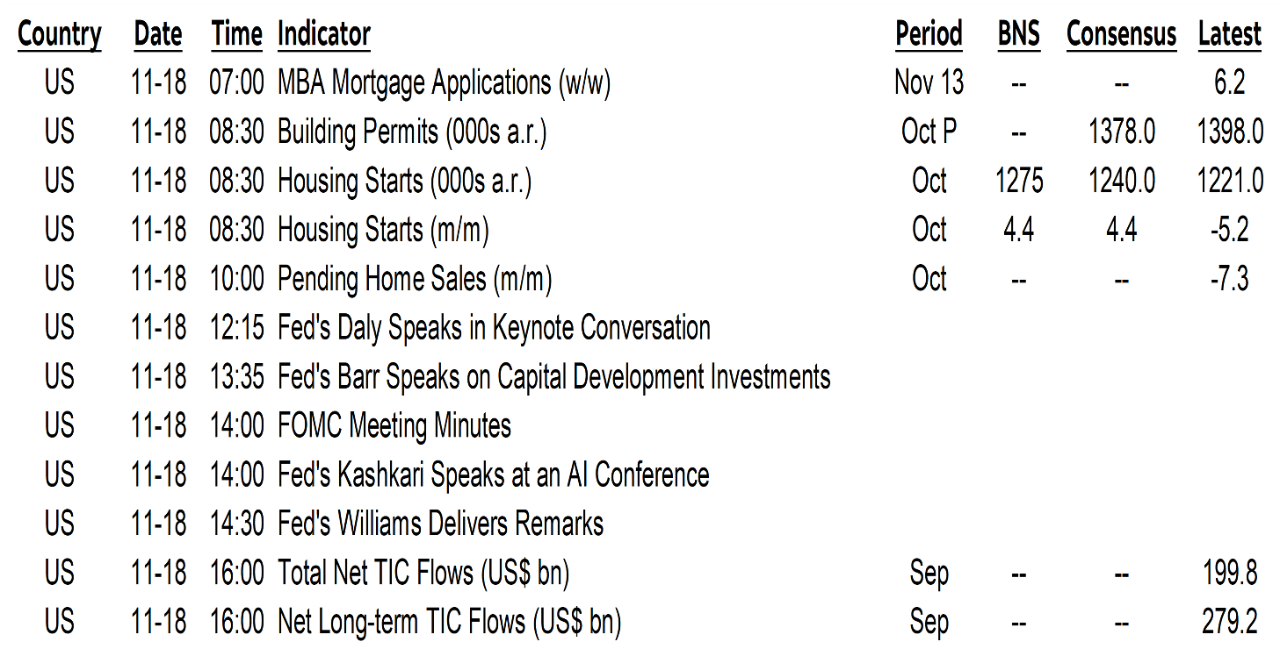
- US—stale FOMC minutes and housing data
- BoC’s Gravelle to talk scenarios and maybe CPI
- Monitor headlines out of Carney-Trump and broader APEC meetings
- Chile’s struggling economy
- Aussie yields rally as RBA minutes continue to drive reduced hike bets…
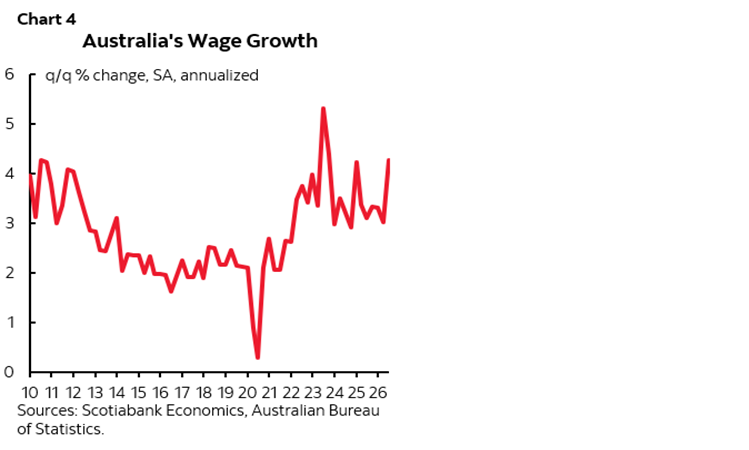
- …despite wage figures that show second-round pressures ahead of jobs data
- Gilts rally as positioning caught off-guard by CPI
- BI surprises—again!
- Rand drops as gold plunge outmuscles warmer core CPI
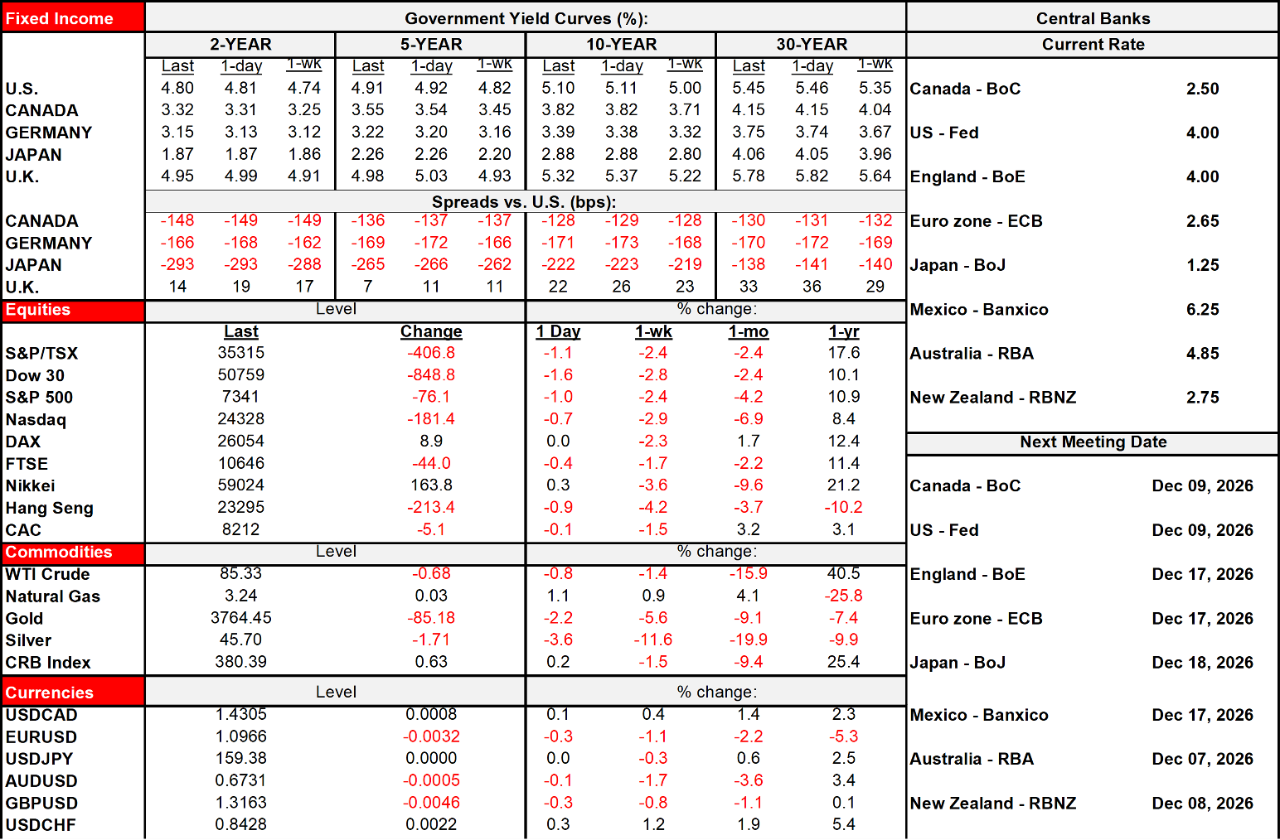
Last evening’s tech earnings beat is having very limited effect on broader risk appetite. The dollar is somewhat firmer against several crosses with weakness led by sterling, the euro, MXN and rand while CAD is flat. N.A. sovereign yields are little changed so far with most of the movement in bonds occurring in the UK (CPI, see below) and Australia (ongoing minutes, wages, see below). Gold is getting walloped this morning and oil prices are a few dimes lower. Stocks are wavering with the Nasdaq outperforming on the heels of last evening’s solid earnings from Nvidia with lighter spillover into S&P futures, but equities elsewhere are on the backfoot. Turns out, it’s not just about tech.
US—STALE MINUTES AND HOUSING DATA
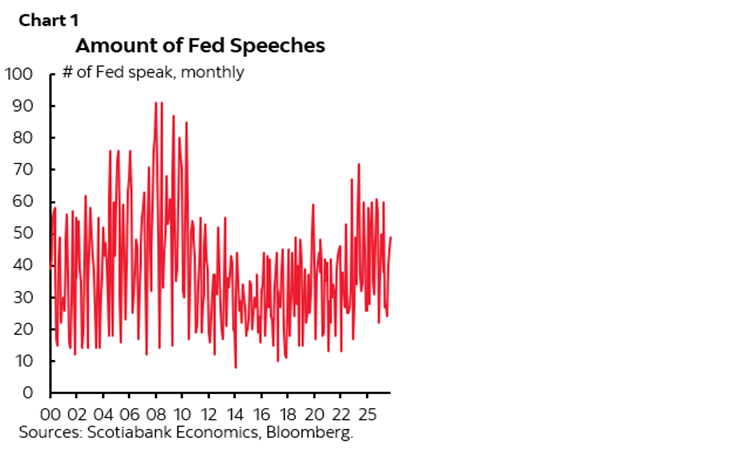
Minutes to the October 27th–28th FOMC meeting are stale before they even arrive this afternoon (2pmET). They don’t talk less in the Warsh era, for one thing (chart 1). A massive download of Fed-speak has hit markets from across all officials except the Chair. Fresh warm core CPI and a solid nonfarm payrolls report paired with Fed-speak has raised pricing for the December meeting from about 20bps to approaching 30bps now.
The US also refreshes some housing data including starts during October (8:30amET) and pending home sales for the same month (10amET). TIC flows in September (4pmET) will round out the day.
CANADA—BOC SPEAK AND TRADE TALKS
Bank of Canada Deputy Governor Toni Gravelle speaks this afternoon (12:30pmET release). His topic will be “scenario analysis and risk-management approach to monetary policy.” There will be no press conference, only audience Q&A. Gravelle may remark on this week’s CPI figures, but I expect him to be more forward-looking. Recall that Governor Macklem speaks next week as the last word before the pre-decision blackout.
Watch for potentially further headlines on the meeting between PM Carney and Trump. They reportedly met on the sidelines of the APEC meeting in Shenzhen for about 20 minutes this morning. Both sides had other representatives associated wit the trade and foreign affairs files. Carney has previously guided that progress is being made on a limited bilateral side deal to lower tariffs but that the auto sector’s viability is key. Guidance out of the meeting indicated that “they agreed to continue to work and to stay in close contact.”
UK CPI DROVE OVERREACTION IN GILTS
UK CPI inflation met expectations while services inflation stabilized. That combination caught positioning off guard and may have driven an overreaction toward lower front-end yields as the 2-year gilt richened by about 6bps. The reaction took a while to kick in as markets digested the details.
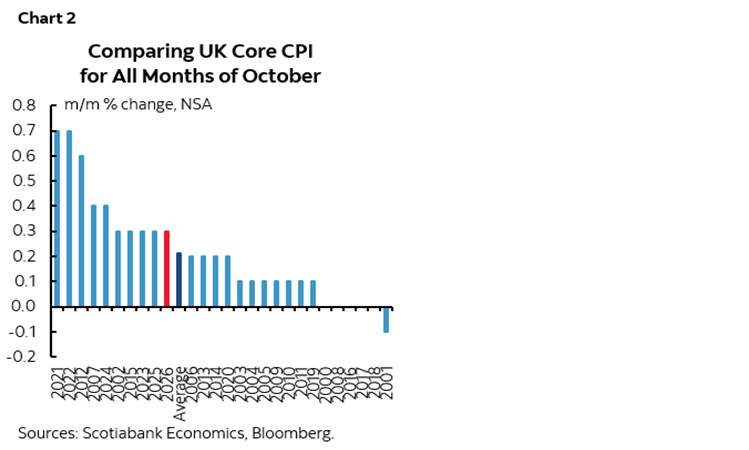
CPI was up 0.5% m/m NSA, matching consensus, and enough to add a tenth to the year-over-year rate at 3.6%, also matching consensus. Core CPI was unchanged and on consensus at 2.8% y/y. The month-over-month core CPI change was around average when comparing like months of October since it’s seasonally unadjusted data (chart 2). CPI services was unchanged at 3.7% y/y (3.8% consensus) and has been roughly moving sideways since Spring.
CHILE’S STRUGGLING ECONOMY
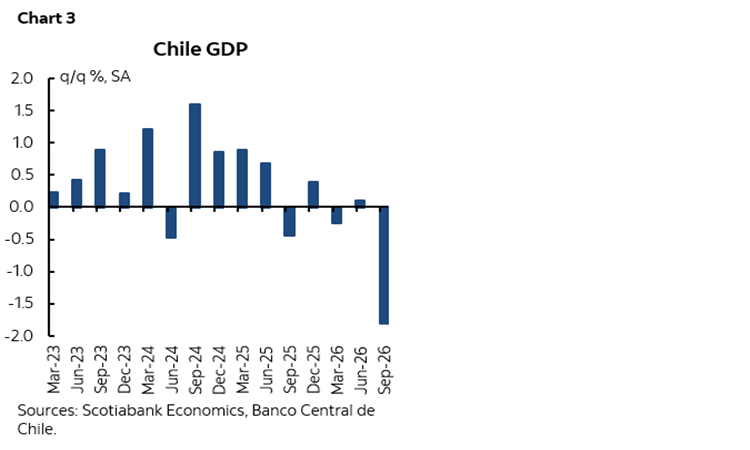
Chilean GDP fell 1.8% q/q SA nonannualized which was greater than the expected drop of -1.4%. The prior quarter was revised up a tick to 0.1% q/q SA. The economy has been treading water for an extended period (chart 3). The weakness in Q3 was fairly widespread as output fell in mining (-12.9% q/q SA) because of reduced copper output (-11.9%), while agriculture fell -1.8% and was matched by construction. Financial services retreated 1.1%, manufacturing fell by -0.5% and the restaurant/hotel business continues to retreat.
Key will be how BCCh trades off persistent upside to CPI inflation readings—such as October’s 4.5% y/y rate from 4.1% the prior month) against a weakening economy and prospects for emergent slack to create future disinflation. Markets are pricing the central bank to have about a four-in-ten chance at a hike on December 15th and about a full hike priced for the January 26th meeting.
AUSSIE YIELDS CONTINUE TO DROP DESPITE WAGE FIGURES
Despite solid wage figures, short-term Australian yields fell overnight with the 2s yield down another 5bps. That’s an extension of the trade that began after RBA minutes arrived on Monday night (ET). Those minutes revealed widening disagreement on the state of the economy and forward-looking risks as three dissenters downplayed upside risks to inflation in favour of downside risks to the economy and “expressed their concern that the economy might be near the point of entering a material sharper downturn and pointed to the costs in terms of unemployment.”
Cue tonight’s jobs data for October (7:30pmET) that have posted declines in two of the past three months and a continued rise in unemployment. The unemployment rate of 4.7% is 1.3 ppts higher than the unsustainable trough in 2022.
Leaning against this narrative—which was either ignored or mitigated what could have been a bigger rates rally—was the Q3 wage data released overnight. Wages were up by 3.5% y/y and 1.1% q/q SA nonannualized which was a tenth higher than expected but largely because of a downward revision to Q2 (0.7% instead of 0.8%). The annualized quarterly pattern remains well above the RBA’s 2–3% inflation target range (chart 4).
BANK INDONESIA SURPRISES—AGAIN!
BI sided with the smaller share of consensus (16 out of 38 forecasters) who expected a 25bps rate hike overnight. Governor Damayanti positioned the hike as pre-emptive against inflation risk and rupiah softness. The currency has depreciated by about 4% since September and the bank views this as creating stability risks in domestic markets alongside inflation risk.
GOLD OUTMUSCLED CPI IN DRIVING A WEAKER RAND
The South African rand is among the worst performers this morning despite warmer than expected South African core CPI. The culprit is probably the plunging price of gold that is off by about US$86 this morning to about $3760/oz. Gold is now more than $1600 lower than the peak earlier this year and about $900 lower than where it was as recently as late August.
CPI came and went and was ignored against that backdrop as SARB is widely expected to hold tomorrow while expressing some concern about gold prices and hence a driver of its economy. CPI was up 0.7% m/m NSA and 5.2% y/y (4.5% prior), both of which matched consensus. Core inflation was up 0.3% m/m (0.2% consensus) and 4.2% y/y (4.0% prior, 4.1% consensus). The combination of falling gold prices and firmer than expected inflation present a bit of a quandary for the central bank that will be closely scrutinized tomorrow.
DISCLAIMER
This report has been prepared by Scotiabank Economics as a resource for the clients of Scotiabank. Opinions, estimates and projections contained herein are our own as of the date hereof and are subject to change without notice. The information and opinions contained herein have been compiled or arrived at from sources believed reliable but no representation or warranty, express or implied, is made as to their accuracy or completeness. Neither Scotiabank nor any of its officers, directors, partners, employees or affiliates accepts any liability whatsoever for any direct or consequential loss arising from any use of this report or its contents.
These reports are provided to you for informational purposes only. This report is not, and is not constructed as, an offer to sell or solicitation of any offer to buy any financial instrument, nor shall this report be construed as an opinion as to whether you should enter into any swap or trading strategy involving a swap or any other transaction. The information contained in this report is not intended to be, and does not constitute, a recommendation of a swap or trading strategy involving a swap within the meaning of U.S. Commodity Futures Trading Commission Regulation 23.434 and Appendix A thereto. This material is not intended to be individually tailored to your needs or characteristics and should not be viewed as a “call to action” or suggestion that you enter into a swap or trading strategy involving a swap or any other transaction. Scotiabank may engage in transactions in a manner inconsistent with the views discussed this report and may have positions, or be in the process of acquiring or disposing of positions, referred to in this report.
Scotiabank, its affiliates and any of their respective officers, directors and employees may from time to time take positions in currencies, act as managers, co-managers or underwriters of a public offering or act as principals or agents, deal in, own or act as market makers or advisors, brokers or commercial and/or investment bankers in relation to securities or related derivatives. As a result of these actions, Scotiabank may receive remuneration. All Scotiabank products and services are subject to the terms of applicable agreements and local regulations. Officers, directors and employees of Scotiabank and its affiliates may serve as directors of corporations.
Any securities discussed in this report may not be suitable for all investors. Scotiabank recommends that investors independently evaluate any issuer and security discussed in this report, and consult with any advisors they deem necessary prior to making any investment.
This report and all information, opinions and conclusions contained in it are protected by copyright. This information may not be reproduced without the prior express written consent of Scotiabank.
™ Trademark of The Bank of Nova Scotia. Used under license, where applicable.
Scotiabank, together with “Global Banking and Markets”, is a marketing name for the global corporate and investment banking and capital markets businesses of The Bank of Nova Scotia and certain of its affiliates in the countries where they operate, including; Scotiabank Europe plc; Scotiabank (Ireland) Designated Activity Company; Scotiabank Inverlat S.A., Institución de Banca Múltiple, Grupo Financiero Scotiabank Inverlat, Scotia Inverlat Casa de Bolsa, S.A. de C.V., Grupo Financiero Scotiabank Inverlat, Scotia Inverlat Derivados S.A. de C.V. – all members of the Scotiabank group and authorized users of the Scotiabank mark. The Bank of Nova Scotia is incorporated in Canada with limited liability and is authorised and regulated by the Office of the Superintendent of Financial Institutions Canada. The Bank of Nova Scotia is authorized by the UK Prudential Regulation Authority and is subject to regulation by the UK Financial Conduct Authority and limited regulation by the UK Prudential Regulation Authority. Details about the extent of The Bank of Nova Scotia's regulation by the UK Prudential Regulation Authority are available from us on request. Scotiabank Europe plc is authorized by the UK Prudential Regulation Authority and regulated by the UK Financial Conduct Authority and the UK Prudential Regulation Authority.
Scotiabank Inverlat, S.A., Scotia Inverlat Casa de Bolsa, S.A. de C.V, Grupo Financiero Scotiabank Inverlat, and Scotia Inverlat Derivados, S.A. de C.V., are each authorized and regulated by the Mexican financial authorities.
Not all products and services are offered in all jurisdictions. Services described are available in jurisdictions where permitted by law.