

ON DECK FOR TUESDAY, NOVEMBER 10th
KEY POINTS:
- Fed Governor Waller spiked the US front-end…
- …shifting market positioning into US CPI
- Has the US monetary policy dialogue gotten absurd?
- US CPI preview
- Oil is down again—but hardly cheap, with ongoing cost pressures
It’s US CPI day. I wouldn’t say it’s right up there with that important milestone on your social calendar or gotta-see big game, but it’s a big deal in the obsessive world of mercurial Fed watchers.
Ditto for Fed officials. Enter Governor Waller who is at it again. He said this morning that he could support a 50 bps move on December 9th pending today’s readings for inflation last month. Recall that he came out swinging just before July CPI, saying that he’d support a hike at the July 29th meeting dependent upon the outcome of US CPI on July 14th. That reading coughed up a donut (0% m/m core CPI) and Waller recanted thereafter. He has a proclivity toward attracting attention around big single point data calls and just did it again.
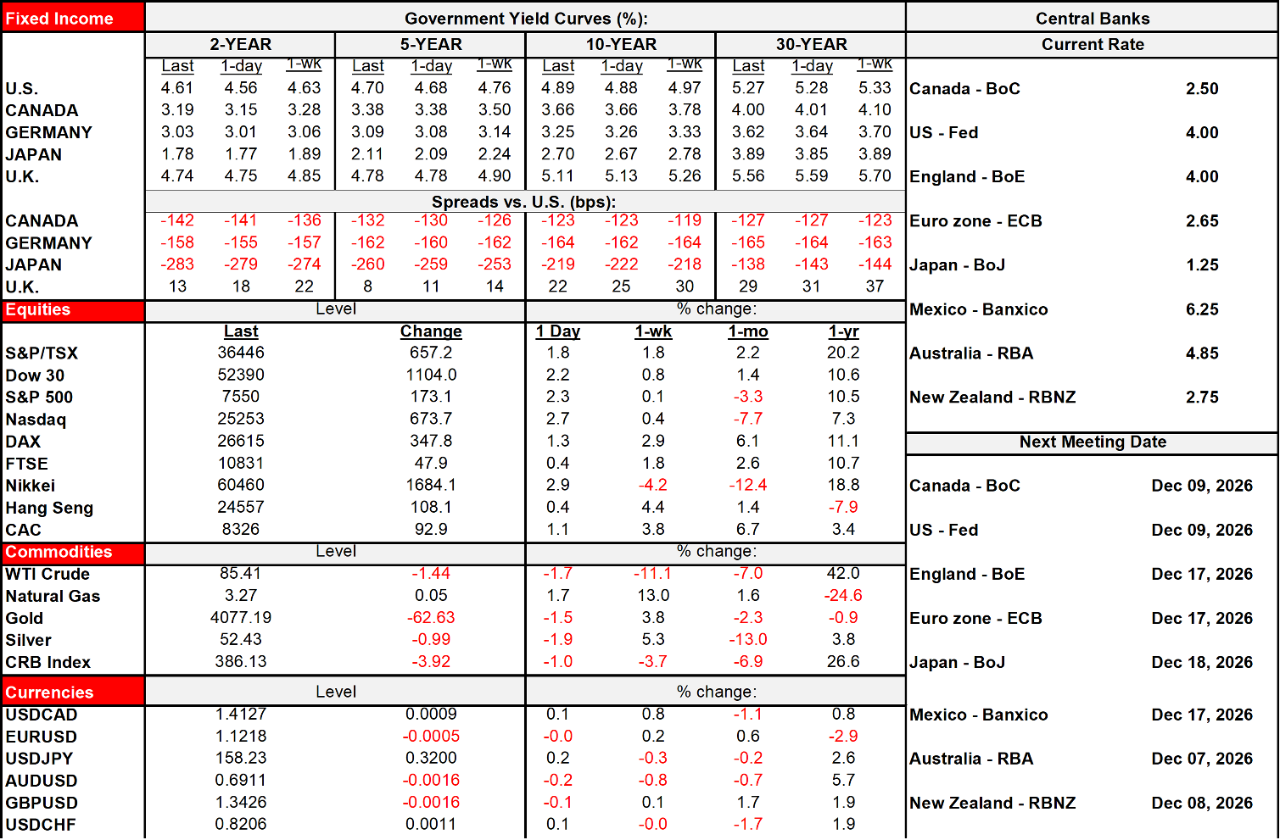
Waller’s remarks shifted positioning into CPI. The US two-year yield jumped nearly 7bps right at 4amET when his overseas speech hit the screens. Pricing for the December meeting jumped about 4bps to a full quarter-point hike and if CPI is strong then it may go beyond. The dollar was given somewhat of a boost. US equity futures largely shook it off but are underperforming bigger gains in European cash markets that could be a lagging reaction to yesterday afternoon’s N.A. gains.
Oil is down another $1-2. WTI is nearly US$20 below the late October peak and back to early September levels but still about US$30 higher than where it was at the start of the year so let’s not be tempted to call it cheap with cost pass through over with; it’s not. Brent is about US$23 off the late October peak and back to early September levels but still about US$30 higher than the start of the year.
Here is exactly what Waller said, snipped out of his speech:
“This means that even if, as I expect, the monthly rate of inflation improves in October, I am leaning toward supporting an increase in our policy rate of 25 basis points at the FOMC's December meeting. That's my plan if things proceed as I expect. But if the October CPI inflation data out later today are similar to the past two monthly readings—with core CPI inflation around 0.3 percent or even higher—then a stronger policy move may be needed. In that case, I believe a 50 basis point hike in the policy rate should be considered at the December meeting. Hiking only 25 basis points would put our credibility at risk, a risk I am not eager to take.”
My bigger problem is the extent to which the FOMC has apparently given up on forecasting and taken its lead from Chair Warsh in that regard since he spends all of his time boycotting forecasts and avoiding guidance in favour of telling us a story about the last five years while tossing disparaging remarks at ‘Wall Street.’ Upsizing with a 50bps move with an open door to do more on the basis of backward-looking CPI risks overtightening. The problem I have with such mega-sizing conditionality on backward data is that it makes zero effort to anticipate conditions 6, 12, 18, 24 months off into the future—a time period that coincides with the full lagging effects of monetary policy adjustments today. It sounds like grandstanding.
What’s your view on whether AI investment is cresting? Your view on fiscal policy turning restrictive and whether now is the time to combine increasingly restrictive monetary policy with restrictive fiscal policy? Your view on how long consumers can keep driving strong spending growth with no real income gains and no real house prices gains while depleting their saving rate? Your view on energy market dynamics and whether oil can keep falling—perhaps plunging—or whether the Iran war will flare again and the inability to trust either side of the conflict? Your view on the broad dollar’s effects on net trade drivers of growth? Your view on how widening adoption of AI will impact the job market? Your view on whether first round pressures of tariffs and commodity shocks are more likely to give way to second-round disinflationary pressures in the US system where labour markets clear in real time and companies are more likely to slash and seek higher productivity? Your view on whether you really care what the task forces reveal or whether that’s just a smoke-and-mirrors game? All that’s just to name a few macro considerations oriented toward the future on an endless list without even broaching external risks like whether France’s elections will skewer the eurozone next year.
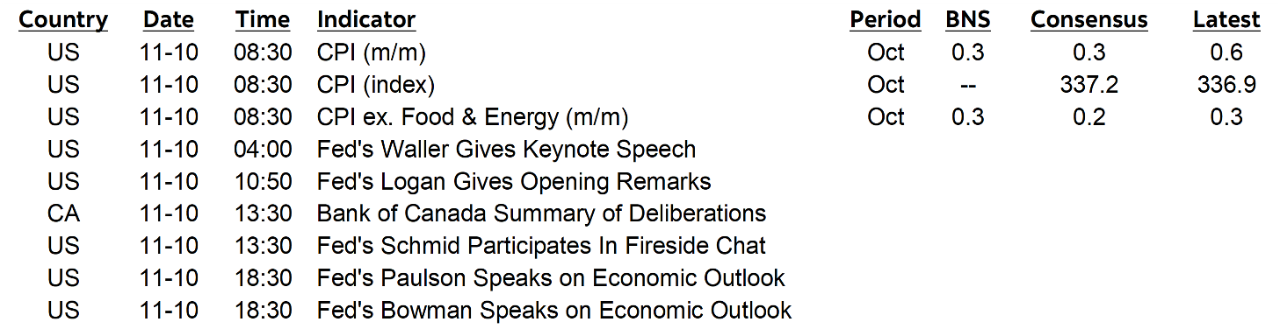
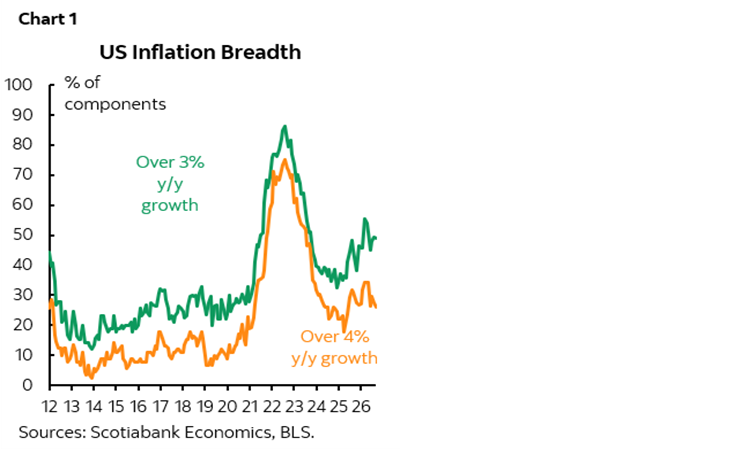
As for the call, consensus sits at 0.3% m/m for total CPI and 0.2% for core CPI during October (8:30amET). I’m a little more nervous about core CPI at 0.3% along with about one-fifth of consensus. Arguments were given in my weekly which I won’t repeat now. Breadth may also be key (chart 1). Then it’s onto PPI on Friday to round out the ingredients to firm up a PCE call.
Then it’s onto other FOMC reactions starting with Dallas President Logan (10:50amET), KC’s Schmid (1:30pmET), Vice Chair Bowman (3:30pmET and 6:30pmET) and Philly’s Paulson (6:30pmET).
DISCLAIMER
This report has been prepared by Scotiabank Economics as a resource for the clients of Scotiabank. Opinions, estimates and projections contained herein are our own as of the date hereof and are subject to change without notice. The information and opinions contained herein have been compiled or arrived at from sources believed reliable but no representation or warranty, express or implied, is made as to their accuracy or completeness. Neither Scotiabank nor any of its officers, directors, partners, employees or affiliates accepts any liability whatsoever for any direct or consequential loss arising from any use of this report or its contents.
These reports are provided to you for informational purposes only. This report is not, and is not constructed as, an offer to sell or solicitation of any offer to buy any financial instrument, nor shall this report be construed as an opinion as to whether you should enter into any swap or trading strategy involving a swap or any other transaction. The information contained in this report is not intended to be, and does not constitute, a recommendation of a swap or trading strategy involving a swap within the meaning of U.S. Commodity Futures Trading Commission Regulation 23.434 and Appendix A thereto. This material is not intended to be individually tailored to your needs or characteristics and should not be viewed as a “call to action” or suggestion that you enter into a swap or trading strategy involving a swap or any other transaction. Scotiabank may engage in transactions in a manner inconsistent with the views discussed this report and may have positions, or be in the process of acquiring or disposing of positions, referred to in this report.
Scotiabank, its affiliates and any of their respective officers, directors and employees may from time to time take positions in currencies, act as managers, co-managers or underwriters of a public offering or act as principals or agents, deal in, own or act as market makers or advisors, brokers or commercial and/or investment bankers in relation to securities or related derivatives. As a result of these actions, Scotiabank may receive remuneration. All Scotiabank products and services are subject to the terms of applicable agreements and local regulations. Officers, directors and employees of Scotiabank and its affiliates may serve as directors of corporations.
Any securities discussed in this report may not be suitable for all investors. Scotiabank recommends that investors independently evaluate any issuer and security discussed in this report, and consult with any advisors they deem necessary prior to making any investment.
This report and all information, opinions and conclusions contained in it are protected by copyright. This information may not be reproduced without the prior express written consent of Scotiabank.
™ Trademark of The Bank of Nova Scotia. Used under license, where applicable.
Scotiabank, together with “Global Banking and Markets”, is a marketing name for the global corporate and investment banking and capital markets businesses of The Bank of Nova Scotia and certain of its affiliates in the countries where they operate, including; Scotiabank Europe plc; Scotiabank (Ireland) Designated Activity Company; Scotiabank Inverlat S.A., Institución de Banca Múltiple, Grupo Financiero Scotiabank Inverlat, Scotia Inverlat Casa de Bolsa, S.A. de C.V., Grupo Financiero Scotiabank Inverlat, Scotia Inverlat Derivados S.A. de C.V. – all members of the Scotiabank group and authorized users of the Scotiabank mark. The Bank of Nova Scotia is incorporated in Canada with limited liability and is authorised and regulated by the Office of the Superintendent of Financial Institutions Canada. The Bank of Nova Scotia is authorized by the UK Prudential Regulation Authority and is subject to regulation by the UK Financial Conduct Authority and limited regulation by the UK Prudential Regulation Authority. Details about the extent of The Bank of Nova Scotia's regulation by the UK Prudential Regulation Authority are available from us on request. Scotiabank Europe plc is authorized by the UK Prudential Regulation Authority and regulated by the UK Financial Conduct Authority and the UK Prudential Regulation Authority.
Scotiabank Inverlat, S.A., Scotia Inverlat Casa de Bolsa, S.A. de C.V, Grupo Financiero Scotiabank Inverlat, and Scotia Inverlat Derivados, S.A. de C.V., are each authorized and regulated by the Mexican financial authorities.
Not all products and services are offered in all jurisdictions. Services described are available in jurisdictions where permitted by law.