

ON DECK FOR FRIDAY, AUGUST 28th
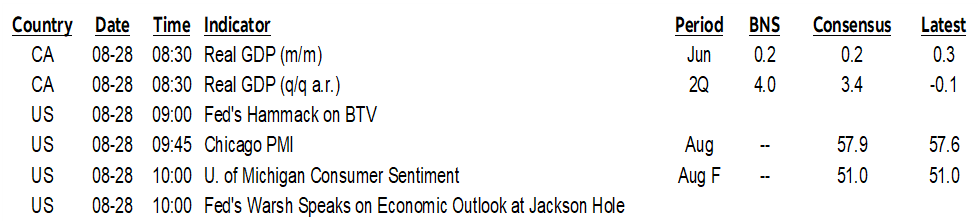
KEY POINTS:
- Markets await Warsh’s grand entrance at Jackson Hole
- Will Warsh go big picture or near-term? Maybe both
- Jackson Hole agenda reveals no other central bank heads
- Nonfarm revisions could be positive
- Canadian GDP: fastest growing economy in the G7?
- Eurozone inflation trades off French, Spanish readings so far
- Tokyo core inflation supports near-term BoJ tightening
- Tracking the trade war tidbits
Good morning from the lovely northern side of Lake Ontario. The week could end with a bang, or a whimper today. It significantly depends upon Federal Reserve Chair Warsh’s short speech at 10amET. Before his speech, Canada watchers will get a GDP report that might vault it to the top of the G7 on growth. Early reads on Eurozone CPI are out ahead of the rest of them next week, and so is a fresh reading from Japan.
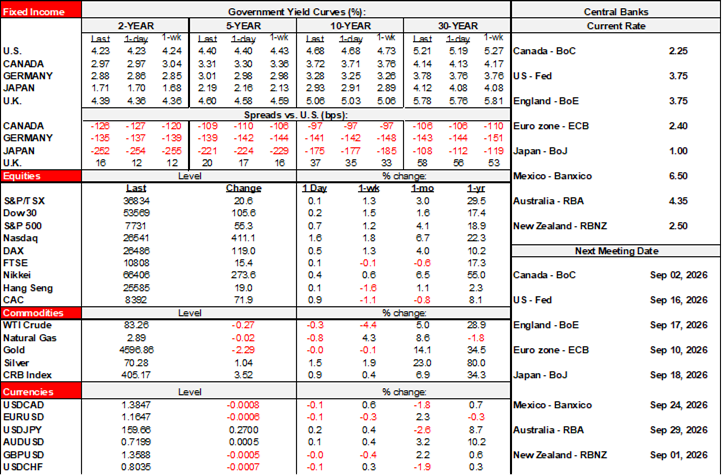
What effect is it all having so far? Not much. Sovereign bond yields are leaning slightly higher in Europe and are flat in the US and Canada. Currencies are very flat in anticipation of Warsh except for the won that continues to outperform; semiconductors and the BoK dominate over silly US political jabs. Equities are mixed with N.A. futures little changed but with a slight negative bias on the Nasdaq as European cash markets rally by up to 1%. Oil is flat because the dollar is flat because nobody knows what Warsh will say.
JACKSON HOLE—WHAT WILL WARSH SAY?
The Jackson Hole agenda is here and was made available last evening. This year’s theme is “Financial Innovation: Implications for Payments and Policy.” Content that aligns with the theme may be more informative to those whose interests are closely aligned with changes in the financial system.
Chair Warsh speaks at 10amET. What will he say? That’s more up in the air than usual this time. That’s because when asked during his press conference on July 29th what he might do with this year’s address, he said:
“I look at it as a blank sheet of paper. Historically it would be sort of a setting up speech of what was going to be happening in the Fall. I haven't made any judgements on that. I'd also like to frame the big questions. What's happened with productivity? Demographics? Shocks? I haven't decided is it a big picture speech of a set up of all the action we'll have between September and December.”
He may very well be best advised to do some of both by providing some guidance—howsoever veiled—on nearer term interpretations while sharing initial perspectives on the tentative work fo the task forces. Recall that Warsh also indicated that he may or may not have early thoughts on progress by the task forces.
If Warsh does go the route of teeing up future possible moves, then a) it would conflict with his stance against providing explicit forward guidance, but b) would probably lean more toward the neutral-dovish side of expectations.
Why? The Committee’s Summary of Economic Projections in mid-June anticipated that the fed funds rate would remain unchanged at 3.75% through to year-end before cutting once next year. This year’s dot plot was split 50–50 between no action with one putting down a cut, and one hike.
Since June, US data has deteriorated somewhat in terms of the dual mandate. Core inflation has ebbed with soft back-to-back month-over-month core PCE readings and nonfarm payrolls have been disappointing with very little net gain of just 60k over the past three months. Financial market conditions have been volatile, but the surge in the 10-year Treasury yield to just shy of 4.7% has backed into higher mortgage rates. Recent evidence for a data-wedded Committee wouldn’t really support sounding incrementally hawkish.
It may also be too soon to begin sharing the work of the five Task Forces that Warsh set up to report back into the Fall and by year-end.
Also watch for possible remarks from the sidelines or formal appearances on the agenda itself by other global central bank officials. There may be more information on attendees available through the media in the run-up to the event. We do not as yet have such indications. ECB President Lagarde may be likely since it could be her last given a pledge to stay on until at least year-end and the possibility she may step down before her term is up in October 2027 given the French election will be held in Spring and a desire to have a successor chosen before.
NONFARM PAYROLL REVISIONS DUE AT THE SAME TIME THAT WARSH SPEAKS
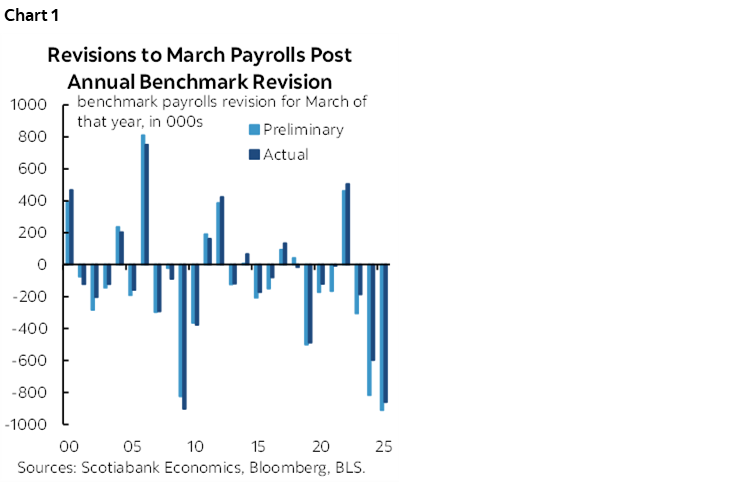
The BLS issues its preliminary nonfarm payroll benchmarking revisions at the same time Warsh begins to speak (10amET). Scotia's house call is +300k to March 2026 payrolls for an average of about +25k per month from April 2025 to March 2026. Cautions include that the underlying source of the revisions—QCEWS data on payrolls at the state level—is only available up to December 2025 and the addition of 2026Q1 data this morning could also include revisions to the prior three quarters that affect the inputs to nonfarm revisions as at March 2026. Still, if estimates are anywhere close, then the pattern of big downward revisions in recent years may end (chart 1). See my weekly for further elaboration.
CANADA’S ECONOMY IS EXPECTED TO REBOUND
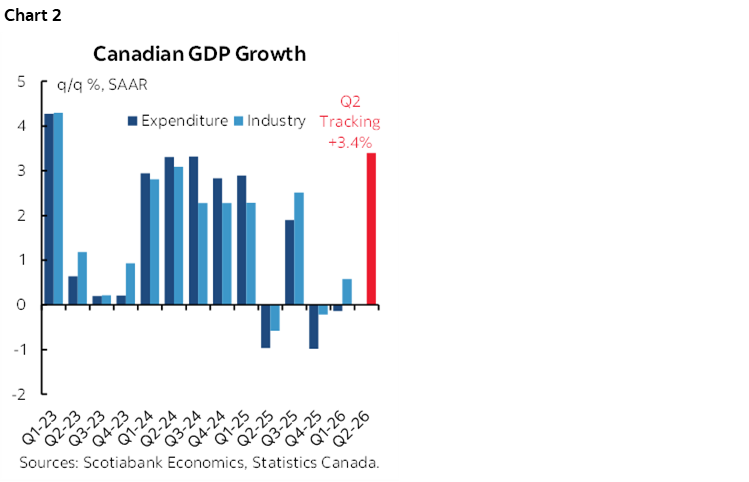
Canada updates GDP figures for Q2 as well as the individual months of June and July today (8:30amET). Q2 growth could land at 4% q/q SAAR (Scotia) with consensus stretching from about the high-2% range to about 4½% and the median is at 3.4%. That’s using the traditional expenditure-based approach. The BoC had forecast 2.5% growth in its MPR on July 15th. Since then, we have received more data. There are still a lot of unknowns.
Using what we know from monthly GDP figures reveals tracking of 3.4% q/q SAAR growth in Q2 which tends to line up fairly closely to the expenditure-based accounts (chart 2). Monthly GDP is income-based. Expenditure-based GDP considers additional factors like inventory investment swings and more thoroughly incorporates the effects of trade figures.
On that note, it may be tough to repeat the large 4% weighted addition to Q1 GDP growth from inventory investment. Higher import volumes suggest that there could be ongoing inventory additions even if at a slower pace. Export volumes, however, have been on an absolute tear and this could make net export contributions to GDP growth offsetting to inventory swings.
To help cut through all of that, keep an eye on final domestic demand. In a GDP accounting sense, it adds up consumption plus investment plus government spending and therefore excludes inventories and net trade. FDD is a better barometer of underlying momentum in the domestic economy to the extent to which you can separated it from trade influences.
Either way, Q2 GDP growth should be a solid print that could be the strongest growth since at least 2025Q1 and perhaps since 2023Q1.
As for momentum, it’s too early to really tell, but what we do have suggests that the economy has a good, solid, running headstart. Monthly GDP figures up to June and our early estimate for July—when hours worked jumped higher by 0.6% m/m SA—imply baked-in Q3 GDP growth of 1.8% q/q SAAR. That will be updated after this morning’s figures.
June GDP is expected to rise by 0.2% m/m SA based on Statcan’s advance guidance and our tracking. Credible estimates are at either 0.2% or 0.3%.
EUROZONE CPI—NEED MORE COUNTRIES
France and Spain released CPI figures for August ahead of the rest of the Eurozone next week. The readings conflicted with one another which means Germany and Italy may determine in which direction the overall Eurozone reading tilts next week.
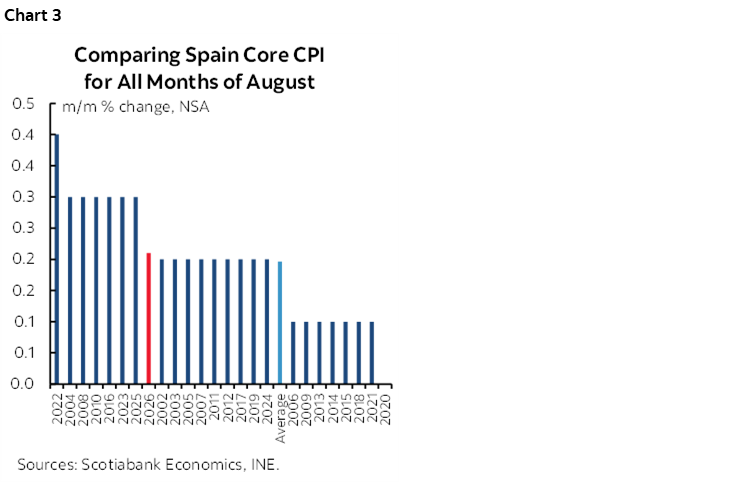
Spanish core CPI was up by 0.2% m/m NSA which is spot-on the ten year average for like months of August (since it’s seasonally unadjusted). Chart 3. Headline CPI was up by 0.6% m/m (consensus 0.8%). So far, so good, as Spanish inflation was tame last month.
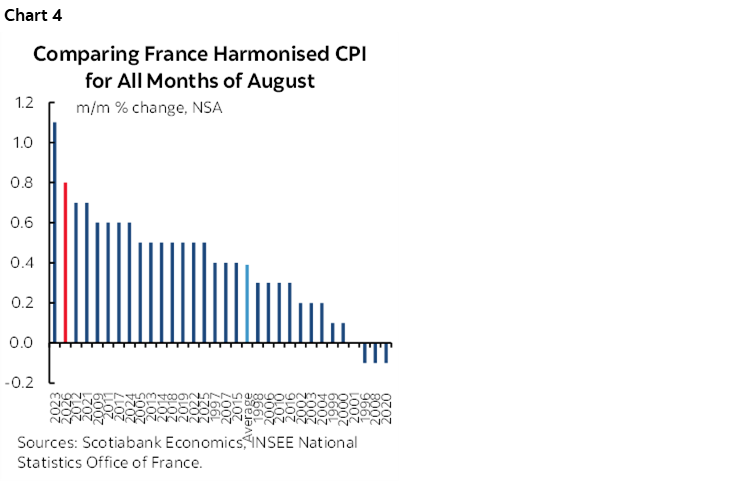
And then there is France. CPI was up 0.8% m/m NSA (0.7% consensus) which lifted the year-over-year rate to 2.7% (2.4% prior, 2.6% consensus). Prices were up 0.8% m/m NSA (0.7% consensus) which was relatively warm (chart 4).
TOKYO CPI SUPPORTS BOJ TIGHTENING IN SEPTEMBER
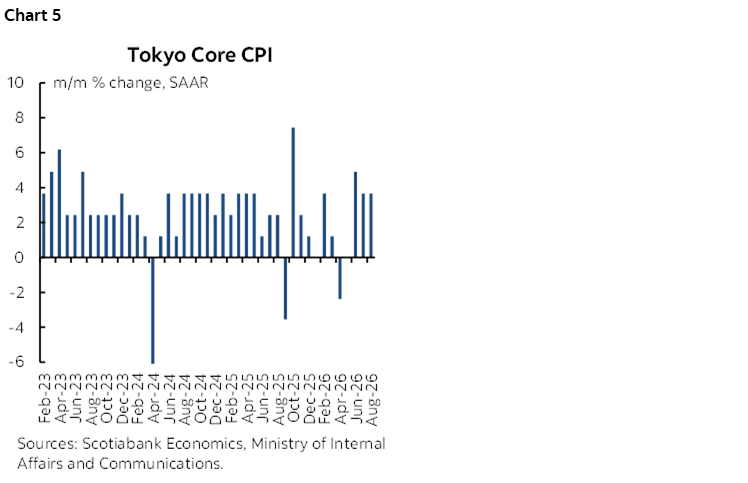
Tokyo’s core CPI reading in August remained hot at 3.7% m/m SAAR (0.3% m/m SA). That extends the recent streak of warm readings (chart 5). The BoJ is priced for 21bps of a quarter point hike on September 18th. Japan’s bond yields rose in bear steepener fashion with 2s up about 2bps and the long-end up by 5–6bps.
TRADE WAR TIDBITS
Other than petty renaming acts, substantive developments in the unprovoked trade war the US started with Canada include:
- Canada’s Export Development Corporation stepped up supports to Canadian exporters yesterday (here).
- Trump said yesterday that “We don’t want Canada to make cars for the US.” That repeats Lutnick’s line from six months ago. That said, was it an entirely possible unthinking slip not to also say trucks, or was the signal in the noise that the US could be stepping away from including super duty trucks? Unthinking is the more likely bet.
- Lutnick claimed that Canada will want to talk about a trade deal after separatist votes. Nobody should hold their breath. Quebec’s election is expected to be won by the separatist PQ, but it has clearly stated it will not hold a potential referendum until after Trump leaves office (hint hint…). Besides, support for separation is very low in both Quebec (here) and Alberta (here). And yet, this is an extension of overt political interference in Canadian affairs by a senior member of the Trump cabinet. It follows the behaviour of the disliked US Ambassador to Canada who met with Alberta separatists and has been agitating them. The US government met with them in Washington. The US long ago lost the right to complain about foreign political interference in its politics.
- Canada’s Minister LeBlanc observed and welcomed the signal from USTR Greer that Canada’s streaming laws are not a “red line” which LeBlanc interpreted as follows here.
- the list of Canadian retaliatory tariffs is getting shorter after removing seafood products but adding tariffs on wood charcoal and copper wire. The list started at 874 items and is now down to 648.
- depending upon how broadly we define copper wire, estimates of the US share of Canadian spending on copper wire seem to be between 15–35%. There are several major Canadian producers and so this is an example of the approach to retaliatory tariffs—target what the US is targeting on metals tariffs and where there are substitutes or domestic production.
- Trump’s cut to ground beef tariffs benefits Canada as the third largest source of imported beef into the US.
- There were more US GOP politicians saying Canada can’t possibly win a trade war against the US given the size differences. The US doesn’t always win wars as one might have noticed. Further, don’t underestimate the capacity to support the economy with whatever it takes in the shorter-term for the sake of not committing to a terrible trade deal for the longer run.
- Trump is pressing Mexican President Sheinbaum to stop the flood of migrants at the border into US-Mexico negotiations.
UNINTENDED RENAMING CONSEQUENCES
There is another unintended outcome to Trump’s failed attempt at renaming Lake Ontario than just whether the five Great Lakes acronym is HOMES or SHAME as clever folks on social media ran with (always HOMES).
Unlike the Gulf of Mexico, Lake Ontario is not the only body of water that is shared by Canada and the US. All but one of the 5 Great Lakes is shared by Ontario.
By my understanding with the caveat this is outside of my area of expertise, the Ontario Geographic Names Board Act can recommend name changes. The Ontario Minister of Resources has the statutory power to approve the name. He reports to the Premier of course. Then it changes on maps and publications in Canada. From what I understand, the feds used to control naming but then gave that to the provinces.
So, could the bizarro world that arises from all of this theoretically have the Great Lakes named differently on both sides of the border? I hope not. How very messy. How very confrontational to the hundreds of years of history behind the names and the indigenous roots to several of them. Two nutty moves don’t make one mature one! There is a much stronger tendency to associate the Great Lakes with Canada anyway, so what Canada calls them will stand outside of US maps.
DISCLAIMER
This report has been prepared by Scotiabank Economics as a resource for the clients of Scotiabank. Opinions, estimates and projections contained herein are our own as of the date hereof and are subject to change without notice. The information and opinions contained herein have been compiled or arrived at from sources believed reliable but no representation or warranty, express or implied, is made as to their accuracy or completeness. Neither Scotiabank nor any of its officers, directors, partners, employees or affiliates accepts any liability whatsoever for any direct or consequential loss arising from any use of this report or its contents.
These reports are provided to you for informational purposes only. This report is not, and is not constructed as, an offer to sell or solicitation of any offer to buy any financial instrument, nor shall this report be construed as an opinion as to whether you should enter into any swap or trading strategy involving a swap or any other transaction. The information contained in this report is not intended to be, and does not constitute, a recommendation of a swap or trading strategy involving a swap within the meaning of U.S. Commodity Futures Trading Commission Regulation 23.434 and Appendix A thereto. This material is not intended to be individually tailored to your needs or characteristics and should not be viewed as a “call to action” or suggestion that you enter into a swap or trading strategy involving a swap or any other transaction. Scotiabank may engage in transactions in a manner inconsistent with the views discussed this report and may have positions, or be in the process of acquiring or disposing of positions, referred to in this report.
Scotiabank, its affiliates and any of their respective officers, directors and employees may from time to time take positions in currencies, act as managers, co-managers or underwriters of a public offering or act as principals or agents, deal in, own or act as market makers or advisors, brokers or commercial and/or investment bankers in relation to securities or related derivatives. As a result of these actions, Scotiabank may receive remuneration. All Scotiabank products and services are subject to the terms of applicable agreements and local regulations. Officers, directors and employees of Scotiabank and its affiliates may serve as directors of corporations.
Any securities discussed in this report may not be suitable for all investors. Scotiabank recommends that investors independently evaluate any issuer and security discussed in this report, and consult with any advisors they deem necessary prior to making any investment.
This report and all information, opinions and conclusions contained in it are protected by copyright. This information may not be reproduced without the prior express written consent of Scotiabank.
™ Trademark of The Bank of Nova Scotia. Used under license, where applicable.
Scotiabank, together with “Global Banking and Markets”, is a marketing name for the global corporate and investment banking and capital markets businesses of The Bank of Nova Scotia and certain of its affiliates in the countries where they operate, including; Scotiabank Europe plc; Scotiabank (Ireland) Designated Activity Company; Scotiabank Inverlat S.A., Institución de Banca Múltiple, Grupo Financiero Scotiabank Inverlat, Scotia Inverlat Casa de Bolsa, S.A. de C.V., Grupo Financiero Scotiabank Inverlat, Scotia Inverlat Derivados S.A. de C.V. – all members of the Scotiabank group and authorized users of the Scotiabank mark. The Bank of Nova Scotia is incorporated in Canada with limited liability and is authorised and regulated by the Office of the Superintendent of Financial Institutions Canada. The Bank of Nova Scotia is authorized by the UK Prudential Regulation Authority and is subject to regulation by the UK Financial Conduct Authority and limited regulation by the UK Prudential Regulation Authority. Details about the extent of The Bank of Nova Scotia's regulation by the UK Prudential Regulation Authority are available from us on request. Scotiabank Europe plc is authorized by the UK Prudential Regulation Authority and regulated by the UK Financial Conduct Authority and the UK Prudential Regulation Authority.
Scotiabank Inverlat, S.A., Scotia Inverlat Casa de Bolsa, S.A. de C.V, Grupo Financiero Scotiabank Inverlat, and Scotia Inverlat Derivados, S.A. de C.V., are each authorized and regulated by the Mexican financial authorities.
Not all products and services are offered in all jurisdictions. Services described are available in jurisdictions where permitted by law.