

ON DECK FOR TUESDAY, AUGUST 25th
KEY POINTS:
- CAD has weakened a cumulative penny since Friday on oil and trade
- Canadian banks beat expectations
- Canada to announce retaliatory tariffs today & what to watch
- Canada to announce supports today & what could be included
- Fact checking some wrong claims about Canada
- US ADP continues to track softly
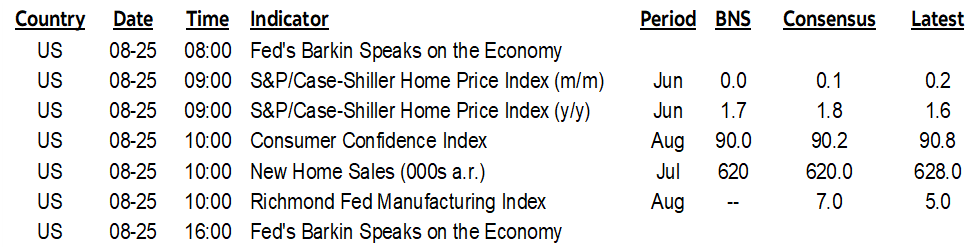
- US to update confidence, new home sales, Richmond, house prices
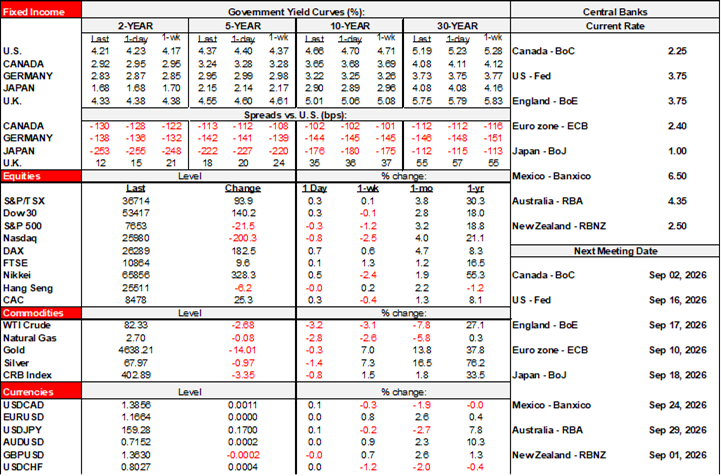
Stocks are broadly higher including ½% to 1% gains in US futures, a small gain in TSX futures, and modest increases across European cash markets. Sovereign bond yields are under downward pressure across most major markets with the front-ends outperforming in Europe and Canada while everyone’s longer-term yields are lower by 3–5bps. Currencies are mixed with the weakest cross being NOK followed by slight further slippage in CAD; CAD has depreciated by a cumulative penny or so since Friday which I wouldn’t call a ‘tumble’ as sensational headlines have suggested. Furthermore, a prime catalyst behind weakness in CAD and NOK has been falling oil prices this week including another 3%+ drop today; yesterday’s announcements of sanctions by US Treasury Secretary Bessent was more bark than bite certainly relative to the advance hype.
CANADIAN BANKS BEAT EXPECTATIONS
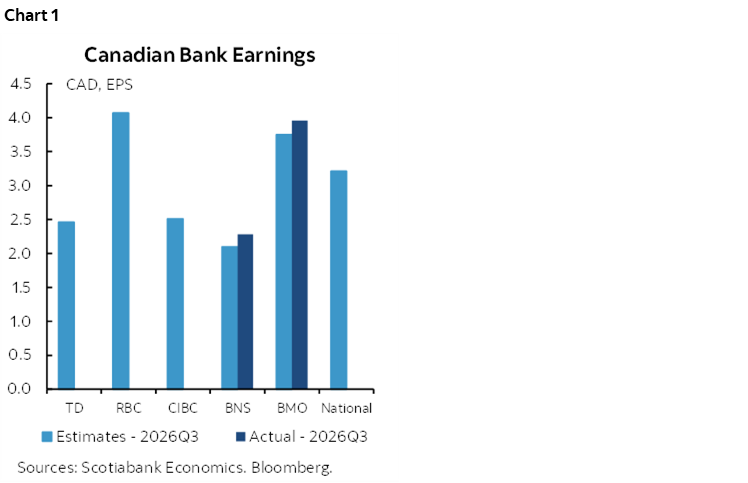
Scotiabank beat expectations with adjusted Q3 EPS at C$2.28 (consensus $2.10). BMO also beat with adjusted EPS of $3.96 (consensus $3.75). Chart 1 shows the tracking thus far with other banks to report over the rest of the week. See Scotia’s investor decks for more.
LIMITED US DATA ON TAP
There is some US data on tap this morning with the main focus upon consumer confidence this month (10amET) and new home sales during July (10amET). Refreshed house prices during June and Q2 (9amET) and the Richmond Fed’s manufacturing index for August (10amET) are also due. ADP private payrolls continue to be soft with the four-week moving average of w/w gains at 11.75k, or 47k at a monthly rate.
CANADA TO ANNOUNCE RETALIATORY TARIFFS AND SUPPORTS TODAY
As for further developments on the trade war that the United States administration started, we’re at the puerile name-calling, he-said-she-said stage but mixed in between such nonsense are policy developments.
Canada is expected to announce retaliatory tariffs against the United States and further support measures today. Carney roughly spelled out the targets in his presser on Saturday to include steel, dairy, appliances, pulp and paper, electronics, and sectors affected by Section 232 and 338 tariffs.
Carney said in yesterday’s press conference that it was difficult to do dollar-for-dollar retaliation and that a more targeted route was likely in somewhat of a walk-back from his earlier remark. Recall that Canada optically claimed it was going dollar-for-dollar the last time around but fell short of matching. We are hearing conflicting guidance on this matter this morning.
An example of the targeted nature and how to adapt is to buy your appliances first if you're looking at a US brand. It's a perfect example of how there are substitutes from elsewhere.
I suspect that purchasing managers are likely acting fast to front-run the orders in a way that could provoke a first-round effect that lifts manufacturing orders and inventories while adding to near-term growth. Some buyers have already ordered for the holiday season, while others may act quickly which could mitigate the pass-through effects into inflation for a time. We would likely offset this pulled-forward effect on growth by dampening the subsequent months/quarter.
We will use this list of retaliatory targets to inform the possible impact upon inflation. One crude approach is to say that if Canada imposes equal 50% tariffs on $30B of imports from the US most of it in consumer goods, then it could be a weighted contribution to CPI of about 0.75% assuming full pass through. Then rein in that first pass with two adjustments; one is that there is unlikely to be full pass-through, and two is that some of the targeted items are likely to be industrial goods with indirect passthrough risk. That could leave us something in the low tenths of a percentage point by way of direct effects on total CPI but then it also depends upon steps thereafter the broader risks to supply chains.
As for core inflation, trimmed mean and weighted median CPI exclude the direct effects of changes in indirect taxes like tariffs but not the indirect passthrough effects. Traditional CPI excludes neither. The fuller impact upon inflation would trade off slightly lower forecast growth and whether supports overdo it.
Canada is also expected to announce fiscal and other supports this morning. An announcement is expected at 11amET. Supports for workers and affected industries and companies is expected. FinMin Champagne said yesterday that in addition to household and business supports and loan supports the measures have to be simple and fast and keep people in their jobs.
That latter part makes it sound like reaching back to the pandemic job programs when they shared costs with employers, conditional upon not letting people go. Back then it was called the Canada Emergency Wage Subsidy (here). Canada probably learned a thing or two about its support programs since then, which counsels a new and improved approach. The fine line to be walked is between support versus overdoing it and for too long in a way that impedes adjustments in the economy. The possibility of a CEWS V2 arrangement is part of why we should be careful about downside risk. We do not, however, know what form such assistance will take and will be monitoring the announcements.
There is also accelerating movement afoot to bring forth a Budget. Champagne met with bank CEOs yesterday, held pre-budget consultations in Montreal yesterday and is repeating the exercise in Toronto today. There is no date to go by yet and won’t be until much closer to deliver, but I wouldn't be surprised if we get a much earlier Fall budget. Recall that Canada switched to the full budget in the Fall last year and then a Spring economic and fiscal update which is the reverse of what it had been for years.
Further on the file of support measures was yesterday’s announcements on shipbuilding by PM Carney (here). Notable upon his entry was the loud applause he received; an Angus-Reid poll said 76% of Canadians supported walking away from trade talks which is important information for the US side’s tendency to dismiss this as a Carney issue. Carney committed another $8B to build icebreakers in Quebec. Shipbuilding is going to be an absolutely booming industry. In fact, I don’t think this country has built this many notable ships since World War 2 when Canada had the world’s third biggest navy behind the US and UK. The effects will be to draw upon displaced production of steel and other industrial output due to US tariffs. Here is the list:
- 15 Riverclass destroyers
- 2 Joint Support Ships
- 2 Coast Guard Arctic patrol ships
- 2 polar icebreakers
- up to 16 multi-purposes icebreakers
- 1 science vessel
- 2 ferries
- Now 6 icebreakers at the Davie shipyard in Quebec.
- Up to 12 submarines with the Germans and Norwegians.
46 ships and 12 subs in total. Plus hundreds of billions or trillions of major infrastructure and defence projects. Now for a bit of a reality check. Can it all be delivered or how much of it is a wish list? For example, Canada hasn't really built many ships in a long time. Where do the workers come from? The initial projects are starting with a mixture of Canadian and imported workers. As for other inputs, these huge, overlapping contracts are likely to push up costs and with implications for deficits, taxes and/or other forms of program spending.
OTHER RISKS AND FACT-CHECKING
As for other developments in the trade war, here’s a series of explanations downplaying other threats and risks along with some factchecking on the claims that otherwise would give a false impression of Canada’s economy to our clients:
- Trump’s threat to impose 50% tariffs on all cars, trucks and auto parts by January 1st 2027 (here) is an empty one and clients should ignore it. First, it’s so far out there that the signal is to downplay the seriousness behind the venting. Second, this would entirely shut down the North American auto industry including on the US side via vicious ripple effects on supply chains and with financial stability risks. Go back to comments from auto industry execs in February of last year when they said draconian tariffs would exponentially compound upon one another in the back-and-forth cross-border activity and make it uneconomical to produce. Plants would shutter in short order. This is why share prices of US auto firms reacted negatively to the headline and I’m sure they’re letting the administration know what they think. As an added aside, Canada does not do “95%” of its business with the US; about two-thirds of exports go to the US and exports are about 30% Canadian GDP which means just over one-fifth of GDP is represented by exports to the US. That’s big, but about one-quarter of the alleged dependency.
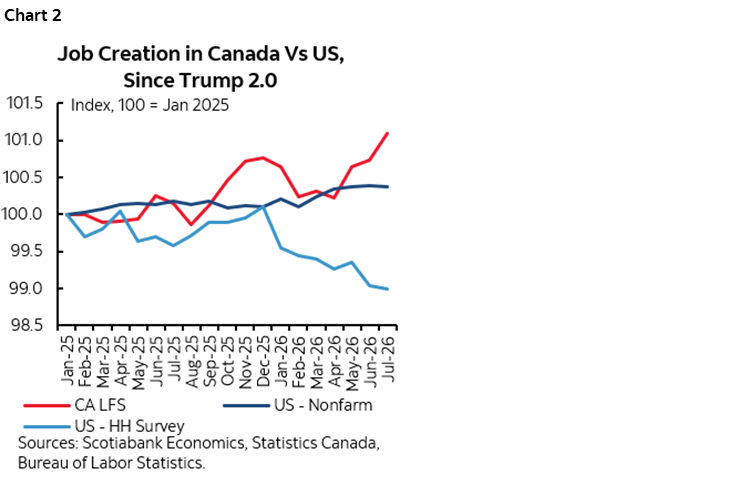
- The fact-check on this post is that Canada’s unemployment rate is not 10%—it’s 6.4%. And if Canada used the US methodology then Canada's UR would be 5.4%—or about half of Trump’s claim. Canada has a more liberal definition of what classified as searching for a job and also counts workers starting one year younger. In any event, I wouldn’t go comparing the performance of the US job market to Canada without the facts presented in chart 2.
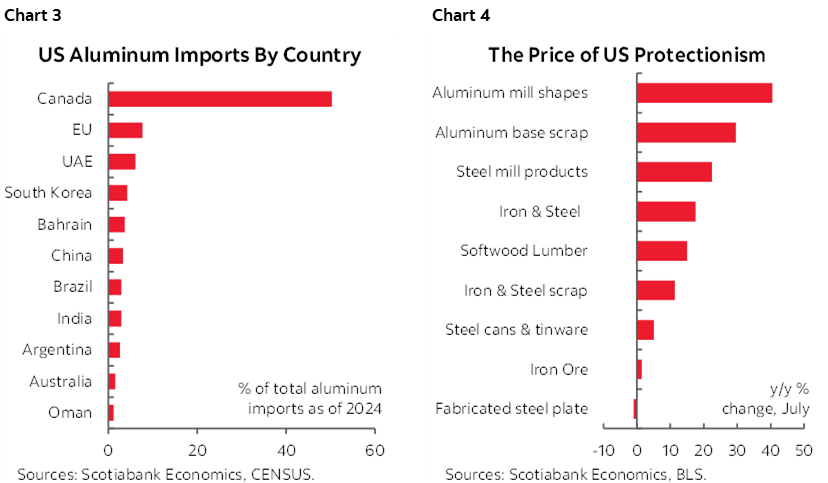
- Trump also said late yesterday that “This country desperately needs aluminum. We need aluminum badly, we mainly get it from Canada.” Perhaps that’s an indication of the growing realization that imposing 50% tariffs on Canadian aluminum exports is punishing the US?? Second thoughts could have been the first thoughts. Chart 3 shows where the US gets its aluminum and chart 4 shows what has happened to aluminum prices as tariffs get passed along.
- Trump’s post declaring a love of French may also be an indication the US is walking back on Canada’s alleged claims to interfere with cultural protections and use of French as explained in my weekend piece on the collapse of trade talks. Paired with aluminum remarks, this too could be a bit of an olive branch mixed in with the other less constructive remarks.
Where Canada needs to be careful in my opinion is on overdoing the return volley. Namely, I would be very careful toward restricting exports of critical minerals and energy. It could be emotionally gratifying in the short-term, but very damaging over the long-term.
- Canada would harm its reputation for being a stable business partner over the long-term;
- there may be lawsuits over breach of contracts;
- it would divide Canada with one example being that Alberta and Saskatchewan would go totally nuts over restricting oil and gas, potash, uranium etc.
- Even Ontario’s premier said “everything is on the table but I can't do it alone" in reference to needed support for such measures from other premiers which is unlikely. For example, restricting electricity exports from Ontario could be awkward if Quebec and others don’t go along.
If you were to do some of these measures, however, then now would be the time to do it for maximum effect in terms of risks. US refiners have very strained capacity and so an energy supply shock through restrictions could punt the daily average all-grades US gasoline price to, say, $5–6+ per gallon? Of course you’d also be doing that to Canadian consumers….
DISCLAIMER
This report has been prepared by Scotiabank Economics as a resource for the clients of Scotiabank. Opinions, estimates and projections contained herein are our own as of the date hereof and are subject to change without notice. The information and opinions contained herein have been compiled or arrived at from sources believed reliable but no representation or warranty, express or implied, is made as to their accuracy or completeness. Neither Scotiabank nor any of its officers, directors, partners, employees or affiliates accepts any liability whatsoever for any direct or consequential loss arising from any use of this report or its contents.
These reports are provided to you for informational purposes only. This report is not, and is not constructed as, an offer to sell or solicitation of any offer to buy any financial instrument, nor shall this report be construed as an opinion as to whether you should enter into any swap or trading strategy involving a swap or any other transaction. The information contained in this report is not intended to be, and does not constitute, a recommendation of a swap or trading strategy involving a swap within the meaning of U.S. Commodity Futures Trading Commission Regulation 23.434 and Appendix A thereto. This material is not intended to be individually tailored to your needs or characteristics and should not be viewed as a “call to action” or suggestion that you enter into a swap or trading strategy involving a swap or any other transaction. Scotiabank may engage in transactions in a manner inconsistent with the views discussed this report and may have positions, or be in the process of acquiring or disposing of positions, referred to in this report.
Scotiabank, its affiliates and any of their respective officers, directors and employees may from time to time take positions in currencies, act as managers, co-managers or underwriters of a public offering or act as principals or agents, deal in, own or act as market makers or advisors, brokers or commercial and/or investment bankers in relation to securities or related derivatives. As a result of these actions, Scotiabank may receive remuneration. All Scotiabank products and services are subject to the terms of applicable agreements and local regulations. Officers, directors and employees of Scotiabank and its affiliates may serve as directors of corporations.
Any securities discussed in this report may not be suitable for all investors. Scotiabank recommends that investors independently evaluate any issuer and security discussed in this report, and consult with any advisors they deem necessary prior to making any investment.
This report and all information, opinions and conclusions contained in it are protected by copyright. This information may not be reproduced without the prior express written consent of Scotiabank.
™ Trademark of The Bank of Nova Scotia. Used under license, where applicable.
Scotiabank, together with “Global Banking and Markets”, is a marketing name for the global corporate and investment banking and capital markets businesses of The Bank of Nova Scotia and certain of its affiliates in the countries where they operate, including; Scotiabank Europe plc; Scotiabank (Ireland) Designated Activity Company; Scotiabank Inverlat S.A., Institución de Banca Múltiple, Grupo Financiero Scotiabank Inverlat, Scotia Inverlat Casa de Bolsa, S.A. de C.V., Grupo Financiero Scotiabank Inverlat, Scotia Inverlat Derivados S.A. de C.V. – all members of the Scotiabank group and authorized users of the Scotiabank mark. The Bank of Nova Scotia is incorporated in Canada with limited liability and is authorised and regulated by the Office of the Superintendent of Financial Institutions Canada. The Bank of Nova Scotia is authorized by the UK Prudential Regulation Authority and is subject to regulation by the UK Financial Conduct Authority and limited regulation by the UK Prudential Regulation Authority. Details about the extent of The Bank of Nova Scotia's regulation by the UK Prudential Regulation Authority are available from us on request. Scotiabank Europe plc is authorized by the UK Prudential Regulation Authority and regulated by the UK Financial Conduct Authority and the UK Prudential Regulation Authority.
Scotiabank Inverlat, S.A., Scotia Inverlat Casa de Bolsa, S.A. de C.V, Grupo Financiero Scotiabank Inverlat, and Scotia Inverlat Derivados, S.A. de C.V., are each authorized and regulated by the Mexican financial authorities.
Not all products and services are offered in all jurisdictions. Services described are available in jurisdictions where permitted by law.