

ON DECK FOR THURSDAY, AUGUST 20th
KEY POINTS:
- Higher oil prices and trade enthusiasm are pumping CAD gains
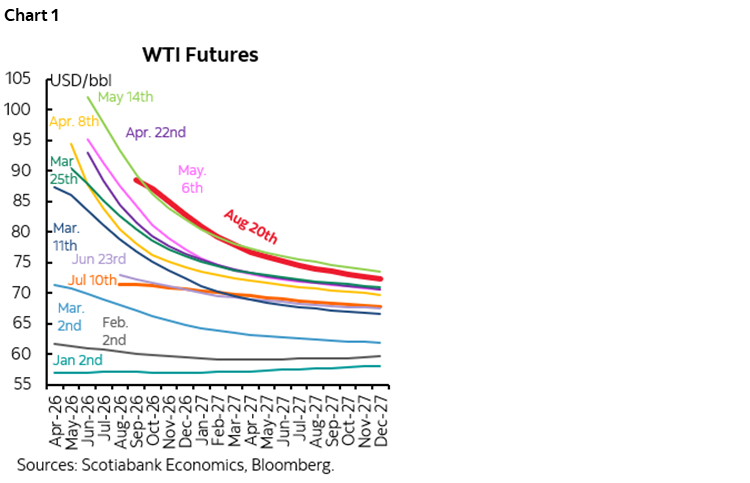
- WTI futures curve testing new highs; higher for longer may provoke the BoC
- Bessent’s buyback intervention shaken off, and recall his Yellen criticism
- Reinforcing and updating our Canadian yield curve forecasts
- How would a Canada-US trade deal impact effective tariff rate calculations?
- Doing the math: does Canada need two new pipelines?
- A Canada-US deal is resoundingly positive…
- ...but is 72 hours too rapid for an agreement?
- Dairy’s treatment in the talks remains a mystery; a primer on supply management
- Australian jobs disappointed, tamping down RBA pricing
- Riksbank held, guidance still points to year-end hike
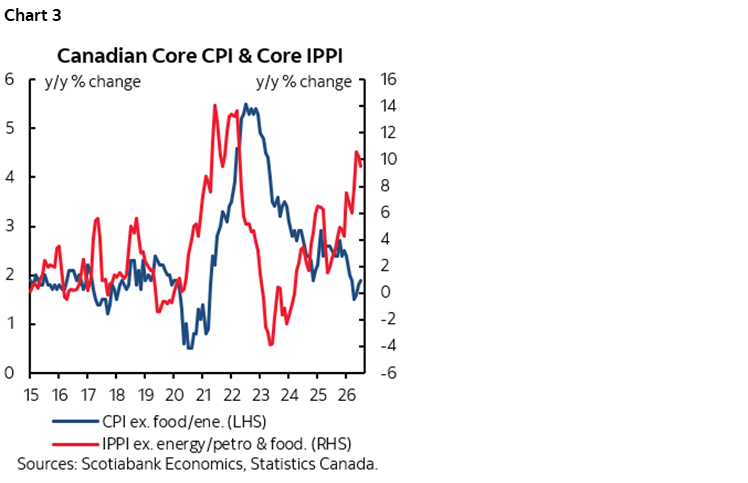
- Canadian core industrial prices point to continued pass through risk into core CPI
- US claims, limited Fed-speak on tap after yesterday’s dull minutes
- Trump tees up broader Iran-related sanctions, Treasury still mum
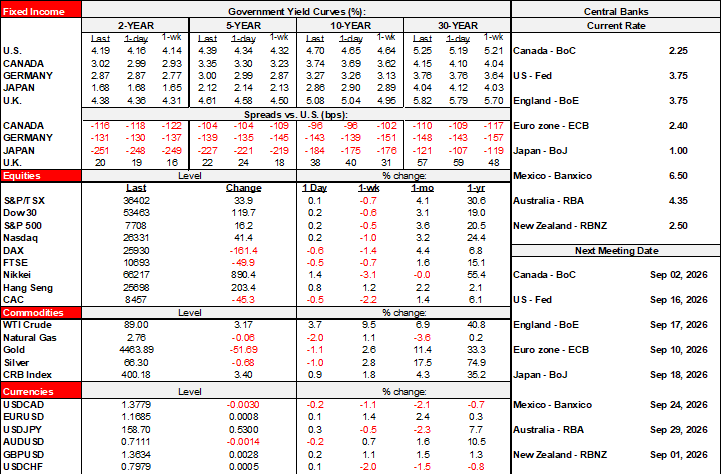
Treasury Secretary Bessent’s intervention in the US Treasury market worked for a few hours yesterday but is being shaken off already. Ditto for Trump’s expected but still rather shoddy effort yesterday to school everyone on why the US should have lower rates ‘because the economy is doing so well’ which made my face turn as red as a McIntosh on his behalf. US Treasury yields are higher by 2–6bps with a steeper curve. Canada’s front-end is underperforming the US on higher BoC rate hike bets. Gilts and EGBs are also cheapening while Aussie (jobs, see below) and Swedish (Riksbank, see below) rates outperform all others. FX land is mixed on dollar appetite but CAD is the class leader and is being buoyed by another $3 gain in oil prices as the WTI futures curve is challenging fresh highs (chart 1). Trade talks + oil + rebounding economy gives us greater conviction in our long held off-consensus BoC hike call (see below). Equities are playing slight defence in N.A. futures and European cash markets.
After recapping more mundane stuff, I’ll provide an updated Canadian rates forecast, spit balled estimates of new overall tariff rates on Canada, views on the positives and cautions around trade talks, question whether Canada needs two new pipelines, remind folks about dairy marketing issues and wrap up with what Bessent did that strikes a parallel to his vicious criticisms of Yellen.
WEAK AUSSIE JOBS TAMP DOWN RBA PRICING
Australia’s job market disappointed expectations in July which drove a rally across the rates curve. September’s RBA meeting is priced for a hold and only half a 25bps hike is priced by year-end.
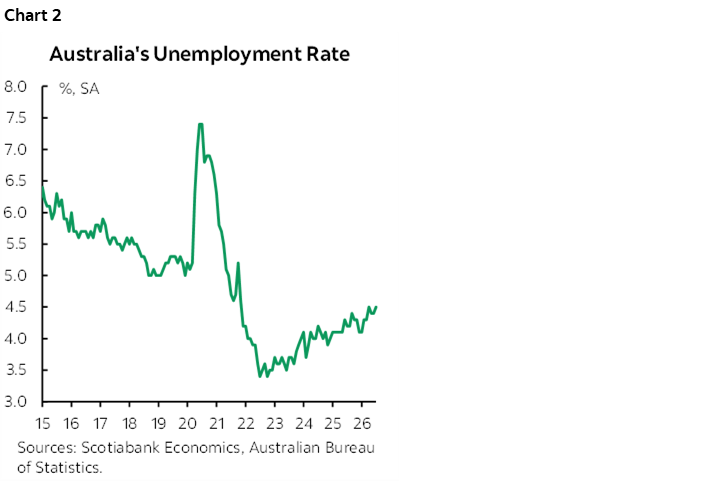
About 16k jobs were lost last month, but a) they were all part-time (-32k) as full-time jobs increased (16k), and b) the dip followed a massive 80k rise in June that followed a modest 4k upward revision. The unemployment rate ticked up to 4.5% even though the participation rate fell a tick to 66.9%. Chart 2 shows the continued rise of the UR.
RIKSBANK HELD, GUIDANCE STILL POINTS TO YEAR-END HIKE
Sweden’s Riksbank held its policy rate unchanged at 1.75% as widely expected. Its guidance tamped down pricing for a move in the near-term but continues to support pricing for a 25bps hike by year-end. Key is that they retained reference to “the probability of a rate increase later this year remains” and flagged that inflation has been stronger than anticipated over the summer while warning that if energy prices spill into broader inflation, then they would have to tighten. Overall, however, markets took it as a little less convincing by pushing the two-year yield down 3bps while the krona underperformed.
N.A. CALENDAR
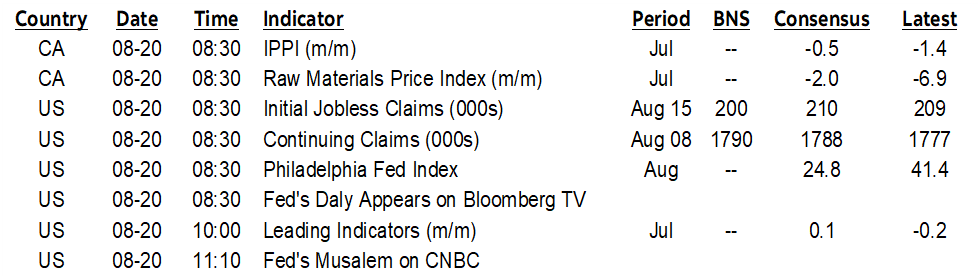
There is very little on tap into the N.A. session. Canadian producer prices in July saw headline industrial prices edge up 0.6% m/m but prices ex-energy slipped –0.2% m/m NSA which is common for July with the broad trend in y/y industrial prices ex-energy (+8.8% y/y) still pointing to pass through into core CPI ex-food and energy (chart 3).
US weekly initial jobless claims remain low at 206k with continuing claims continued to stabilize since April.
There will also be a bit of Fed-speak with San Fran’s Daly (8:30amET) and St. Louis President Musalem (11:10amET) due to speak. This follows the uneventful FOMC minutes that drove a very slight front-end Treasury rally yesterday.
UPDATED CANADIAN RATES OUTLOOK
Where do trade developments potentially leave us from a rates perspective? With greater conviction on longstanding forecasts.
Chart 4 shows our current house view that was submitted yesterday in fresh polls. There are relatively minor tweaks that are mostly about a little near-term marked to market changes compared to prior forecasts, but the broad strokes of our house rates views remain intact.
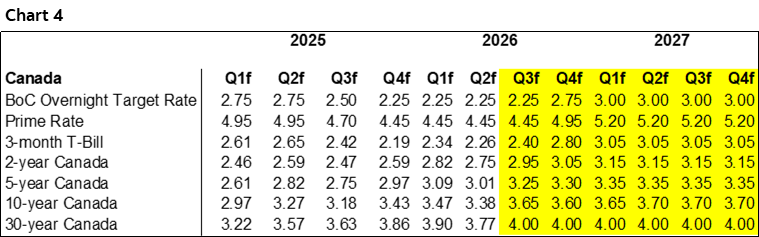
We’ve had BoC rate hikes in our 2026 forecast since last November—well ahead of consensus and markets and well ahead of the Iran war and commodities surge and partly conditioned upon viewing last fall’s insurance BoC cuts that went below a Taylor Rule approach as unsustainable. Chart 5 shows our forecast along with what markets were pricing last November when we first forecast hikes plus what markets are now pricing along with consensus. In turn, we’ve had constructive views toward an improving outlook that we’re now seeing and cautious optimism on how trade policy could evolve that we’re also seeing.
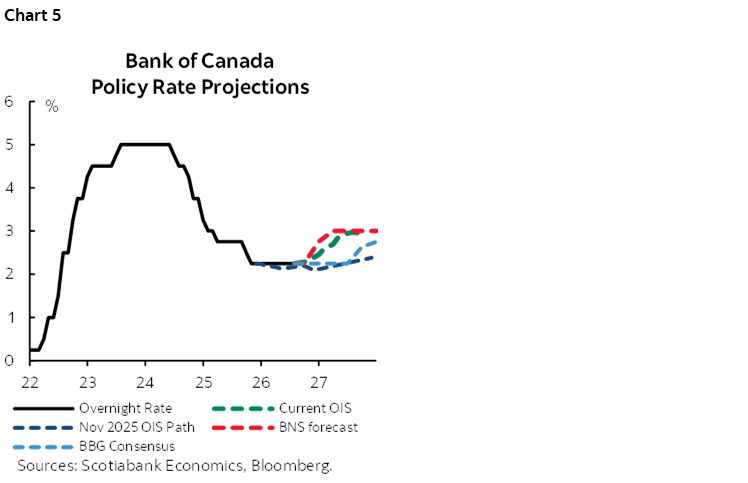
I would suggest keeping a very open mind toward October and December BoC OIS that will be further informed by developments over the next eight days. If we do indeed get a decent trade and security deal by the weekend and then we get 4% Q2 GDP next Friday, with another Budget waiting in the wings, ongoing elevated commodities, ripping jobs etc, then there is a decent case for wiping the insurance cuts from a year ago off the map. Stay tuned.
There remains high uncertainty on timing action by the BoC as well as magnitudes which continues to support multiple scenarios and probabilities. I still think our forecast is relatively modest in expecting 75bps of hikes into early next year as it would still leave the policy rate in neutral territory at 3% despite an alternative scenario that it could well move into restrictive territory. The cut bias that many other shops had over the year is clearly gone.
SPIT BALLING NEW EFFECTIVE TARIFF RATES
Going by unconfirmed media reports that indicate sharp reductions in tariff rates on autos and metals, what would this do to the overall tariff burden facing Canada?
Reports indicate that the metals tariffs will be dropped from 50% to 25% but with little clarity around the exact products. Reports also indicate that the sticker tariff on autos will drop from 25% to 15%. The effective tariff applied to autos then becomes the sticker rate times one minus the share of autos exports that are exempt which depends upon whether we’re talking parts or assembled autos. If assembled auto content from the US continues to be exempt and any auto parts export content that comes from Canada, the US or Mexico remains exempt, then the tariff on autos overall would drop sharply. One reason for this is that parts matter more to Canada than assembled autos by accounting for around two-thirds of Canadian autos exports. Canadian auto parts companies are among the world’s biggest players.
Enter charts 6 and 7 that show the calculations for Canadian goods exports to the US and separately for Canadian goods exports to the world. Note that services are excluded because they are not what is being targeted. They are tentative to help inform the dialogue until we get all the facts. For instance, we’ve heard no word on lumber’s treatment.
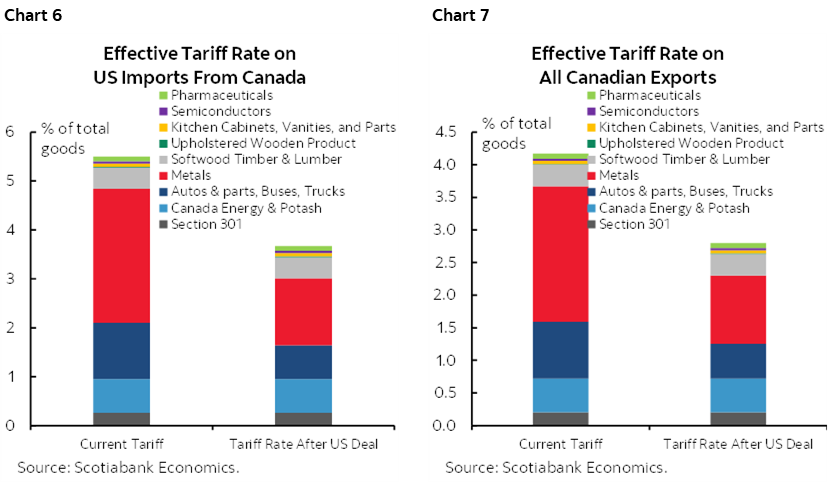
The overall US tariff rate on Canadian exports would be 3.7% instead of 5.5% going into the talks. The total rate on all Canadian exports to everywhere would drop from 4.2% to 2.8%.
These are rounding errors. Flesh wounds. They’re not 1% like they were before all of this zero-sum, mischievous, beggar-thy-neighbour nonsense began with the US launching its trade wars, but at such low rates and with nothing applied to the vast majority of sectors, the result is next to nothing by way of an incremental overall tariff burden. That would be very positive for Canada.
It’s a green light for growth.
Furthermore, these rates are vastly lower than what the US is applying against anyone else's exports to the US. Consider this alongside all of the other arguments like the US income/growth elasticity effect on Canadian imports, CAD depreciation, high commodities, Canadian fiscal policy contributing more to growth, and longstanding evidence that exports and FDI have been diversifying away from the US for many years into other parts of the world.
The picture that is emerging is that Trump apparently does indeed love Canada—he just has to belittle everyone to make all of this look like a pathetic victory or some sort like Trump 1.0 that left the original NAFTA agreement almost entirely intact. Despite the endless insults and threats and name calling, what we're landing on remains a tightly integrated relationship between the US and Canadian economies. US tariffs against everyone else are vastly higher so he's basically either a) solidifying NAFTA, and/or b) can't effectively drive much of a wedge against Canada for various reasons such as the pain that more belligerent outcomes would cause through US supply chains and because the US business lobby and polls are pushing back.
THE POSITIVES IN TRADE TALKS
As for residual pessimism that may be retained by some observers, I have all the time in the world for ongoing caution until we see an agreement finalized and passed which could take a while, but not for continued extreme negativity. The way both sides are talking makes it sound like this will be a fully new CUSMA framework alongside addressing security issues, rather than a few tariff tweaks.
After all, the US list of issues with Canada was never really all that comprehensive going back to last Fall’s USTR letter to Congress (here). It seemed back then to be mostly an irritants list with tariffs then applied on several sectors. They were never really after a wholesale rewriting of the agreement imo despite Trump’s rhetoric. Supply management, alcohol, digital taxes, procurement programs etc represented a fairly limited list. So, when I hear folks suggesting this is just an unwind of the irritants, well, that’s all this was ever really about on both sides!
For starters, it doesn’t look like CUSMA will be torn up as the most bearish camp was leaning toward. It also doesn’t look like nothing will be done only to stumble into annual reviews that would persist in a way that creates ongoing elevated uncertainty. Instead, it looks like a deal on trade, security and other matters is upon us but we need to see it. One key will be whether CUSMA is extended for another 16 years as per the agreement’s provision.
And so the positives when taken step-by-step are looking like they include a) no torn up agreement, b) no additional US tariffs, c) no additional Canadian retaliation, d) the very real possibility that a renewed trade deal will be passed, e) progress on specific sectoral issues on both sides, f) progress on other specific irritants like digital issues, g) a reduction of US tariffs, h) a reduction of Canadian counter-measures that were put in place as a response to US belligerence, and i) a large reduction of uncertainty.
It sounds like the deal won’t be perfect since there is no justification for any tariff measures against Canada, but overall, it may be as close to perfect as possible when dealing with this US administration.
Importantly, however, it may not prevent the volatile US President from coming back with future mischief. His polling, the likelihood that the new Congress will be very different in composition, and the US courts and business lobby could serve as checks on his tendencies.
IS 72 HOURS TOO QUICK FOR A DEAL?
If we follow this same timeline as during NAFTA 2.0 in Trump 1.0, then be patient on the path toward implementation. That said, I’ll offer suggestions on how this time could proceed more quickly.
Here’s the timeline of trade negotiations the last time we went through all of this.
- the process started in August 2017
- the US and Mexico agreed to a deal in August 2018
- Canada joined with agreement the next month
- It took until October 2018 to achieve an overall formal agreement
- Signed the next month by all three leaders
- A consultation period followed
- Mexico ratified it in June 2019.
- Changes were incorporated by December 2019
- The US Senate approved it on Jan 16th 2020.
- Trump signed it into law on Jan 29th 2020.
- Canada then ratified it in its parliament on March 13th 2020 at which point all countries had passed it.
- CUSMA/USMCA then came into effect on Canada Day 2020.
What is different this time, however, is that the Trump and the GOP are deeply down in the polls amid the serious risk of losing one or both chambers on November 7th and hence Congress could change in January. That could expedite timelines particularly since the Dems are no friends of Canada or Mexico especially on the far left. It’s still a stretch to get a deal completely finalized and quickly approved, but not necessarily to get it all done within the current US Congress.
Another point that leans against the lengthy timeline the last time around is that the issues have already been under negotiation for around a year if not longer which is comparable to the last time. They reportedly were close to a deal last Fall before events drove Trump away.
Still, I find it highly ambitious to say that we'll have an agreement with details by Friday night as the Canadian side is saying. The US has said it wants to maintain CUSMA/USMCA—as per the overwhelming feedback it got from the US business lobby last fall—but with side agreements to address separate issues with Mexico and Canada so maybe this is the Canadian part while Mexico has been negotiating separately into its next round with the US next month.
And recall that during Trump 1.0 with USMCA, Mexico agreed first and then Canada joined and then a full agreement with all three was merged. Perhaps that’s reversed this time with Canada striking first.
WHY IS TRUMP TALKING PIPELINES?
Shifting gears, there was another solid upside surprise in yesterday’s US crude inventories after last week's surprise rise. The driver was higher imports namely swiped from Venezuela and in second place is Canada.
That’s why Trump supports Keystone XL, even though it’s no longer about that name. Ergo, 'sorry about all that tariff misunderstanding, do you think you could lend us some oil please Mr. PRIME MINISTER Carney? Pretty please?'
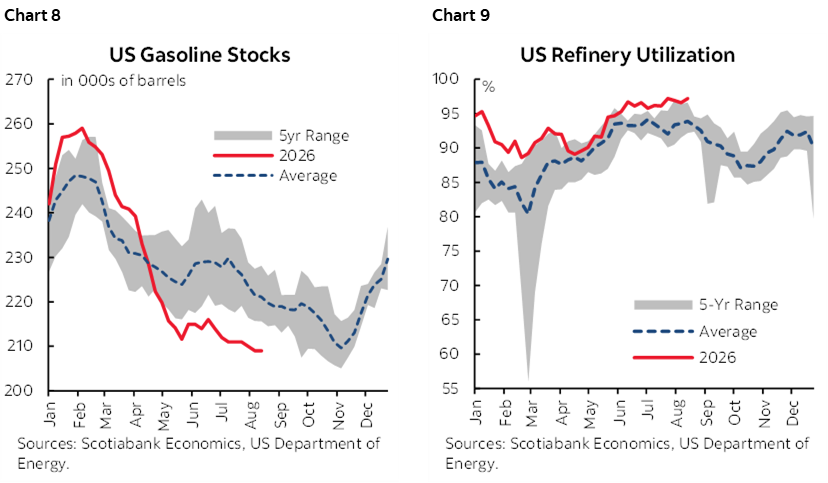
There is no relief in sight for US gas prices though (charts 8, 9).
PIPELINE MATH
Canada appears to face a potential embarrassment of pipeline riches of late. Between the west coast pipeline proposal and possibly resurrecting US approvals for another pipeline, the question becomes how to fill them. Where are you getting all that oil? What happens if you don’t get it?
First, as an aside, when he speaks of Keystone XL, it's likely that Trump is mixed up with that project that Biden killed versus the Prairie Connector on the Canadian side and the other pipelines that would be necessary on the US side along a different route than K-Xl. Backgrounders are here, here, and here.
In terms of the math, Alberta presently ships out egress of about 5 million bpd of oil in total. The Prairie Connector pipeline to the US border—partly built and fully permitted on the Canadian side but not the US side—would carry about 1/2 million bpd to the US. The west coast pipeline proposal would carry about 1 million bpd out through the BC coast presumably to Asia. To carry an extra 1½ million bpd to the US and Asia would require—all else equal—about a 30% boost in oil output from Alberta, both conventional and heavy.
How are you going to produce that much more oil to fill both pipelines and capture all the C02 at the same time in order to tick that environmental box with the Carney administration that seeks to bury the gas?
Which presents an interesting pipeline dilemma for Canada. Do you keep going ahead with a possible pipeline to the west coast in order to take oil to Asia? Or the Prairie Connector connections in the US? Or both? Can Canada produce enough oil to do both? Is it in Canada's best interests to increase connections to an increasingly unstable US, or to diversify? Is it in Canada's interest from a unity standpoint to allow greater connections between Alberta and the US, or Alberta having to work with BC to get oil to the west coast and out?
Maybe you build both from a project optionality standpoint, because the next time you get such a chance may either be, umm, never, or years/decades from now. Ramping up enough output could be a big challenge unless something else changes, like PM Carney bails on carbon capture and perhaps heeds warnings from Norway.
The caution is that since Canada is a place with an often unflattering history of white elephants, half-utilized pipelines could be a political albatross for years and multiple administrations. Maybe there’s a plan for that too.
THE ISSUES ON DAIRY SUPPLY MANAGEMENT
A notable area of uncertainty involves trying to square the circle between what Trump says about US farmers now facing now tariffs into Canada with the agreement that is in the works, versus guidance from the Canadian side that supply management remains fully intact.
Charts 10–13 show how Canada implements its quota and tariff system on dairy products imported from the US and the portion of the quotas used by US dairy exporters. US exporters always paid no tariffs up to the limit of the quotas after which the tariffs become punishing. US producers generally don’t come close to the upper limit of these quotas and so they don’t pay the tariffs. And the US has the same system which Trump agreed to in the Trump 1.0 CUSMA/USMCA deal.
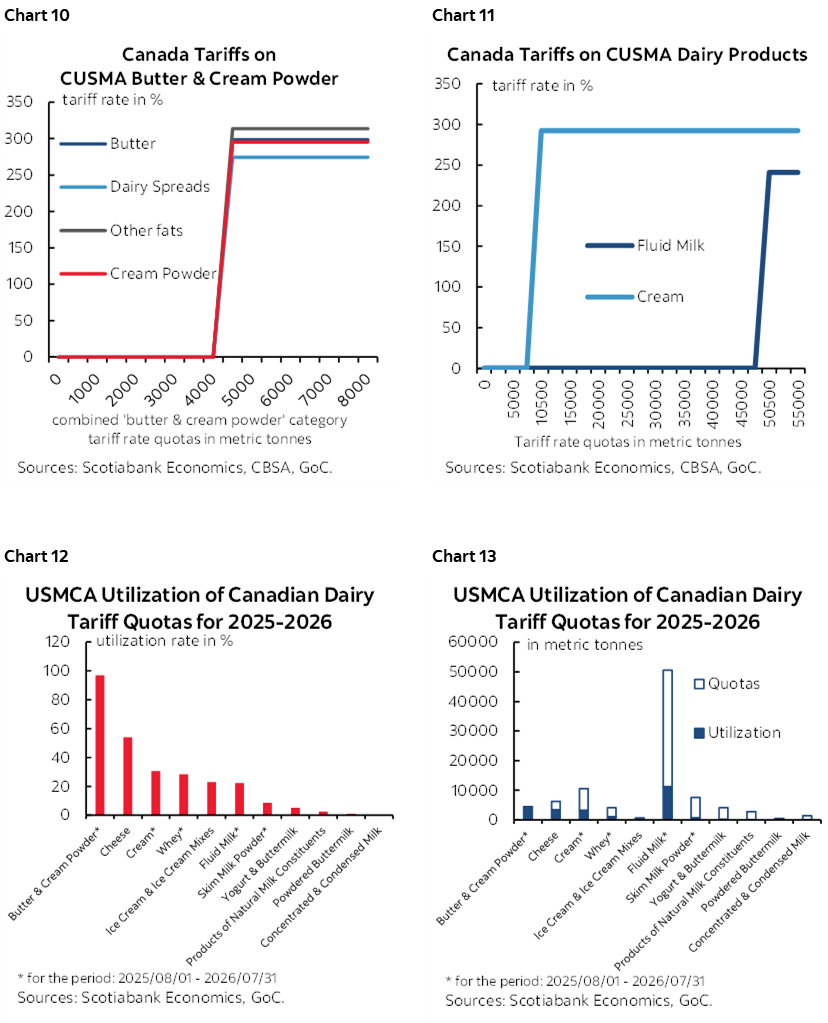
The US grievance, however, is about how Canada effectively allocates those quotas, not to retail, but to other parts of the supply chain. ie: can't buy American milk at your local grocery store.
Consumers clearly pay higher prices as a cost to supply management in both countries. It’s unclear how it may change. When Trump says tariffs are gone could that mean higher quotas beyond which tariffs are binding? Could it mean fundamentally addressing concerns about how Canada manages the quotas in order to effectively enable US producers to export more dairy and put it on retail shelves? We don’t know at this point.
Ultimately Canada can't really do a whole lot to do the right thing in terms of economics on dairy supply management because of the industry and regional politics. The PQ will very likely run away with the Quebec election on October 5th (here). They claim they won't hold a referendum on separating as long as Trump is in office, although it’s more likely that they won’t do this because about 70% of Quebeckers don’t support separation (here); they’re older, less rebellious, more invested, and recall the cost that the 1980 and 1995 referendums exacted. Yet the PQ draws support particularly from rural Quebec where dairy is. You don't really want to provoke that apple cart.
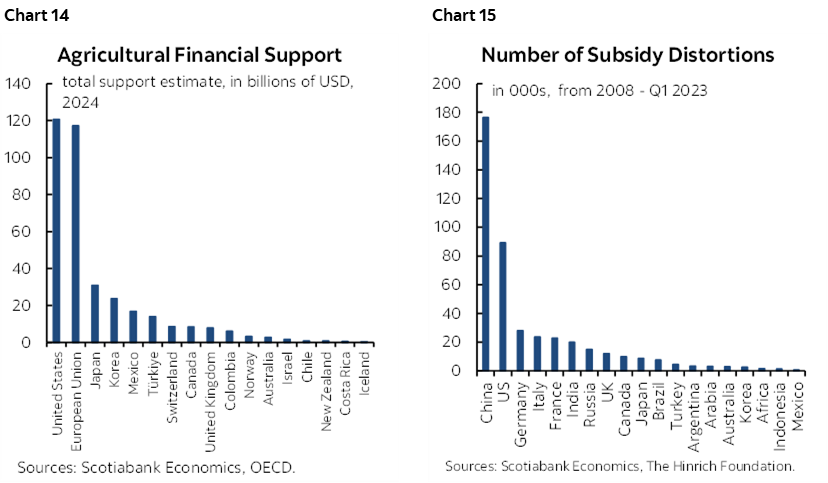
My nirvana is a global agreement on ag trade that tears down all barriers but that will never happen. The US has the biggest ag subsidies anywhere, even slightly outranking the European CAP program (chart 14). The US Farm Bill rips off consumers and taxpayers to benefit mainly corporate farms that are unlike the mom and pop farms of the dirty '30s. Rich world subsidies and supports retard growth in developing countries. Consumers in rich countries also pay the price. The US and China maintain the greatest prevalence of subsidy programs overall across all sectors of their economies of any country in the world, highlighting how ‘rich’ it is to claim that others cheat (chart 15).
BESSENT IS DOING WHAT YELLEN DID
The US long end is shaking off yesterday’s Treasury announcement on buybacks. The funny thing is that he’s basically doing what former Treasury Secretary Yellen did in 2024 when Bessent alleged that Yellen was manipulating Treasury debt management to benefit Biden’s 2024 bid. Does that mean yesterday’s action was done to benefit the GOP into the midterm elections? If so, then political interference in the Treasury market may be a constant across administrations.
Also note that following Trump’s social media post about additional sanctions against Iran (here). There has as yet been no formal announcement from Treasury on the measures as follow-up to Bessent’s warnings about pending actions last week. See my weekly for thoughts on what the actions could include and concerns about their potential blowback.
DISCLAIMER
This report has been prepared by Scotiabank Economics as a resource for the clients of Scotiabank. Opinions, estimates and projections contained herein are our own as of the date hereof and are subject to change without notice. The information and opinions contained herein have been compiled or arrived at from sources believed reliable but no representation or warranty, express or implied, is made as to their accuracy or completeness. Neither Scotiabank nor any of its officers, directors, partners, employees or affiliates accepts any liability whatsoever for any direct or consequential loss arising from any use of this report or its contents.
These reports are provided to you for informational purposes only. This report is not, and is not constructed as, an offer to sell or solicitation of any offer to buy any financial instrument, nor shall this report be construed as an opinion as to whether you should enter into any swap or trading strategy involving a swap or any other transaction. The information contained in this report is not intended to be, and does not constitute, a recommendation of a swap or trading strategy involving a swap within the meaning of U.S. Commodity Futures Trading Commission Regulation 23.434 and Appendix A thereto. This material is not intended to be individually tailored to your needs or characteristics and should not be viewed as a “call to action” or suggestion that you enter into a swap or trading strategy involving a swap or any other transaction. Scotiabank may engage in transactions in a manner inconsistent with the views discussed this report and may have positions, or be in the process of acquiring or disposing of positions, referred to in this report.
Scotiabank, its affiliates and any of their respective officers, directors and employees may from time to time take positions in currencies, act as managers, co-managers or underwriters of a public offering or act as principals or agents, deal in, own or act as market makers or advisors, brokers or commercial and/or investment bankers in relation to securities or related derivatives. As a result of these actions, Scotiabank may receive remuneration. All Scotiabank products and services are subject to the terms of applicable agreements and local regulations. Officers, directors and employees of Scotiabank and its affiliates may serve as directors of corporations.
Any securities discussed in this report may not be suitable for all investors. Scotiabank recommends that investors independently evaluate any issuer and security discussed in this report, and consult with any advisors they deem necessary prior to making any investment.
This report and all information, opinions and conclusions contained in it are protected by copyright. This information may not be reproduced without the prior express written consent of Scotiabank.
™ Trademark of The Bank of Nova Scotia. Used under license, where applicable.
Scotiabank, together with “Global Banking and Markets”, is a marketing name for the global corporate and investment banking and capital markets businesses of The Bank of Nova Scotia and certain of its affiliates in the countries where they operate, including; Scotiabank Europe plc; Scotiabank (Ireland) Designated Activity Company; Scotiabank Inverlat S.A., Institución de Banca Múltiple, Grupo Financiero Scotiabank Inverlat, Scotia Inverlat Casa de Bolsa, S.A. de C.V., Grupo Financiero Scotiabank Inverlat, Scotia Inverlat Derivados S.A. de C.V. – all members of the Scotiabank group and authorized users of the Scotiabank mark. The Bank of Nova Scotia is incorporated in Canada with limited liability and is authorised and regulated by the Office of the Superintendent of Financial Institutions Canada. The Bank of Nova Scotia is authorized by the UK Prudential Regulation Authority and is subject to regulation by the UK Financial Conduct Authority and limited regulation by the UK Prudential Regulation Authority. Details about the extent of The Bank of Nova Scotia's regulation by the UK Prudential Regulation Authority are available from us on request. Scotiabank Europe plc is authorized by the UK Prudential Regulation Authority and regulated by the UK Financial Conduct Authority and the UK Prudential Regulation Authority.
Scotiabank Inverlat, S.A., Scotia Inverlat Casa de Bolsa, S.A. de C.V, Grupo Financiero Scotiabank Inverlat, and Scotia Inverlat Derivados, S.A. de C.V., are each authorized and regulated by the Mexican financial authorities.
Not all products and services are offered in all jurisdictions. Services described are available in jurisdictions where permitted by law.