

ON DECK FOR WEDNESDAY, AUGUST 19th

KEY POINTS:
- Canadian markets say ‘show me details’ on a possible trade deal
- CAD’s small rally reflects guarded optimism…
- …toward prospects of a meaningful Canada-US deal…
- …sans anything whatsoever to go by so far
- A Canada-US deal could be unambiguously positive for Canada…
- …including the economy, equities and CAD, but not bonds
- Keystone XL?? You’re kidding me
- FOMC minutes—hawkish tone but stale…
- ...with agreement on the key four questions but not on the answers
- Relatively benign UK CPI shaken off
- Australian wage growth remains above the RBA’s inflation target range
- BI held its policy rate
Global markets are largely rangebound across broad asset classes this morning. US Ts and gilts are slightly outperforming EGBs. Canadian government bonds …. Equities are little changed across a mix of slight ups and tiny downs for N.A. futures and European cash markets. The dollar is a touch softer this morning and with CAD a middle-of-the-pack performer. As argued below, Canadian markets will want details before hopping on the bandwagon. Instructive in that sense are Canada’s volatile experiences with Trump and the rest of the world’s mistrust toward the volatile Trump administration.
Positive Steps Toward a Canada-US Trade and Security Deal
Great, there’s a possible deal. What’s in the deal? Dunno. Do I trust there is a deal because Trump said so? Not really. Do markets trust there is a deal? Not so much, as CAD only appreciated by about a quarter cent since Trump’s social media post last night, CGBs are flat, and so are TSX futures. All he did was to go TACO and postpone the 50% tariffs for three days just 1¾ hours before they were to have been applied against $20 billion of imports from Canada sans CUSMA exemption. Canada’s retaliation is similarly postponed. That’s a positive for now, since otherwise everything would have skidded off into the ditch, but the rest is still uncertain.
What’s in the deal? Haven’t a clue. Is it good for both Canada and the US? Dunno. Trump’s post merely says the two countries have a deal while intimating that the Keystone XL pipeline is back on. We’ll see about that, given a guarded industry toward the pipeline that has moved on given the wild unpredictability of successive US administrations, the long project timelines and the varied competing interests.
We also have this post from the USTR that claims “comprehensive market access for all American goods, economic security commitments, digital trade alignment, and many important provisions that will continue to protect our market and American workers, along with our Canadian partners.” We’ll be the judge of that, not the White House.
Canadian PM Carney’s post was much more measured. It noted that “substantial progress has been made, although there is important work still to be done.” On that count, massive shout-outs to the Canadian team for working so tirelessly and on something so mindless as zero-sum beggar-thy-neighbour trade policies out of the US that divert precious management time by leaders and businesses away from more meaningful pursuits. You’ve served your country well so far.
And so we need details. What’s in the agreement, what are the enforcement mechanisms, what are the timelines for implementation, and of course, how exactly comprehensive is this? Is it a meaningfully comprehensive CUSMA extension, or just the opening salvo? How much did PM Carney give away from a salability standpoint at home? The provinces will need to be briefed and their reactions and cooperation will be important. And is Trump’s signature going to actually mean anything on this ‘deal’ given his pattern of not honouring much of what he commits to doing?
Throughout all of this I have stuck to a cautious optimist line that Canada would get a trade deal before the midterms or before the new US Congress convenes in January. The odds of this happening just went up. That has been part of a macro narrative for improved growth and modest tightening by the Bank of Canada as the case for last Fall’s insurance cuts to persist would be removed at a minimum. I hope that’s true, but I’ll jump on the ‘Let’s Make a Deal’ stage when I see something meaningful. Until then, post on to your heart’s content, we want details!!
If a deal that extends CUSMA and lowers uncertainty in a meaningful way were to be achieved, then it would be positive for Canadian economic growth and negligible for US growth. It would buoy market and business sentiment toward Canada. It could put at ease consumer worries.
And be wary toward the possible confirmation bias in gloomier quarters. I wouldn’t want talk to see some of the research gloomsters who were adopting a negative stance on trade and how damaging it could be to Canada’s economy and markets while making rate cuts more likely then turn around and say a deal doesn’t mean much. Nothing to see here. Don’t want to see it because it goes against all of their other views that deliberately excluded the cautious optimists. #accountability. The BoC wouldn’t dismiss a deal; amid multiple uncertainties, removing or materially dropping trade uncertainty would be another step toward modest tightening.
FOMC Minutes—Hawkish, but Stale and No Agreement on Answers to the Four Qs
Minutes to the July 28th–29th FOMC meeting will be released at 2pmET today. They may have a somewhat hawkish tone given three voting members (Logan, Kashkari, Hammack) wanted a hike at that meeting, although the majority clearly did not. Measures that gauge FOMC sentiment still remain in hawkish territory (chart 1). How many advocated a hike at a subsequent meeting such as September may be offered up.
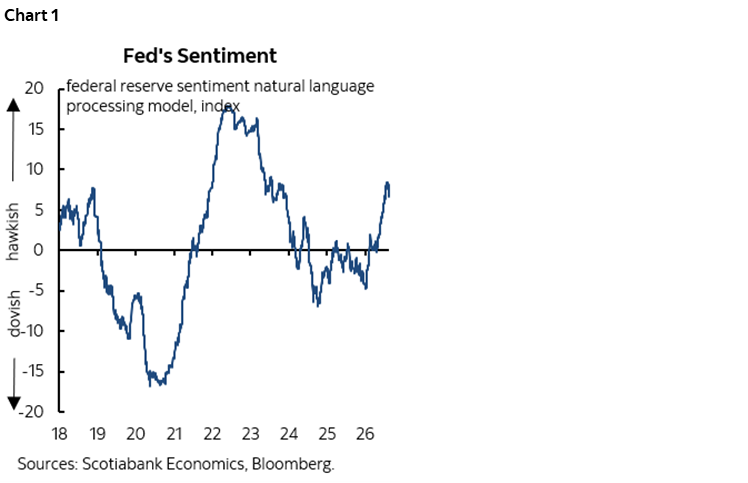
Yet the minutes will be stale on arrival given data released since the meeting. Nonfarm payrolls have been weak for the past three months including a revised 63k gain in May, then 20k in June, and then a -23k drop in July. Core CPI inflation has been on a three-month softening trend. Pricing for rate hikes by the Federal Reserve has followed our advice to receive a temporary overshoot of short-term market interest rates. July’s meeting had 8bps priced that vapourized after the hold. September’s meeting was priced for about 27bps of a hike and is now at just 8bps. October was at 35bps in late July and now sits at half of a quarter-point hike. Year-end pricing has been cut from 44bps to 22bps now.
More important may be the Committee’s discussions around the following four questions. Chair Warsh shared the questions during the July presser and said “there was a lot of agreement on the core questions. There was commonality on the questions but different leanings on the answers.” In other words, don’t look for much agreement across the Committee on the topics. Here they are:
1. What are the implications of the past five years of high inflation on the current policy conjuncture?
2. The economic shocks of recent years were considered including the pandemic, military conflict, energy shocks, AI surge and tariffs. Do they differ in their effects?
3. We took up the issue of changes in prices and whether they are generalized or narrow.
4. We focused upon monetary policy strategies to achieve price stability.
Global Macro Indicators
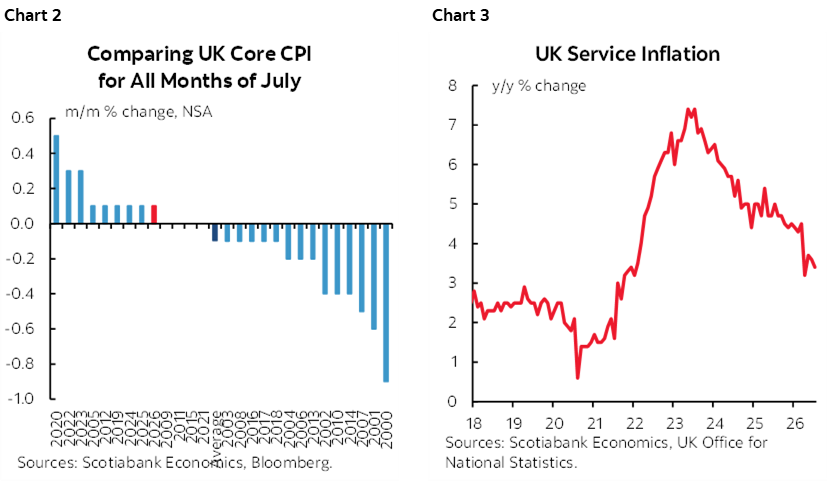
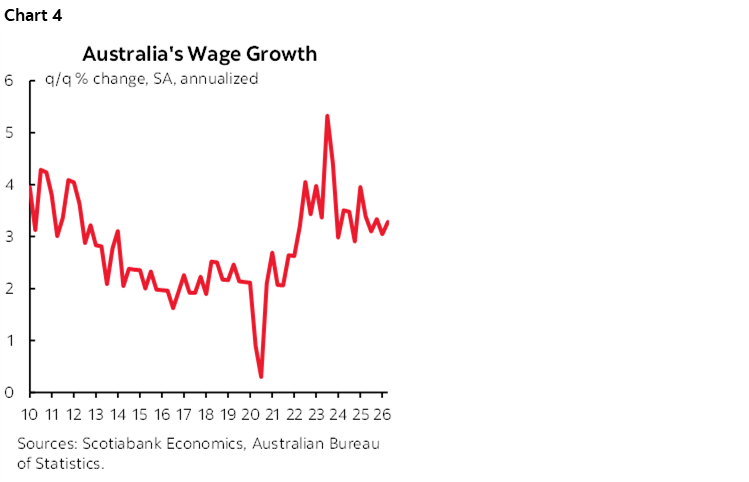
Relatively benign UK CPI inflation drove slight outperformance by the gilts curve relative to EGBs but largely in tandem to moves in US Ts. Core CPI was up by just 0.1% m/m seasonally unadjusted as per the convention. That’s not light by comparison to other like months of July in history (chart 2) but it doesn’t cry out for BoE intervention either. Total CPI was up 0.3% m/m NSA, matching consensus, with the y/y rate edging up to 2.9% (2.6% prior). Core’s year-over-year rate was steady at 2.6%. Services CPI also ebbed. Chart 3.
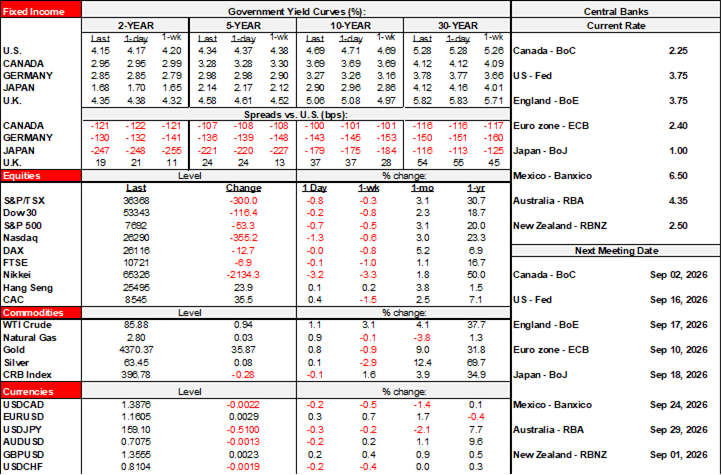
Australian wage growth was steady at 3.3% q/q SAAR in Q2 for a fifth straight quarter (chart 4). You could make an argument that this makes it slightly more difficult for the RBA to achieve its 2–3% inflation target range with wage growth facilitating a little more passthrough risk of cost pressures into core inflation. Markets, however, largely yawned it off as the A$ is only slightly underperforming other major crosses and the Aussie rates curve rallied mostly in sympathy to JGBs, Kiwis and other local curves. Australian markets may have ignored the numbers because the RBA had said they expected “slightly stronger” wage growth in the near-term.
Indonesia’s central bank left its reference rate unchanged at 5.75% as widely expected.
DISCLAIMER
This report has been prepared by Scotiabank Economics as a resource for the clients of Scotiabank. Opinions, estimates and projections contained herein are our own as of the date hereof and are subject to change without notice. The information and opinions contained herein have been compiled or arrived at from sources believed reliable but no representation or warranty, express or implied, is made as to their accuracy or completeness. Neither Scotiabank nor any of its officers, directors, partners, employees or affiliates accepts any liability whatsoever for any direct or consequential loss arising from any use of this report or its contents.
These reports are provided to you for informational purposes only. This report is not, and is not constructed as, an offer to sell or solicitation of any offer to buy any financial instrument, nor shall this report be construed as an opinion as to whether you should enter into any swap or trading strategy involving a swap or any other transaction. The information contained in this report is not intended to be, and does not constitute, a recommendation of a swap or trading strategy involving a swap within the meaning of U.S. Commodity Futures Trading Commission Regulation 23.434 and Appendix A thereto. This material is not intended to be individually tailored to your needs or characteristics and should not be viewed as a “call to action” or suggestion that you enter into a swap or trading strategy involving a swap or any other transaction. Scotiabank may engage in transactions in a manner inconsistent with the views discussed this report and may have positions, or be in the process of acquiring or disposing of positions, referred to in this report.
Scotiabank, its affiliates and any of their respective officers, directors and employees may from time to time take positions in currencies, act as managers, co-managers or underwriters of a public offering or act as principals or agents, deal in, own or act as market makers or advisors, brokers or commercial and/or investment bankers in relation to securities or related derivatives. As a result of these actions, Scotiabank may receive remuneration. All Scotiabank products and services are subject to the terms of applicable agreements and local regulations. Officers, directors and employees of Scotiabank and its affiliates may serve as directors of corporations.
Any securities discussed in this report may not be suitable for all investors. Scotiabank recommends that investors independently evaluate any issuer and security discussed in this report, and consult with any advisors they deem necessary prior to making any investment.
This report and all information, opinions and conclusions contained in it are protected by copyright. This information may not be reproduced without the prior express written consent of Scotiabank.
™ Trademark of The Bank of Nova Scotia. Used under license, where applicable.
Scotiabank, together with “Global Banking and Markets”, is a marketing name for the global corporate and investment banking and capital markets businesses of The Bank of Nova Scotia and certain of its affiliates in the countries where they operate, including; Scotiabank Europe plc; Scotiabank (Ireland) Designated Activity Company; Scotiabank Inverlat S.A., Institución de Banca Múltiple, Grupo Financiero Scotiabank Inverlat, Scotia Inverlat Casa de Bolsa, S.A. de C.V., Grupo Financiero Scotiabank Inverlat, Scotia Inverlat Derivados S.A. de C.V. – all members of the Scotiabank group and authorized users of the Scotiabank mark. The Bank of Nova Scotia is incorporated in Canada with limited liability and is authorised and regulated by the Office of the Superintendent of Financial Institutions Canada. The Bank of Nova Scotia is authorized by the UK Prudential Regulation Authority and is subject to regulation by the UK Financial Conduct Authority and limited regulation by the UK Prudential Regulation Authority. Details about the extent of The Bank of Nova Scotia's regulation by the UK Prudential Regulation Authority are available from us on request. Scotiabank Europe plc is authorized by the UK Prudential Regulation Authority and regulated by the UK Financial Conduct Authority and the UK Prudential Regulation Authority.
Scotiabank Inverlat, S.A., Scotia Inverlat Casa de Bolsa, S.A. de C.V, Grupo Financiero Scotiabank Inverlat, and Scotia Inverlat Derivados, S.A. de C.V., are each authorized and regulated by the Mexican financial authorities.
Not all products and services are offered in all jurisdictions. Services described are available in jurisdictions where permitted by law.