

ON DECK FOR MONDAY, AUGUST 17th
KEY POINTS:
- US Ts continue to richen
- Canada’s CPI update probably won’t matter one bit
- Crunch time for Canada-US negotiations
- JGBs ignored soft GDP, were driven by BoJ spec instead
- China’s economy did a belly flop
- Global Week Ahead—Never Been Seen (reminder link here)
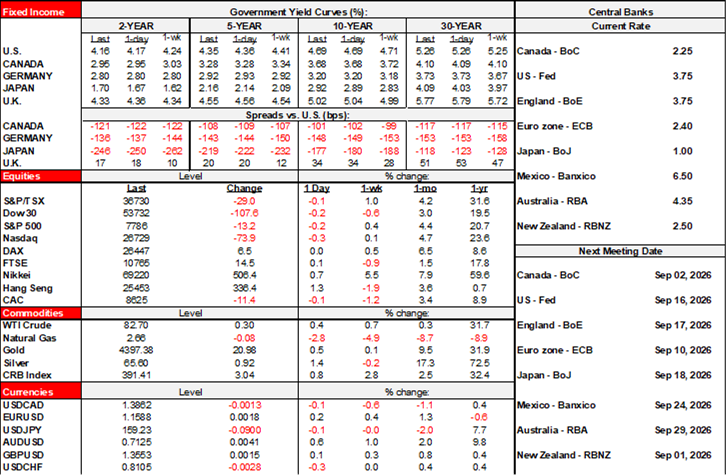
Another day, another dip in US yields, this time a minor 1–2bps rally at the front-end. See my weekly for views on why I think US Ts are still cheap. Sovereign bonds are slightly richening across Europe as well, while Canada’s may be influenced by CPI on tap. JGBs cheapened on BoJ speculation despite soft data (see below) and dragged Antipodean yields a little higher with them. The dollar is broadly softer against all major crosses, but not by much. Equities are somewhat mixed with US futures up and led by the Nasdaq’s half-point gain. TSX futures are flat. European cash markets are little changed.
CANADIAN INFLATION WON’T MATTER WHATEVER HAPPENS
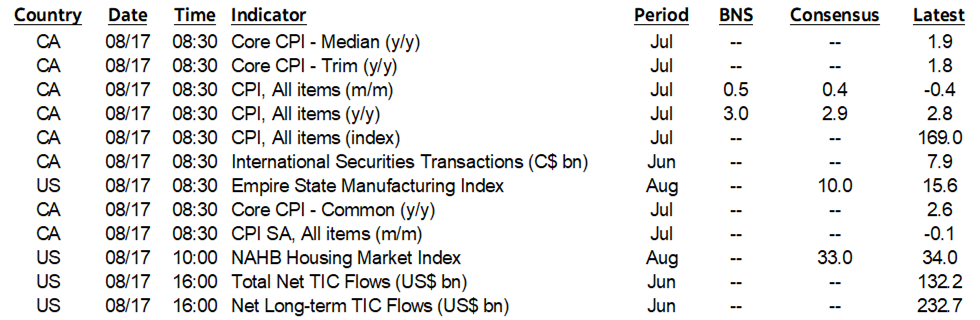
Canada updates CPI inflation for July this morning (8:30amET). A preview is in my weekly, so I’ll be brief here. This is the last inflation report before the September 2nd BoC meeting that everyone expects to be a hold. There is a high bar for CPI to matter one iota in the near-term context of trade negotiations which also depends upon whether and how Canada retaliates should negotiations fail.
Consensus is clustered around estimates of 0.4% and 0.5% m/m in seasonally unadjusted terms as per the polling convention with Scotia at 0.5%. That would mean a year-over-year rate of 2.9% or 3.0% (Scotia), up from 2.8% previously. In seasonally adjusted terms CPI could be about 0.3% m/m SA.
The measures that matter most are the core inflation gauges. Traditional core CPI ex-food and energy has been hot of late, posting gains of 3.1% and 3.9% m/m SAAR in May and June respectively. I wouldn’t be surprised if that measure took a breather and have estimated a material softening.
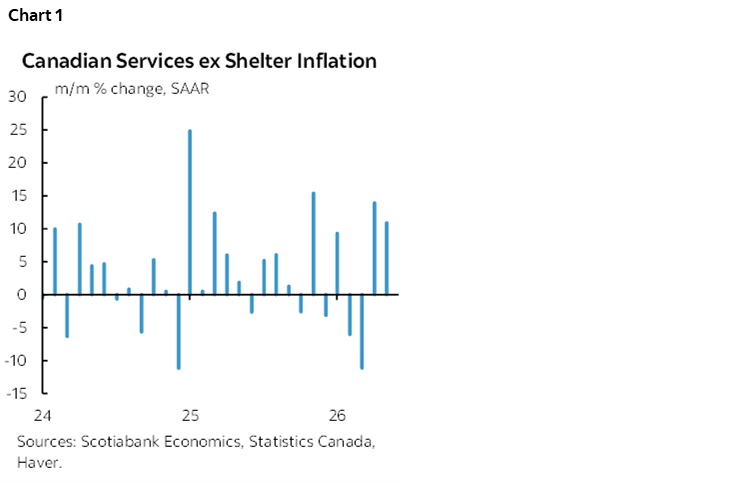
By contrast, the trimmed mean and weighted median CPI measures have been volatile as both March and April saw them accelerate out of a soft patch only to stumble again in May and June when they averaged 1.6% and 1.7% m/m SAAR respectively. Nobody can credibly estimate m/m SAAR TM and WM inflation given the extreme sensitivity to a tonne of unobservable prices and so my usual advice is to wait for the clean-up. Core services could be key if they cool from the recently rapid pace of gains (chart 1).
CANADA-US TRADE NEGOTIATIONS
You can feel the anger in Canada toward the US administration as the final stage of negotiations to avert Trump’s latest tariff assault on Wednesday approaches. I fear how it could escalate in ways that the US administration does not understand if it goes ahead with added tariffs on Wednesday. The Carney administration would be under high political pressure to perhaps retaliate and/or walk away.
The anger is reflected in measures like this to remove US Ambassador Pete Hoekstra that has grown to over 200k signatures in a short period of time. Hoekstra was immensely disliked by the Dutch when he represented the US in that country and for doing things like attending a Nazi grave site and making up nonsense about Muslims in Holland that he had to retract. He is generally disliked in Canada for going out of his way to agitate and attack Canadians versus drawing upon the more typical diplomatic skills that would be more becoming of a diplomatic guest on Canada’s soil. Yet the media and sponsors keep giving him airtime. Canada cannot and should not seek to expel the ambassador as a) it can’t really without the US administration agreeing to recall him, and b) it could invite tit-for-tat retaliation and a much worse escalation of diplomatic frictions. Just ignore him as he holds no real power anyway. Give him no access.
You can unfortunately feel it in polls like this one in which 79% of Americans have a favourable view of Canada but only 45% of Canadians reciprocate. 79% of Americans say the US should treat Canada as a friend and ally and 59% of Americans oppose tariffs on Canada; the other 41% never took a course on basic economics. Of course, much of this isn’t a true reflection of what Canadians think of Americans in my view—at least not the more sensible ones—versus what they think of the US administration. Canadians and Americans have long been friends and allies.
Enter the crunch for negotiations, until the next crunch that is. Reports indicate they’ve made progress but not enough to date with major sticking points being how stupidly high the US still wishes to impose tariffs on autos and lumber so that Americans can pay more for housing and autos.
The US massively subsidizes its auto sector with inducements to locate production at plants across the Midwest and South and tilts the playing field unfairly even against the northern states. The US economy is generally a subsidy swamp as shown in multiple measures including ones I repeated in my weekly. The US proposal is to cut existing auto tariffs from 25% in half which Canada reportedly and rightly rejects.
The US is seeking adjustments to Canada’s dairy marketing supply management system. The US has basically the same system of tariffs and quotas that Trump approved in what he signed during Trump 1.0. Consumers would benefit from reductions on both sides. The US doesn’t quite get Canadian politics with dairy producers concentrated in Quebec and the province facing a general election in October that the separatist PQ is widely expected to win; or perhaps the US administration is deliberately seeking to destabilize Quebec and hence Canadian politics. If they win, they have pledged to hold a referendum on separation that most Quebeckers don’t support, but inflamed tensions in rural regions where the PQ draws support and dairy is concentrated could be impactful to such a vote.
The US wants Canadian provinces to end the ban on American booze, except for Alberta and Saskatchewan that have different ideas on what’s good for team Canada. Canada imposed the ban as a retaliatory measure against the trade war that the US administration started. Ontario—by far the biggest market—has indicated it will only end the ban if a good deal on autos, steel, forestry, agriculture and manufacturing is achieved. Perhaps everyone would be a little better off sans booze amid all the health warnings anyway.
The US imposes a 45% tariff on Canadian lumber. Americans can’t afford homes given the cost and mortgage rates. Some of Wednesday’s threatened tariffs would hit wood products from Canada harder and pad the pockets of US lumber companies facing less competition. Geniuses. Want to improve US housing affordability conditions? Get your fiscal house in order so bonds and hence mortgage rates calm down and cancel the blindingly ill-advised tariffs that Americans ultimately pay for in higher costs for housing. The Trump administration’s policies are maligned against housing affordability in the US.
There are many other issues on the table as well, ranging from steel and aluminum tariffs, access to critical minerals, defence and security arrangements etc. No single all-encompassing deal is expected or realistic, versus a first attempt at a framework to avoid Wednesday’s added US tariff of 50% on $20 billion of Canadian exports to the US that this time would not exempt CUSMA-compliant goods.
If the US goes ahead, then it would be material information to our forecasts because Canada would very likely retaliate and should, which would put trade negotiations on ice. This time mean it. Shout from the rooftops that the US administration can’t get along with anyone and Americans are paying the price.
OTHER DEVELOPMENTS
There were no new developments over the weekend regarding US Treasury Secretary Bessent’s threat of unprecedented actions against Iran. See my Friday morning note and Friday evening weekly for what I think he could do. Bloomberg published a similar article to mine on Saturday.
Japan’s economy disappointed as Q2 GDP grew less than expected and markets didn’t much care. Markets focused more upon speculation over the rate path that the BoJ may pursue. Takehiko Nakao—a former Finance minister in a long line of former finmins—said over the weekend that the BoJ should hike at every remaining meeting this year to close some of the rate differential with the Fed and hence stabilize the yen. JGBs cheapened by about 2bps at the front-end and 6–7bps toward the longer-end.
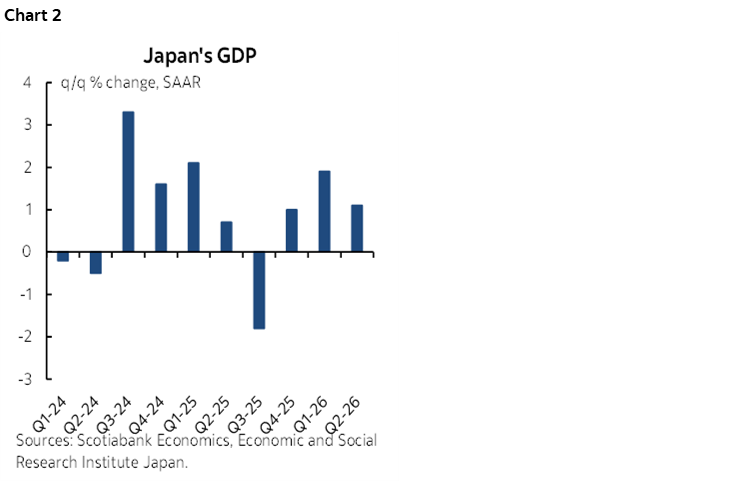
In any event, Japan’s Q2 growth landed at 1.1% q/q SAAR (2.0% consensus) with a minor upward revision to Q1 (1.9% instead of 1.8%). Chart 2. Consumer spending was flat (0.4% q/q SA nonannualized consensus). Business spending fell -1.2% q/q SA (+0.5% consensus). Net trade was a bit stronger at 0.5% q/q SA and inventories made a modest contribution of 0.3% q/q SA.
China’s economy also did a belly flop in July. Industrial output grew 4.5% y/y (5% consensus, 5.3% prior). Retail sales grew by 0.6% y/y (1.5% consensus, 1.0% prior). The unemployment rate ticked up to 5.2% (5.0% prior). Home prices continue to fall with new home prices down -0.2% m/m and resale down -0.3%. Property investment remains very weak (-19.2% ytd/ytd, -18% prior).
DISCLAIMER
This report has been prepared by Scotiabank Economics as a resource for the clients of Scotiabank. Opinions, estimates and projections contained herein are our own as of the date hereof and are subject to change without notice. The information and opinions contained herein have been compiled or arrived at from sources believed reliable but no representation or warranty, express or implied, is made as to their accuracy or completeness. Neither Scotiabank nor any of its officers, directors, partners, employees or affiliates accepts any liability whatsoever for any direct or consequential loss arising from any use of this report or its contents.
These reports are provided to you for informational purposes only. This report is not, and is not constructed as, an offer to sell or solicitation of any offer to buy any financial instrument, nor shall this report be construed as an opinion as to whether you should enter into any swap or trading strategy involving a swap or any other transaction. The information contained in this report is not intended to be, and does not constitute, a recommendation of a swap or trading strategy involving a swap within the meaning of U.S. Commodity Futures Trading Commission Regulation 23.434 and Appendix A thereto. This material is not intended to be individually tailored to your needs or characteristics and should not be viewed as a “call to action” or suggestion that you enter into a swap or trading strategy involving a swap or any other transaction. Scotiabank may engage in transactions in a manner inconsistent with the views discussed this report and may have positions, or be in the process of acquiring or disposing of positions, referred to in this report.
Scotiabank, its affiliates and any of their respective officers, directors and employees may from time to time take positions in currencies, act as managers, co-managers or underwriters of a public offering or act as principals or agents, deal in, own or act as market makers or advisors, brokers or commercial and/or investment bankers in relation to securities or related derivatives. As a result of these actions, Scotiabank may receive remuneration. All Scotiabank products and services are subject to the terms of applicable agreements and local regulations. Officers, directors and employees of Scotiabank and its affiliates may serve as directors of corporations.
Any securities discussed in this report may not be suitable for all investors. Scotiabank recommends that investors independently evaluate any issuer and security discussed in this report, and consult with any advisors they deem necessary prior to making any investment.
This report and all information, opinions and conclusions contained in it are protected by copyright. This information may not be reproduced without the prior express written consent of Scotiabank.
™ Trademark of The Bank of Nova Scotia. Used under license, where applicable.
Scotiabank, together with “Global Banking and Markets”, is a marketing name for the global corporate and investment banking and capital markets businesses of The Bank of Nova Scotia and certain of its affiliates in the countries where they operate, including; Scotiabank Europe plc; Scotiabank (Ireland) Designated Activity Company; Scotiabank Inverlat S.A., Institución de Banca Múltiple, Grupo Financiero Scotiabank Inverlat, Scotia Inverlat Casa de Bolsa, S.A. de C.V., Grupo Financiero Scotiabank Inverlat, Scotia Inverlat Derivados S.A. de C.V. – all members of the Scotiabank group and authorized users of the Scotiabank mark. The Bank of Nova Scotia is incorporated in Canada with limited liability and is authorised and regulated by the Office of the Superintendent of Financial Institutions Canada. The Bank of Nova Scotia is authorized by the UK Prudential Regulation Authority and is subject to regulation by the UK Financial Conduct Authority and limited regulation by the UK Prudential Regulation Authority. Details about the extent of The Bank of Nova Scotia's regulation by the UK Prudential Regulation Authority are available from us on request. Scotiabank Europe plc is authorized by the UK Prudential Regulation Authority and regulated by the UK Financial Conduct Authority and the UK Prudential Regulation Authority.
Scotiabank Inverlat, S.A., Scotia Inverlat Casa de Bolsa, S.A. de C.V, Grupo Financiero Scotiabank Inverlat, and Scotia Inverlat Derivados, S.A. de C.V., are each authorized and regulated by the Mexican financial authorities.
Not all products and services are offered in all jurisdictions. Services described are available in jurisdictions where permitted by law.