

ON DECK FOR TUESDAY, AUGUST 11th

KEY POINTS:
- Markets oscillate between hope and no hope in the Middle East
- Why believe Pakistan this time?
- RBA holds, provides mixed guidance
- US NFIB, ADP, home sales
Tit for tat—you owe us, no you do! That message from Trump in response to Iran’s demands for reparations payments about said it all in terms of what was driving this morning’s mid-August gyrations until Pakistan reeled in some gullible PMs. Oil prices were up by just over 2% earlier this morning and building on yesterday’s rise but have pulled back a bit because Pakistan—which relies upon net oil imports—got out the pom poms to somehow try to convince markets that ‘things are shaping up in favour of peace.’ Ummm….where?? Pakistan has serially misled markets on the prospects for peace and overplayed its hand as a mediator, perhaps seeking to repair its image after harbouring Bin Laden down the road from a large military base. ‘Managed Irresolution’, keep saying that ten times over and we’ll all get why this is dragging on.
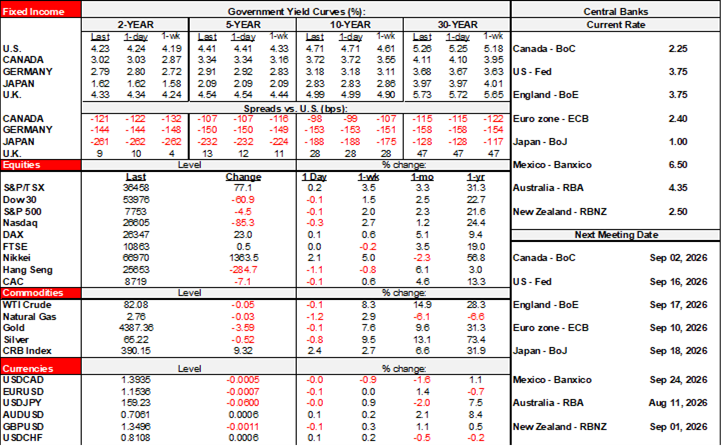
Bonds may be getting fooled by Pakistan’s guidance. They were showing signs of getting the memo with mild cheapening underway and led by a somewhat hawkish if albeit somewhat confused RBA (see below). At the point of publishing, yields have gone flat to a touch lower at the front-end across major markets. Stocks were flat to slightly cheaper, or about what one might expect with the scent of oil the only scent permissible under the junta that took over modern offices. Then Pakistan pushed them flat to higher. FX-land was liking the petro-currencies as you would expect, and the A$ post-RBA, then turned more mixed.
UNCERTAIN RBA MIXES ITS MESSAGES
The Reserve Bank of Australia held its cash rate target at 4.35% overnight which surprised…wait for it…absolutely no one! There was a mild surprise in the hawkish-sounding press conference that woke up traders Down Under from what was otherwise a dull affair.
First, the statement and forecasts (charts 1–3), and then the presser.
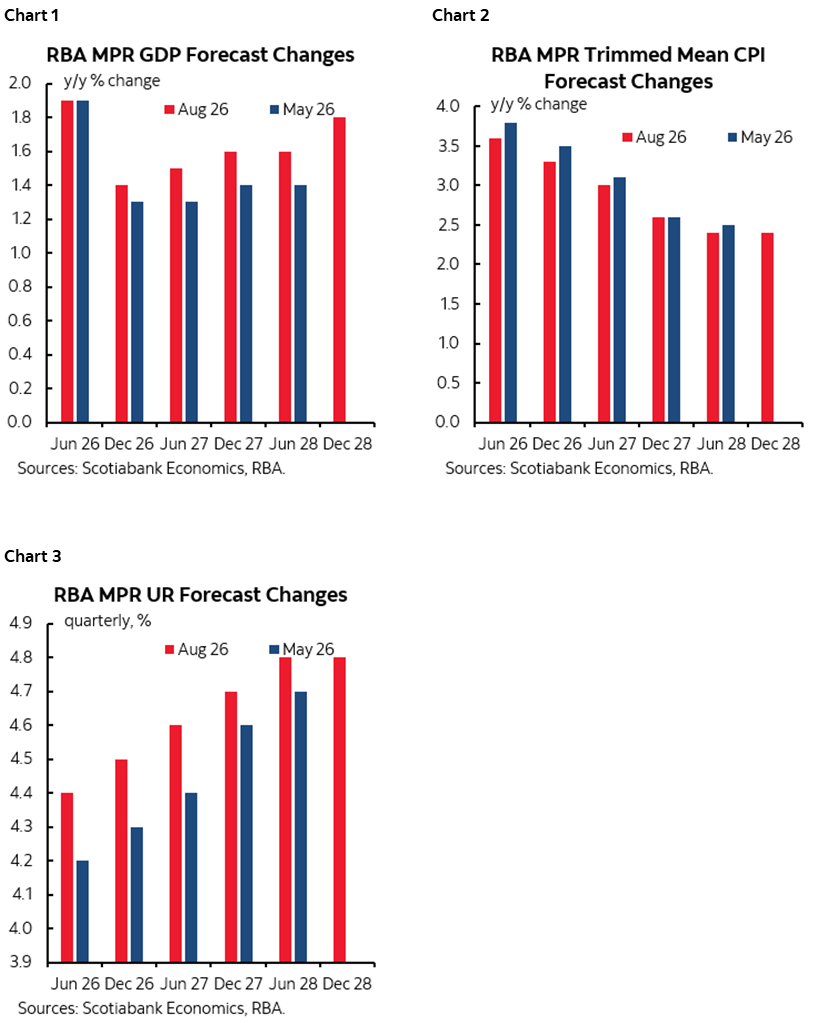
The unanimously supported statement changes reinforced concern that ‘headline inflation is still too high’ and added that ‘Trimmed mean inflation also remains elevated and is little changed from the March quarter.’ They flagged ‘signs’—reaching into fellow countryman Mel Gibson’s movie perhaps—that consumption is slowing but investment is strong and housing is cooling. They acknowledged that the job market has ‘eased by a little more than expected in recent months.’ Like every central bank they covered themselves by saying it’s uncertain how things will proceed in the Middle East—hint, not well—but that growth in its key trading partners (presumably meaning China, US) was stronger than expected in part due to AI investments.
On inflation, the statement continued to flag upside risks stemming from energy market developments. The output gap is still characterized by excess demand that is ‘a little smaller than anticipated in May’ when they last forecast. The statement warned that there are ‘indications that higher fuel prices are being passed through to other goods and services, so inflation is likely to remain high for some time.’ They were encouraged by signs of slowing growth ‘but inflation is still too high.’ Fresh forecasts showed that inflation is not expected to return to the middle of the 2–3% target range until the end of next year with upside risks.
Somehow, markets took the statement and forecasts as relatively dovish to market pricing, so Governor Bullock got out the hammer in the presser during which the 2-year Aussie yield reversed the decline and ended very slightly higher than just before all of the communications. Bullock said “we’ll go again if we need to” and “I think, personally, that it’s quite possible we might need to go, but we’ll wait and see.” Many folks have long pointed out that the RBA faces the same issue as the Fed among others by way of exceeding its inflation target for an extended multi-year period.
So, if there is continued progress on cooling the economy and the labour market continues to underwhelm relative to their expectations, then perhaps they’re done. If oil continues to rise or even stays firm and the odds of greater pass through into other prices intensify, then they’re not. They certainly don’t want markets pricing cuts from a modestly restrictive stance just yet, so there is an element of managed expectations.
Markets are pricing next to nothing for September’s meeting but then start to drift toward 15–20bps of a possible next hike from the November meeting onward.
US RELEASES—NFIB, HOME SALES, ADP WEEKLY
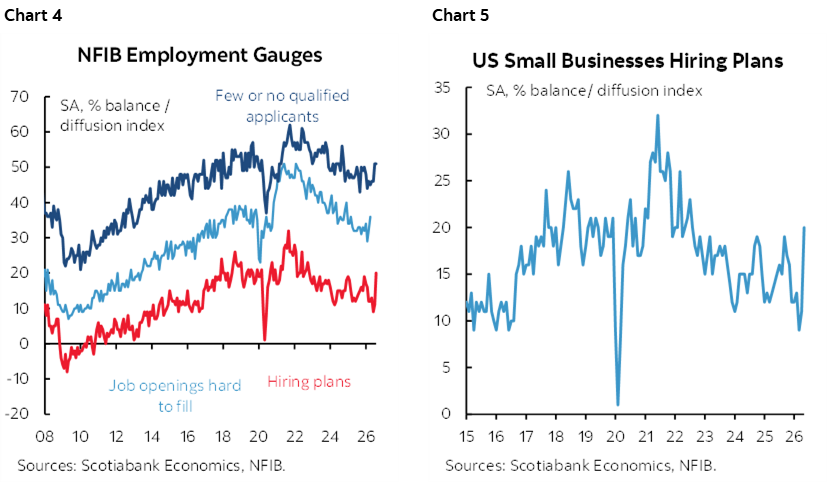
Despite nonfarm’s weak outcome for July, the NFIB’s small business survey registered a jump in jobs that are ‘hard to fill’ to the highest reading since June of last year. The survey also registered a jump in hiring plans to the highest reading since 2022. Apparently, it’s a case of actions versus words. Or it may be an indication of a willingness to hire but either tight immigration policy or skills mismatches or poor pay are holding back hiring. Charts 4 and 5.
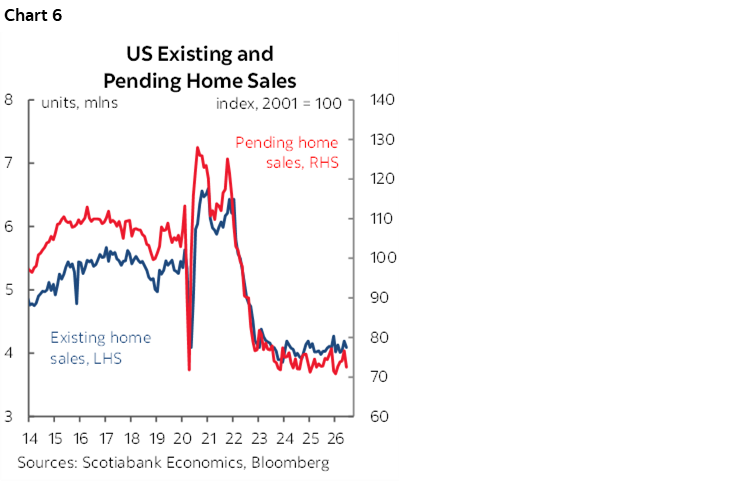
Existing home sales are expected to be little changed with slight downside when July’s numbers hit (10amET). Sales have been hugging bottom for years at the lowest range since the GFC (chart 6). First-time buyers are squeezed by the high (and rising) 30-year mortgage rate that in turn is fed by the rise of the 10-year Treasury yield before adding spreads. Trade-up buyers are increasingly disincentivized to give up locked in mortgages are pandemic lows when the 30-year mortgage rate was less than half what it is now. Tight immigration policy is killing off the prime driver of growth in the housing stock. A wavering job market and affordability pressures on real wages don’t help either.
ADP’s weekly measure of private payrolls is also on tap (8:15amET) but it’s unreliable as a predictor of the monthly ADP measure which in turn doesn’t tend to do well at lining up with private nonfarm payrolls.
DISCLAIMER
This report has been prepared by Scotiabank Economics as a resource for the clients of Scotiabank. Opinions, estimates and projections contained herein are our own as of the date hereof and are subject to change without notice. The information and opinions contained herein have been compiled or arrived at from sources believed reliable but no representation or warranty, express or implied, is made as to their accuracy or completeness. Neither Scotiabank nor any of its officers, directors, partners, employees or affiliates accepts any liability whatsoever for any direct or consequential loss arising from any use of this report or its contents.
These reports are provided to you for informational purposes only. This report is not, and is not constructed as, an offer to sell or solicitation of any offer to buy any financial instrument, nor shall this report be construed as an opinion as to whether you should enter into any swap or trading strategy involving a swap or any other transaction. The information contained in this report is not intended to be, and does not constitute, a recommendation of a swap or trading strategy involving a swap within the meaning of U.S. Commodity Futures Trading Commission Regulation 23.434 and Appendix A thereto. This material is not intended to be individually tailored to your needs or characteristics and should not be viewed as a “call to action” or suggestion that you enter into a swap or trading strategy involving a swap or any other transaction. Scotiabank may engage in transactions in a manner inconsistent with the views discussed this report and may have positions, or be in the process of acquiring or disposing of positions, referred to in this report.
Scotiabank, its affiliates and any of their respective officers, directors and employees may from time to time take positions in currencies, act as managers, co-managers or underwriters of a public offering or act as principals or agents, deal in, own or act as market makers or advisors, brokers or commercial and/or investment bankers in relation to securities or related derivatives. As a result of these actions, Scotiabank may receive remuneration. All Scotiabank products and services are subject to the terms of applicable agreements and local regulations. Officers, directors and employees of Scotiabank and its affiliates may serve as directors of corporations.
Any securities discussed in this report may not be suitable for all investors. Scotiabank recommends that investors independently evaluate any issuer and security discussed in this report, and consult with any advisors they deem necessary prior to making any investment.
This report and all information, opinions and conclusions contained in it are protected by copyright. This information may not be reproduced without the prior express written consent of Scotiabank.
™ Trademark of The Bank of Nova Scotia. Used under license, where applicable.
Scotiabank, together with “Global Banking and Markets”, is a marketing name for the global corporate and investment banking and capital markets businesses of The Bank of Nova Scotia and certain of its affiliates in the countries where they operate, including; Scotiabank Europe plc; Scotiabank (Ireland) Designated Activity Company; Scotiabank Inverlat S.A., Institución de Banca Múltiple, Grupo Financiero Scotiabank Inverlat, Scotia Inverlat Casa de Bolsa, S.A. de C.V., Grupo Financiero Scotiabank Inverlat, Scotia Inverlat Derivados S.A. de C.V. – all members of the Scotiabank group and authorized users of the Scotiabank mark. The Bank of Nova Scotia is incorporated in Canada with limited liability and is authorised and regulated by the Office of the Superintendent of Financial Institutions Canada. The Bank of Nova Scotia is authorized by the UK Prudential Regulation Authority and is subject to regulation by the UK Financial Conduct Authority and limited regulation by the UK Prudential Regulation Authority. Details about the extent of The Bank of Nova Scotia's regulation by the UK Prudential Regulation Authority are available from us on request. Scotiabank Europe plc is authorized by the UK Prudential Regulation Authority and regulated by the UK Financial Conduct Authority and the UK Prudential Regulation Authority.
Scotiabank Inverlat, S.A., Scotia Inverlat Casa de Bolsa, S.A. de C.V, Grupo Financiero Scotiabank Inverlat, and Scotia Inverlat Derivados, S.A. de C.V., are each authorized and regulated by the Mexican financial authorities.
Not all products and services are offered in all jurisdictions. Services described are available in jurisdictions where permitted by law.