

ON DECK FOR MONDAY, AUGUST 10th

KEY POINTS:
- Oil and Iran take over from nonfarm in driving higher yields
- It’s back to square one with Iran’s hardline demands and actions…
- …that will keep oil prices high for a long time
- The yen continues to shake off Bessent’s futile interventions
- Norges hike pricing reduced by Norway’s July CPI
- China’s CPI remains subdued
- Global Week Ahead—CUSMA vs. US Inflation (reminder here)
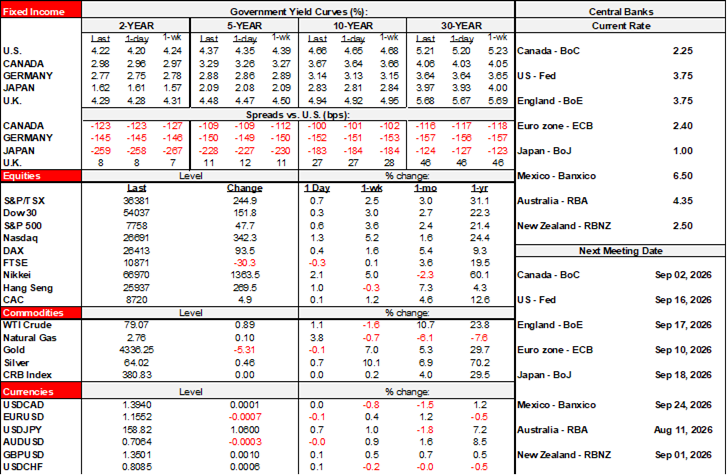
Oil is up by over 1% across Brent and WTI benchmarks this morning given weekend developments concerning Iran (see below). That is driving a slight cheapening bias across global sovereign bond benchmarks that, while tepid, is interesting by way of lacking follow through from Friday’s weak payrolls report that drove yields lower and that was largely shaken off as Asia-Pacific markets caught up to the release. In other words, there is no extended rally. Ditto for stocks where US futures are up a smidge, TSX futures are flat, and Europe is, well, Europe—scattered in the performances of its main benchmarks but generally blah.
YEN FADES US LIFELINE
It’s in currency land where we turn our attention for the bigger development. There is no yen for the yen this morning (pardon the double entendre). The yen is the worst performing currency pair to the dollar to start the week and is depreciating from Friday’s 157.8 close to 158.8 (-0.7%). US Treasury Secretary Bessent’s foray into buying yen by ditching euros from the Exchange Stabilization Fund (instead of more traditionally selling USD) on July 31st was unlikely to provide durable support if we know our history of currency interventions against more fundamental forces.
Bessent’s action was to assist Japan’s concerns about the falling yen (chart 1) but to substitute US actions for Japanese selling of USD denominated Treasuries to support the yen, an action that could have put upward pressure upon US Treasury yields which Bessent seeks to avoid. Great, except that since pushing the yen from about 164 before US buying to a low of under 156 markets have returned to pushing the yen weaker.
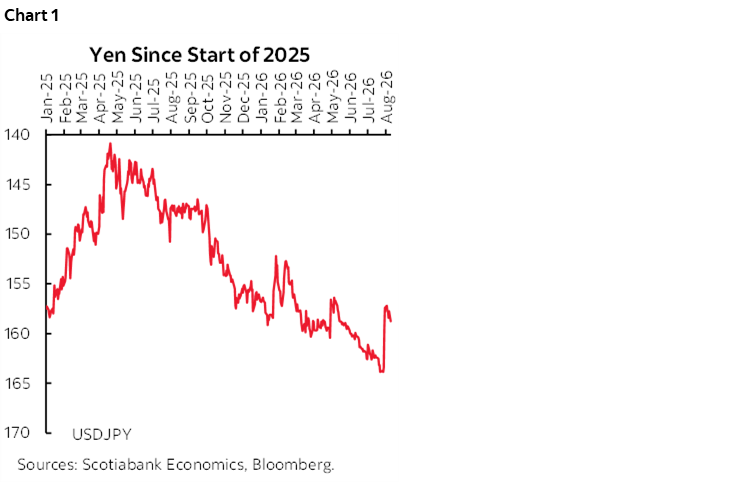
A lot hangs on September. A core challenge to the yen is concern that the Fed may hike amid uncertainty over timing the BoJ’s next and subsequent moves. The Bank of Japan doesn’t have a scheduled meeting until September 18th—two days after the FOMC—which is almost two-thirds priced for a quarter point BoJ hike.
IRAN HAS TURNED THE ‘ART’ OF THE DEAL ON TRUMP
Iran presented the US with a list of demands to reopen the Strait of Hormuz that goes back to square one in terms of demands that were laid out at the beginning of endless negotiations. Here’s the list:
- Withdraw all US forces from the area;
- End the US naval blockade;
- Permanently stop conflict and threats;
- Pay reparations to Iran for the damage caused by the war;
- Life all US sanctions against Iran;
- release all of Iran’s frozen assets;
- end conflict against Iran’s proxy regimes such as Hamas.
A further sign of Iran’s hardline position came over the weekend when Supreme Leader Khamenei promoted the former head of the Islamic Revolutionary Guard to secretary of the Supreme National Security Council. Mohsen Rezaei is known as a hardliner in negotiations.
Iran also claimed that the US repeatedly violates ceasefires and hence poisons negotiations which I thought was rather cheeky considering its own surprise attacks and violations.
Regardless, fat chance getting all of these demands, or even some of them, but that’s not the point. The point is that the US stumbled into a war without approval from Congress, without seeking discussion and input from Allies but then criticizing them for staying out of it, and without any clear strategy or exit plan. The US is now paying the price as Iran turns the ‘art’ of the deal on Trump by coming in high on its list of demands because it knows the US won’t commit to a ground war and knows that US midterms of fast approaching with an administration down deeply in the polls including on affordability issues. The US and Israel have bashed their way around the Gulf but have failed to secure Iran’s stockpile of enriched uranium, failed to end its nuclear research program, failed to eradicate Iran’s stockpile of missiles and drones that keeps growing, failed to secure regime change and generally met its match despite have clear military superiority. The region is in worse shape with greater unease than before the war as the US ponders the extraordinarily dicey step of supporting the Saudi’s nuclear ambitions.
Trump’s latest musings realize this quagmire as he is reportedly considering plan ‘B’ which is to end strikes but maintain the blockade while hoping that the effects eventually cause so much hardship in Iran that it cries uncle. That’s unlikely. Iran’s regime cares little about the plight of its own people and employs brutal tactics to thwart uprisings. Iran has known extreme sacrifice in its past. Iran’s regime will get its support from friends in low places elsewhere, such as the Russians.
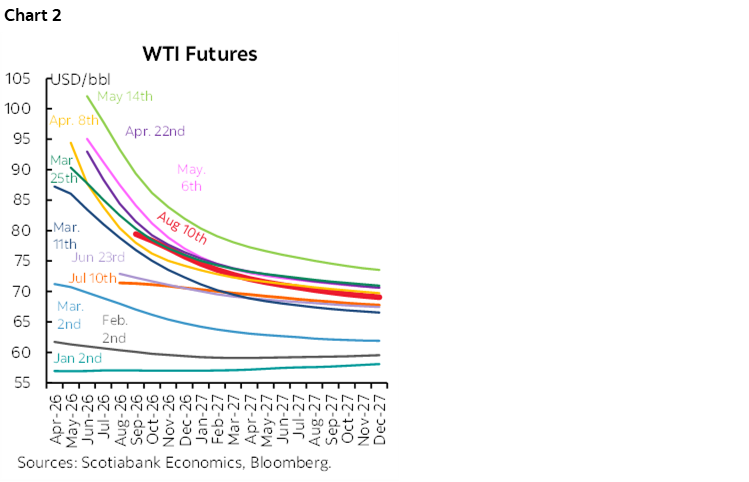
It is very difficult to see a way out from this conflict which means that the geopolitical risk premia attached to oil prices is likely to stay high for a long while yet (chart 2). The outcome is worse than even the flawed deal struck by Obama.
SOFT NORWEGIAN INFLATION REDUCES NORGES BANK HIKE PRICING
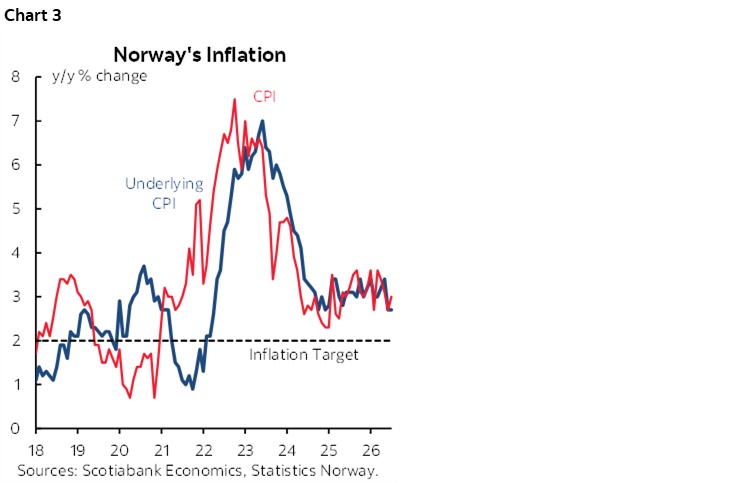
Markets moved even closer to pricing a hold by Norges Bank this week after Norway’s inflation reading was released this morning. They also reduced pricing for a hike by year-end to just under a quarter point while driving Norwegian bonds to slightly outperforming other global benchmarks. CPI climbed 1% m/m and 3% y/y (2.8% consensus) in July but pass through evidence was fairly tame. Underlying CPI was up 0.8% m/m seasonally unadjusted which was unspectacular relative to other like months of July in history which is the comparator since the figure is unadjusted. Chart 3.
SUBDUED CHINESE INFLATION
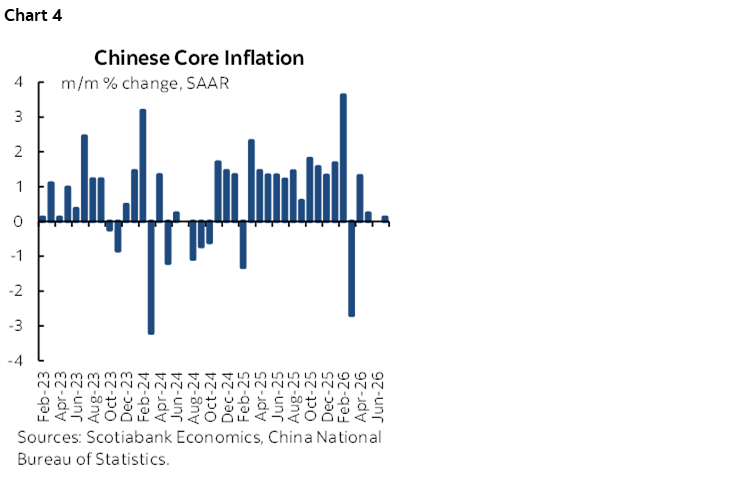
China’s inflation remains tame. Key is that the core CPI measure ex-food and energy was flat again at 0.1% m/m SAAR in July (chart 4). The three-month moving average of this measure is also close to zero (0.1% m/m SAAR). Headline CPI was up by 0.5% y/y (0.8% consensus) and the year-over-year core rate was 0.9% (1.0% consensus).
DISCLAIMER
This report has been prepared by Scotiabank Economics as a resource for the clients of Scotiabank. Opinions, estimates and projections contained herein are our own as of the date hereof and are subject to change without notice. The information and opinions contained herein have been compiled or arrived at from sources believed reliable but no representation or warranty, express or implied, is made as to their accuracy or completeness. Neither Scotiabank nor any of its officers, directors, partners, employees or affiliates accepts any liability whatsoever for any direct or consequential loss arising from any use of this report or its contents.
These reports are provided to you for informational purposes only. This report is not, and is not constructed as, an offer to sell or solicitation of any offer to buy any financial instrument, nor shall this report be construed as an opinion as to whether you should enter into any swap or trading strategy involving a swap or any other transaction. The information contained in this report is not intended to be, and does not constitute, a recommendation of a swap or trading strategy involving a swap within the meaning of U.S. Commodity Futures Trading Commission Regulation 23.434 and Appendix A thereto. This material is not intended to be individually tailored to your needs or characteristics and should not be viewed as a “call to action” or suggestion that you enter into a swap or trading strategy involving a swap or any other transaction. Scotiabank may engage in transactions in a manner inconsistent with the views discussed this report and may have positions, or be in the process of acquiring or disposing of positions, referred to in this report.
Scotiabank, its affiliates and any of their respective officers, directors and employees may from time to time take positions in currencies, act as managers, co-managers or underwriters of a public offering or act as principals or agents, deal in, own or act as market makers or advisors, brokers or commercial and/or investment bankers in relation to securities or related derivatives. As a result of these actions, Scotiabank may receive remuneration. All Scotiabank products and services are subject to the terms of applicable agreements and local regulations. Officers, directors and employees of Scotiabank and its affiliates may serve as directors of corporations.
Any securities discussed in this report may not be suitable for all investors. Scotiabank recommends that investors independently evaluate any issuer and security discussed in this report, and consult with any advisors they deem necessary prior to making any investment.
This report and all information, opinions and conclusions contained in it are protected by copyright. This information may not be reproduced without the prior express written consent of Scotiabank.
™ Trademark of The Bank of Nova Scotia. Used under license, where applicable.
Scotiabank, together with “Global Banking and Markets”, is a marketing name for the global corporate and investment banking and capital markets businesses of The Bank of Nova Scotia and certain of its affiliates in the countries where they operate, including; Scotiabank Europe plc; Scotiabank (Ireland) Designated Activity Company; Scotiabank Inverlat S.A., Institución de Banca Múltiple, Grupo Financiero Scotiabank Inverlat, Scotia Inverlat Casa de Bolsa, S.A. de C.V., Grupo Financiero Scotiabank Inverlat, Scotia Inverlat Derivados S.A. de C.V. – all members of the Scotiabank group and authorized users of the Scotiabank mark. The Bank of Nova Scotia is incorporated in Canada with limited liability and is authorised and regulated by the Office of the Superintendent of Financial Institutions Canada. The Bank of Nova Scotia is authorized by the UK Prudential Regulation Authority and is subject to regulation by the UK Financial Conduct Authority and limited regulation by the UK Prudential Regulation Authority. Details about the extent of The Bank of Nova Scotia's regulation by the UK Prudential Regulation Authority are available from us on request. Scotiabank Europe plc is authorized by the UK Prudential Regulation Authority and regulated by the UK Financial Conduct Authority and the UK Prudential Regulation Authority.
Scotiabank Inverlat, S.A., Scotia Inverlat Casa de Bolsa, S.A. de C.V, Grupo Financiero Scotiabank Inverlat, and Scotia Inverlat Derivados, S.A. de C.V., are each authorized and regulated by the Mexican financial authorities.
Not all products and services are offered in all jurisdictions. Services described are available in jurisdictions where permitted by law.