

ON DECK FOR FRIDAY, OCTOBER 30th
KEY POINTS:
- Tech wreck and war drums wallop risk appetite
- Amazon & Intel followed Alphabet’s misses
- Oil gains on US war plans
- Dollar weakens partly as FOMC hike bets diminish
- Four ways the BoJ kept a December hike in play
- Canada’s GDP takes a backseat to forward considerations
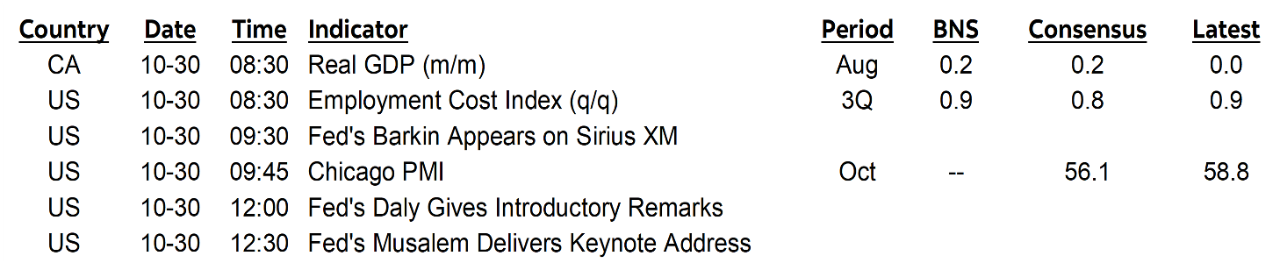
- US employment costs likely posted another firm gain
- Eurozone economy beats expectations with mixed inflation
- Mexico’s economy expected to post solid growth
- BanRep faces a divided consensus
A combination of disappointing US tech earnings and higher oil prices on signs that the US is girding for a major escalation of war against Iran is weighing upon risk appetite.
US stock futures are down by 1% (S&P) to over 2% (Nasdaq). The main driver is a pair of after-market earnings reports from Intel and Amazon that broadly missed a blend of measures from EPS to revenue and revenue guidance. They followed the earlier miss by Alphabet. TSX futures are also off by -¾%. European cash markets are faring a little less badly with a slight rise in London, a flat CAC40 and declines elsewhere.
Interestingly, the dollar is not picking up safe haven flows as every major currency is rallying against it.
Oil prices are up by about 2%+ with WTI at $104 and Brent over US$117. Yesterday’s headlines from the WSJ that war plans are afoot and Trump has been briefed on attack options against Iran are the culprit. A “short, intense campaign” has been guided. Where have I heard that before…oh yeah, about nine months ago!
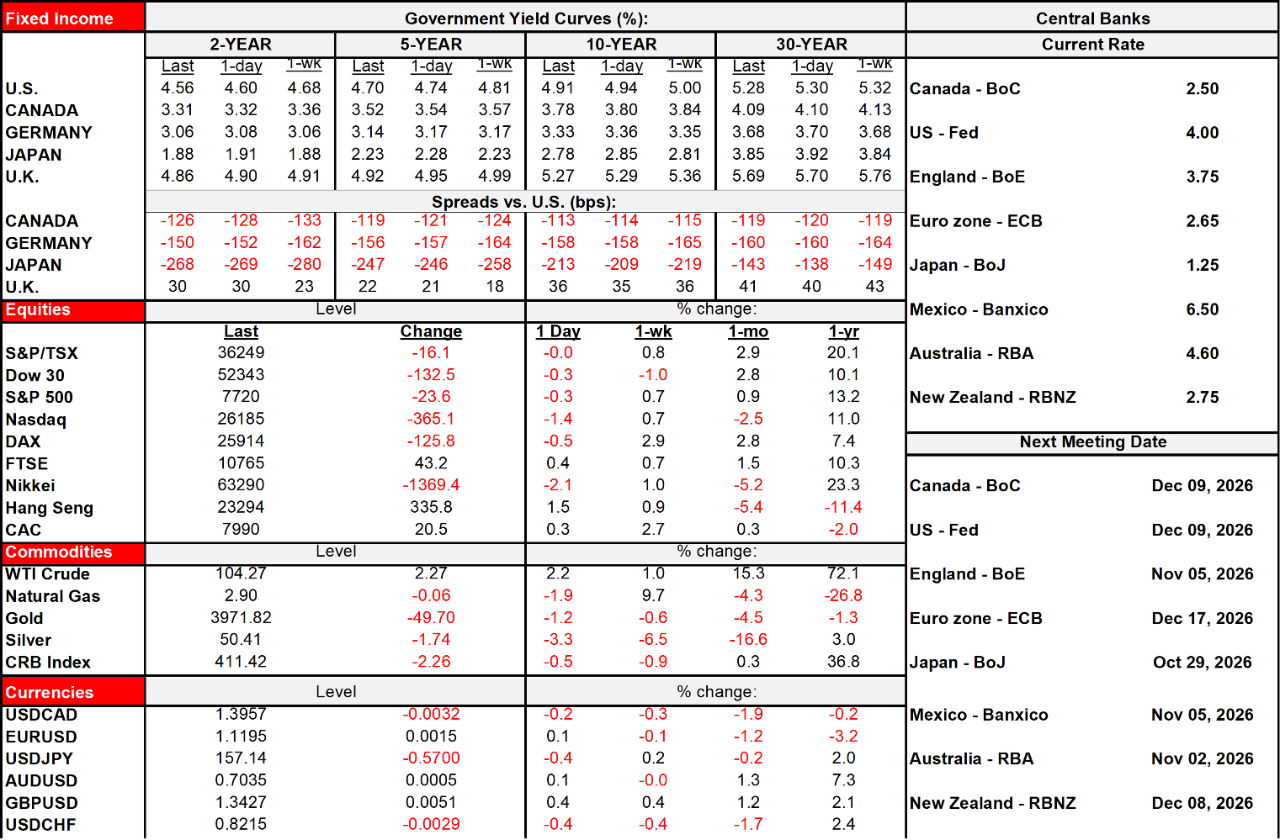
As for rates, pricing for the December FOMC decision has backed off from nearly fully priced a couple of days ago to about 18bps of a quarter point hike priced this morning. I’m not sure that’s the correct direction with oil flaring and adding to how Warsh may be likely to view inflation and despite the tech wreck. US Ts are rallying in slight bull steepener fashion. Most other global benchmarks are slightly dearer as well.
US EMPLOYMENT COSTS CONTINUE TO RISE FASTER THAN INFLATION
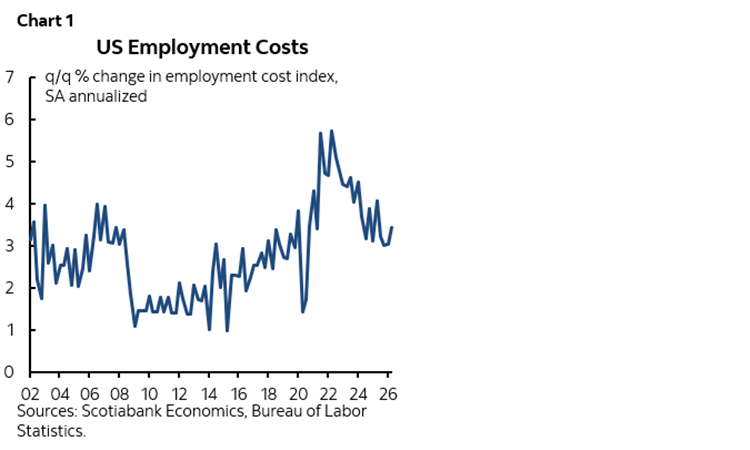
The US Employment Cost Index is an all-in measure of cash and benefits and is expected to post another sizeable gain of 0.8% q/q this morning (8:30amET). They’ve been rising at a steady annualized pace well above the Fed’s 2% target for an extended period but well off the pandemic peak (chart 1).
FOUR WAYS THE BOJ REINFORCED DECEMBER HIKE PRICING
Nothing that the Bank of Japan did overnight swayed Japanese markets or affect pricing for the next move. December’s meeting remains priced for 20bps of a quarter-point hike with 1–2 more thereafter into next summer. The yen is a middle of the pack performer to the dollar this morning. JGBs slightly rallied in bull flattener fashion which probably has more to do with global risk aversion.
You could argue there were three ways in which a December hike was bolstered:
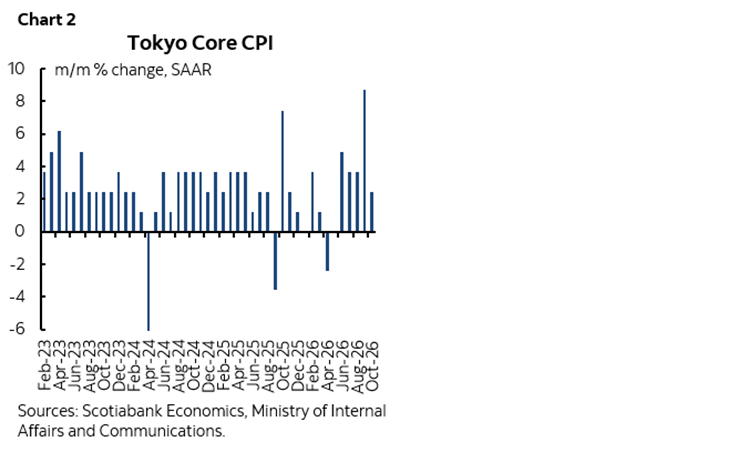
- Numbers: The BoJ raised the core CPI forecast. While remaining at 2.5% y/y for this year, the 2027 forecast was increased by two-tenths to 2.6% with 2028 remaining at 2%. GDP was increased a tick to 0.7% y/y this year, slightly lowered in 2027 to 0.7% and left at 0.8% in 2028. Lacklustre growth takes a back seat to a sustained overshoot of the central bank’s inflation target. Tokyo CPI was released just before the communications and posted a cooler but still firm gain in October (chart 2).
- Each meeting is ‘live’: Governor Ueda said “At every policy meeting, including the next one, we will assess the likelihood of our outlook materializing, as well as the risks, and make our decisions accordingly.” Some drew parallels to similar language in July that preceded the September hike.
- Further, it’s what wasn’t said here: given an opportunity to lean against and choosing not to do so, he basically validated December hike pricing.
- Ueda also noted that the BoJ has achieved its 2% target with upside risk which is a slight upgrade from previously saying they were getting close.
CANADIAN Q3 GDP TRACKING TO BE REFRESHED
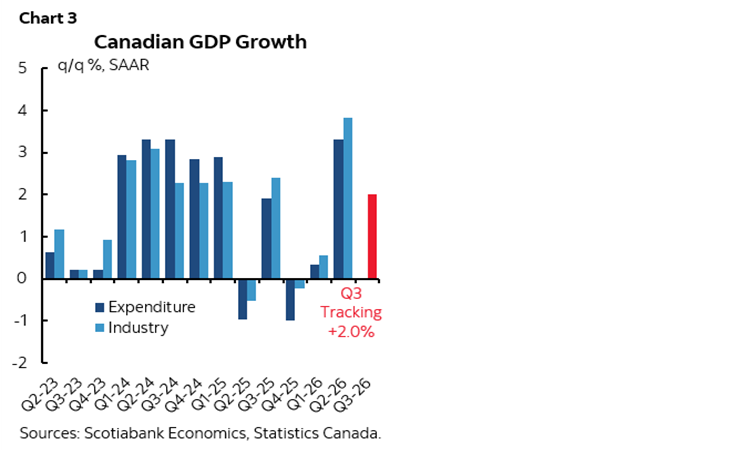
Canada refreshes GDP for August with details along with a first estimate for September sans details. Most expect growth at 0.2% m/m in August based upon Statcan’s earlier flash and because my simple regression against known readings has no quarrel with 0.2. September GDP might be on the backfoot with what we know by way of developments like the drop in hours worked. Growth of about 2% q/q SAAR is being tracked for Q3 overall and will be refreshed post-release (chart 3).
And who cares. The BoC is forward-looking; it doesn’t have Kevin Warsh as its leader. The BoC did the right thing hiking the other day but perennial doves who failed to predict tightening out of the pandemic and again now are replaying their song book; it’s not them, it’s the BoC that messed up.
EUROZONE—FIRM GROWTH, MIXED INFLATION
Eurozone GDP growth during Q3 beat expectations at +0.4% q/q SA nonannualized (0.2% consensus). Charts 4–5. That follows 0.6% q/q nonannualized growth in Q2 for decent back-to-back gains relative to Europe’s norms. Within the Eurozone, Spain led the way at 0.6% q/q SA nonannualized. France’s economy shrank by -0.1% q/q. Germany’s expanded by 0.2%. Italy was flat.
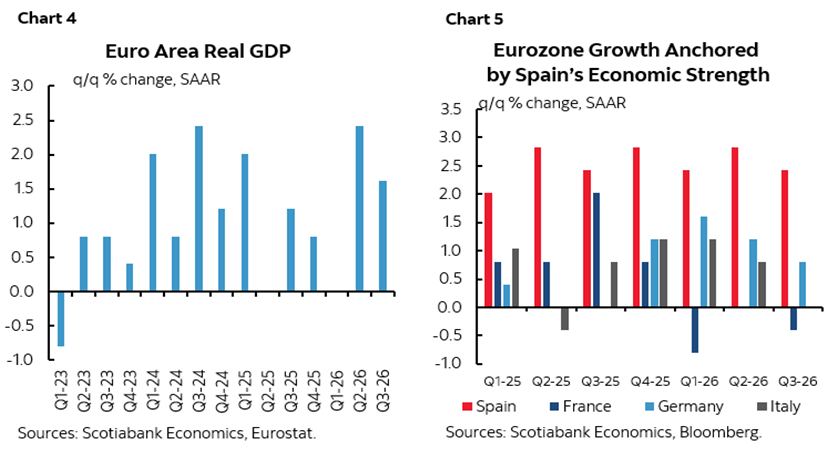
Eurozone inflation will be released next Wednesday but the incomplete consensus estimate of 0.3% m/m SA is looking a little light compared to the breakdown of the countries that released this morning.
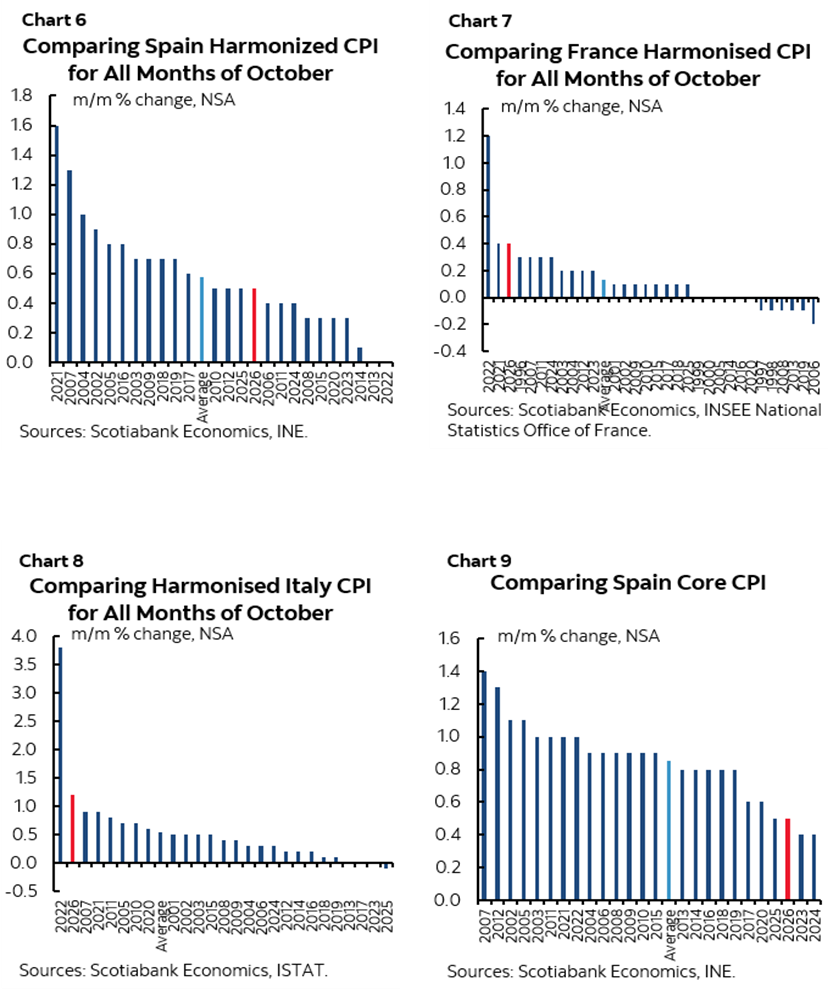
France’s CPI was up 0.4% m/m (0.3% consensus). Spain matched consensus at 0.5%. Italian CPI was much firmer than expected at 1.2% m/m (0.4% consensus). Germany will release national CPI at 9amET, but the individual states release ahead of time and at readings between 0% and -0.3% m/m, they are tracking beneath consensus expectations for the overall tally (0.1% m/m).
Since the figures are not seasonally adjusted, charts 6-8 compare m/m NSA changes to past like months of October. They show France and Italy posting strong gains this time relative to other months of October, Spain a touch weaker than normal and with Germany pending. Spain is the only one that releases core with the preliminary round and it was weaker than normal (chart 9).
LATAM—BANREP, MEXICAN GDP
Colombia’s central bank faces a divided consensus into this afternoon’s decision (2pmET). Slightly more than half of economists expect a hold at 12.25% while a little less than half expect the overnight lending rate to be raised by 25bps.
Mexico’s economy is expected to post growth of about 1% q/q SA nonannualized when Q3 readings arrive (8amET). That would follow 1.4% growth in Q2. Estimates nevertheless range from scant growth to 1¾% q/q.
DISCLAIMER
This report has been prepared by Scotiabank Economics as a resource for the clients of Scotiabank. Opinions, estimates and projections contained herein are our own as of the date hereof and are subject to change without notice. The information and opinions contained herein have been compiled or arrived at from sources believed reliable but no representation or warranty, express or implied, is made as to their accuracy or completeness. Neither Scotiabank nor any of its officers, directors, partners, employees or affiliates accepts any liability whatsoever for any direct or consequential loss arising from any use of this report or its contents.
These reports are provided to you for informational purposes only. This report is not, and is not constructed as, an offer to sell or solicitation of any offer to buy any financial instrument, nor shall this report be construed as an opinion as to whether you should enter into any swap or trading strategy involving a swap or any other transaction. The information contained in this report is not intended to be, and does not constitute, a recommendation of a swap or trading strategy involving a swap within the meaning of U.S. Commodity Futures Trading Commission Regulation 23.434 and Appendix A thereto. This material is not intended to be individually tailored to your needs or characteristics and should not be viewed as a “call to action” or suggestion that you enter into a swap or trading strategy involving a swap or any other transaction. Scotiabank may engage in transactions in a manner inconsistent with the views discussed this report and may have positions, or be in the process of acquiring or disposing of positions, referred to in this report.
Scotiabank, its affiliates and any of their respective officers, directors and employees may from time to time take positions in currencies, act as managers, co-managers or underwriters of a public offering or act as principals or agents, deal in, own or act as market makers or advisors, brokers or commercial and/or investment bankers in relation to securities or related derivatives. As a result of these actions, Scotiabank may receive remuneration. All Scotiabank products and services are subject to the terms of applicable agreements and local regulations. Officers, directors and employees of Scotiabank and its affiliates may serve as directors of corporations.
Any securities discussed in this report may not be suitable for all investors. Scotiabank recommends that investors independently evaluate any issuer and security discussed in this report, and consult with any advisors they deem necessary prior to making any investment.
This report and all information, opinions and conclusions contained in it are protected by copyright. This information may not be reproduced without the prior express written consent of Scotiabank.
™ Trademark of The Bank of Nova Scotia. Used under license, where applicable.
Scotiabank, together with “Global Banking and Markets”, is a marketing name for the global corporate and investment banking and capital markets businesses of The Bank of Nova Scotia and certain of its affiliates in the countries where they operate, including; Scotiabank Europe plc; Scotiabank (Ireland) Designated Activity Company; Scotiabank Inverlat S.A., Institución de Banca Múltiple, Grupo Financiero Scotiabank Inverlat, Scotia Inverlat Casa de Bolsa, S.A. de C.V., Grupo Financiero Scotiabank Inverlat, Scotia Inverlat Derivados S.A. de C.V. – all members of the Scotiabank group and authorized users of the Scotiabank mark. The Bank of Nova Scotia is incorporated in Canada with limited liability and is authorised and regulated by the Office of the Superintendent of Financial Institutions Canada. The Bank of Nova Scotia is authorized by the UK Prudential Regulation Authority and is subject to regulation by the UK Financial Conduct Authority and limited regulation by the UK Prudential Regulation Authority. Details about the extent of The Bank of Nova Scotia's regulation by the UK Prudential Regulation Authority are available from us on request. Scotiabank Europe plc is authorized by the UK Prudential Regulation Authority and regulated by the UK Financial Conduct Authority and the UK Prudential Regulation Authority.
Scotiabank Inverlat, S.A., Scotia Inverlat Casa de Bolsa, S.A. de C.V, Grupo Financiero Scotiabank Inverlat, and Scotia Inverlat Derivados, S.A. de C.V., are each authorized and regulated by the Mexican financial authorities.
Not all products and services are offered in all jurisdictions. Services described are available in jurisdictions where permitted by law.